Unit 3: Production, Cost, and the Perfect Competition Model
(3.1) The Production Function
production function: the way a firm combines inputs to produce an outputs
variable inputs: inputs that can be changed in the short run to change production
EX: oven
fixed inputs: inputs that CANNOT be changed to change production
EX: ingredients
short run: period of time during which there are fixed inputs and it’s too short for a firm to change it’s plant capacity
plant capacity: a firm’s maximum potential level of production
all resources are fixed
long run: the period of time long enough for a firm to change its inputs → can change plant capacity
all resources are variable
total product (TP): total amount of output produced by x number of inputs
sometimes referred to as total physical product, etc
marginal product (MP): additional output produced by one more unit of input (often labor)
MP = change in TP / change in input
average product (AP): average quantity of output produced by one input (variable)
AP = TP/L (labor)
observations:
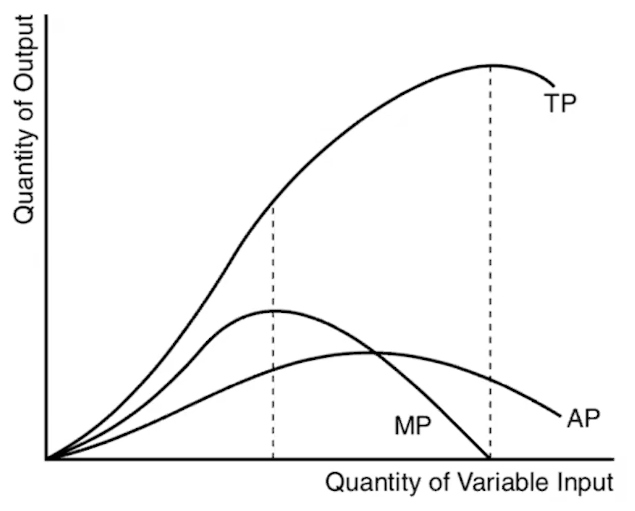
MP increases initially because of specialization (division of labor)
MP then decreases because of diminishing marginal returns
happens in the short run especially
MP represents the slope of TP
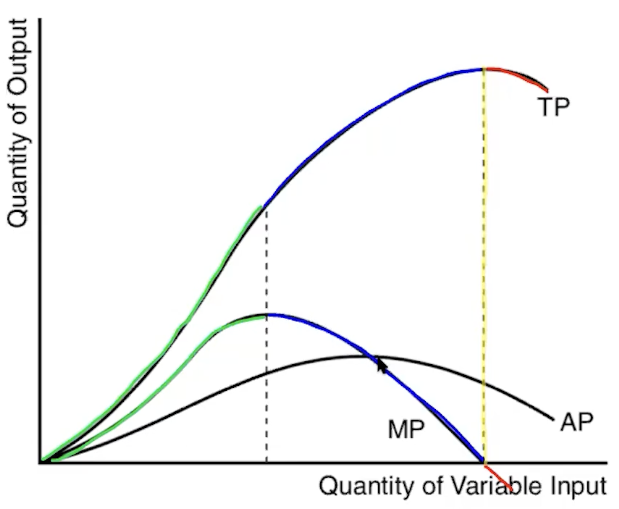
when MP increases → TP increases at an increasing rate
when MP is positive but decreasing → TP is increasing at decreasing rate
when MP = 0 → TP is at maximum
when MP is negative → TP is decreasing 3
TP increases → starts increasing at a decreasing rate (so gets flatter) → then decreases
MP crosses with maximum of AP
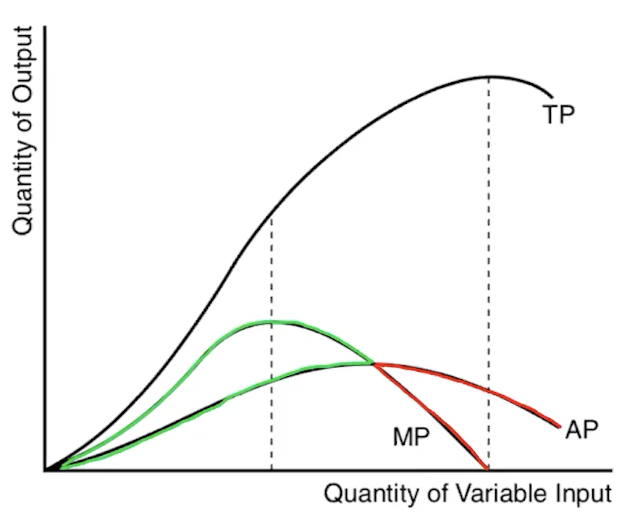
when MP is above AP → AP is rising
when MP is below AP → AP is falling