Blood flow regulation:
Blood flow regulation:
Can blood flow be regulated by changing capillary diameter:
- Capillaries are smaller than arterioles, but as they don't have smooth muscle, they cannot constrict or dilate to change flow resistance.
What is the role of arterioles in regulating blood flow through branched networks
- Arterioles are the main determinants of blood flow due to their small diameter. A small amount of constriction or dilation has a large effect on flow.
Do capillaries play a role in regulating blood flow:
- Yes. Capillaries are not always open. Precapillary sphincters at the inlet to a capillary can constrict and prevent blood entry. Opening of these sphincters makes more parallel capillaries available, thereby reducing flow resistance and increasing flow.
Flow induced vasodilation:
- Blood vessels can detect the rate of blood flowing through them from the shear stress exerted by blood on the vessel wall.
- Shear stress is sensed by the endothelial cells, which respond by increasing their intracellular Ca2+ concentration.
- Ca2+ activates the enzyme nitric oxide synthase (NOS), which stimulates the synthesis of the small diffusible gas, nitric oxide (NO) from arginine. NO diffuses to nearby muscle cells and stimulates a cytosolic enzyme, known as soluble guanylyl cyclase (sGC), to convert GTP to the second messenger, cyclic GMP (cGMP).
- This activates a number of downstream signalling pathways that promote muscle relaxation and the arteriole dilates.
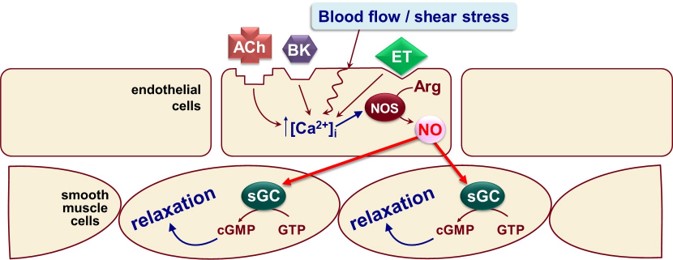
- The same mechanism is employed by many circulating molecules, such as acetylcholine (ACh), bradykinin (BK) and endothelin (ET), acting at specific membrane receptors.
- Agents that act in this way are known as endothelium-dependent vasodilators. Nitrate drugs, which are used to treat angina, mimic this effect by releasing NO next to the muscle cells and activating sGC directly.
Veins as blood resevoir:
- venoconstriction (constriction of the veins) is of most significance in the large veins
- Because they hold a lot of blood, constricting the large veins reduces the total vascular volume and squeezes more blood into the heart.
- The increased blood in the heart is an increased venous return and preload.
- Thus venoconstriction :
- increases end-diastolic volume
- increases stroke volume as a consequence of the Frank-Starling mechanism.