Proteins
Make up gelatin, hair, antibodies, spider webs, blood clots, etc…
Made up of amino acids
At the atomic level, all proteins are made up of carbon, hydrogen, oxygen, nitrogen, and sometimes sulphur
Proteins can be obtained from both animal and plant sources
Protein and DNA
The genetic info in DNA codes for producing specific proteins and nothing else
These proteins then go on to accomplish all life processes
Functions of Proteins
Enzymes
are biological catalysts that speed up chemical rxns in the body
can function to break molecular bonds, rearrange bonds, or form new bonds
Hormones
regulate physiological processes, such as growth and development, metabolism, and reproduction
chemical signaling molecules, usually proteins or steroids, secreted by an endocrine gland or group of endocrine cells that act to control or regulate specific physiological processes, like growth, development, metabolism, and reproduction
Antibodies
Proteins that bind like a lock-and-key to the body’s foreign invaders - whether they are viruses, bacteria, fungi, or parasites
Protein Carriers
Transport materials through cell membranes and through the body
Structural
Keratin found in hair and fingernails, fibrin helps blood clot, and collagen forms the protein portion of bones, skin, ligaments, and tendons
Amino Acids
Shape determines protein function
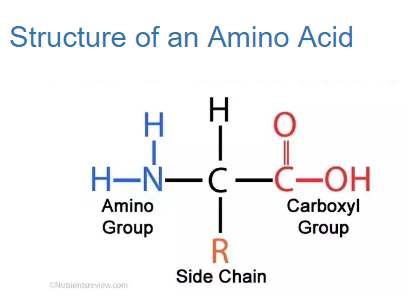
Every amino acid has the same structure
Consists of a central carbon atom bonded to an amino group (-NH2), carboxyl group (-COOH), and a hydrogen atom.
The difference lies in the R group - R group gives the amino acid distinct properties.
Proteins
There are 20 diff amino acid R groups
9 amino acids are essential (consume in our diets)
11 amino acids are non-essential (our bodies create them)
R groups determine the properties of the amino acid and the protein
Side groups may be polar or nonpolar, acid or base
Sequence and # of amino acids ultimately determines a protein’s shape, size, and function
Acidic and Basic Amino Acids
Acidic amino acids possess a carboxyl group on their R-group
Basic amino acids possess an amino group on their R-group
Protein Structure
Amino acids are the monomers that make up proteins
The bonds that hold amino acids together are called peptide bonds
Formed by a dehydration synthesis reaction
Occurs between an amino group of one amino acid and the carboxyl group of an adjacent amino acid
As more amino acids are added, it becomes a polypeptide
A peptide that is greater than 50 amino acids in length
A protein consists of one or more polypeptides that are folded into a precise 3-dimensional shape
Only after the folding occurs is the protein able to function
The unique amino acid sequence of a protein is reflected in its unique folded structure
This structure determines protein’s function
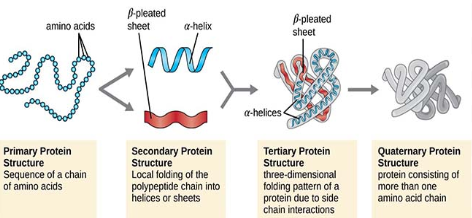
Proteins have up to 4 levels of structures, each giving them diff characeristics to the overall protein:
Primary structure
Secondary structure
Tertiary Structure
Quaternary Structure
Primary Structure
Primary structure of a protein is the unique linear sequence of its amino acid in each polypeptide chain
Changing even a single amino acid in the primary structure will alter the overall structure of the protein or destroy its biological function
Secondary Structure
Secondary structure folds and coils as the polypeptide chain grows
Formed by H- bonds between O atoms of a carboxyl group (partially +)
There are two types:
α helix
β pleated sheets
Tertiary Structure
In the tertiary structure, the polypeptide chain undergoes additional folding due to side chain (R-group) interactions
Quaternary Structure
Two or more polypeptide chains come together to form a functional protein, like collagen and hemoglobin
Hemoglobin is the combination of four polypeptides
Denaturation
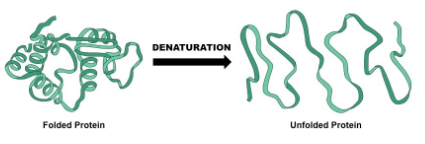
Involves the breaking of many of the weak bonds (hydrogen bonds) within a protein molecule that are responsible for the highly ordered structure of the protein
Denature
Heat, pH and salt [ ] can break hydrogen bonds, which changes the structure of the protein
Change in structure = change in function