Trace Evidence: Fiber
Fiber Evidence
Fiber evidence can be used to connect a suspect to a victim
or a crime scene in many of the same ways a hair can.
Fibers can be one of two types:
1) Natural
2) Artificial
How do we come to find fibers in a crime scene?
How do we define a fiber?
1) A material that has a length many times of its width.
2) The smallest unit of textile material.
Can a hair be considered a fiber?
Yes. A very specific type of fiber.
Can a fiber be considered a hair?
Yes. Natural fibers such as wool are hairs.
All hairs are considered a fiber but not all fiber considered hair
Natural Fibers
Obtained from animal, vegetable, or mineral sources.
Animal fibers
Hairs can be considered animal fibers.
Wool is the most commonly encountered animal fiber.
Silk is considered an animal fiber derived from the silk worm.
Vegetable fibers
Constitute the largest class of natural fibers.
The major component of vegetable fibers = cellulose.
Cellulose is a naturally occurring polymer.
Cotton is the most commonly encountered vegetable fiber.
Mineral fibers
Some minerals occur as a fiber.
Asbestos is the most commonly encountered mineral fiber
Artificial Fibers
Most fibers are polymers.
Can be divided into two sub-classes.
1) Derived (Regenerated)
2) Synthetic
Derived Fibers
Recovered natural polymers (cellulose), which are dissolved and resolidified it. The derived fiber will have properties that are unique.
Rayon (Viscose) was the first ever derived fiber (1911).
The fibers were woven together to result in sheets of fabric.
Acetate is also a derived fiber (from cotton and wool).
The derived acetate is soluble in acetone
Synthetic Fibers
Fibers made by human beings (not plant or animal based) where
the polymers are chemically created.
Nylon was the first synthetic fiber (~1938).
Nylon is considered a polyamide due to its chemical structure.
By rearranging the chemical structure of the polymer, dozens of other synthetic fibers were created.
The resulting new synthetics all had unique properties.
Kevlar
Nomex
SpandeX
Polymers: Polymers are long chains of smaller units called monomers
How it’s made
How are fibers made?
A process of adding layers of chemical reagents to the
cellulose to create breakdowns of the monomer bonds and assist them in
polymerizing.
The shape of the die inside the Wet Spinning head nozzle will determine the morphology of the fiber. Shape, diameter, and cross-section happen at this step.
Works like a pasta machine, cuts different sizes and shapes of noodles
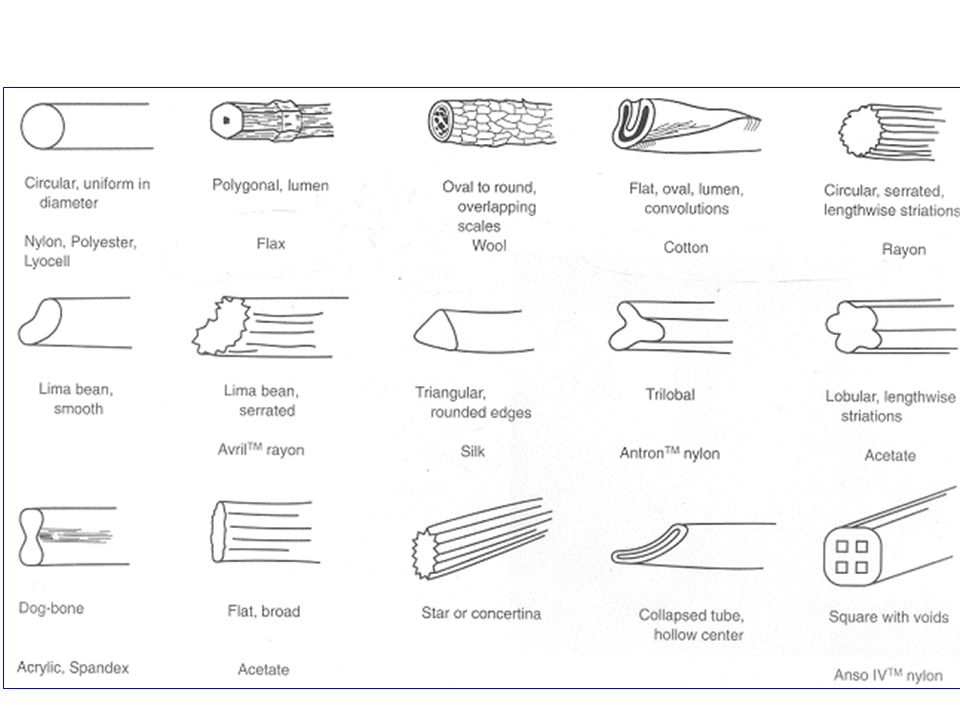
Fiber Identity
Methods used to determine fiber identity
1) Microscopic Comparison
Compound Microscope
Can observe the morphology of the fiber under various conditions of light passing through it.
Surface form, diameter, and color can be noted easily.
Visible-Light microspectrophotometer
Colors that look identical but are made from different manufacturers will have subtle differences in the chemical composition of the dyes. This technique is much more sensitive to the differences in those chemical compositions.
Polarized Light Microscope
The manufacturing process that makes the fiber also causes the molecules in the fiber to behave in specific ways.
Passing polarized white light through the fiber will cause specific colors, called interference colors to be visible to the analyst.
Methods used to determine fiber identity
Physical properties
Dissolved in a solvent such as acetone.
Dissolved in strong acid.
Burn test: Different fibers will have different responses to these tests. Those reactions, plus the Observations under a microscope, will help provide more information about the identity of the fiber.
BUT……What if you only have one fiber? How would you proceed?
Spectroscopy
Instrumental method of determining the identification of material without damaging it.
Infrared (IR) spectroscopy passes a beam of IR light through a sample.
Each type of fiber material will selectively absorb wavelength of IR
Raman spectroscopy passes a laser beam through a sample