Module 3_ Communicating in a Multicultural Society and World
II Module 3: COMMUNICATING IN A MULTICULTURAL SOCIETY AND WORLD
1. Key Definitions
Multicultural:
Relating to or constituting several cultural or ethnic groups within a society (Oxford Dictionary)
Multicultural Society:
A society, where people with different nationalities, languages, religions and ethnicities live together.
Multiculturalism:
The view that cultures, races, and ethnicities, particularly those of minority groups, deserve special acknowledgement of their differences within a dominant political culture. It seeks the inclusion of the views and contributions of diverse members of society while maintaining respect for their differences and withholding the demand for their assimilation into the dominant culture.
Diversity:
The recognition and valuing of the difference, encompassing such factors as age, gender, race, ethnicity, ability, religion, education, marital status, sexual orientation and income.
2. Cross-Cultural Communication
Definition:
the communication between people who have differences in any one of the following: styles of working, age, nationality, ethnicity, race, gender, sexual orientation, etc.
Focus:
How people from different cultures communicate.
Refers to the attempts that are made to exchange, negotiate and mediate cultural differences by means of language, gestures and body language.
❖creates a feeling of trust and enables cooperation.
3. Importance of Cross-Cultural Communication
Benefits:
❖Globalization
❖Business opportunities
❖Job opportunities
❖Sharing of views and ideas
❖Talent improvisation
❖Better understanding of diverse market
4. Local Communication
Definition:
is being able to communicate (verbal and non-verbally) with the members of your local area/community.
4.1. Local Community
Definition:
A group of interacting people sharing a common environment, influenced by collective beliefs, needs, and resources.
a group of interacting people sharing an environment. In human communities, intent, belief, resources, preferences, needs, risks, and a number of other conditions may be present and common, affecting the identity of the participants and their degree of cohesiveness.
5. Global Communication
Definition:
The process of exchanging knowledge, ideas, and information across borders, not limited to local areas.
❖ communicating with people across the globe.
❖ exchanging of knowledge, ideas, and information and interaction of individual across the borders instead of a limited or local area.
Development:
is the developmentand sharing ofinformation, throughverbal and non-verbalmessages, ininternational settingsand contexts.
5.1. Examples of Global Communication
Government-to-Government:
Interaction between governments concerning current affairs and conflicts.
Business-to-Business:
Engagement between international business parties regarding agreements.
People-to-People:
Communication among individuals living far apart, e.g., friends in different countries.
6. Differences Between Local and Global Communication
6.1. Equality and Context
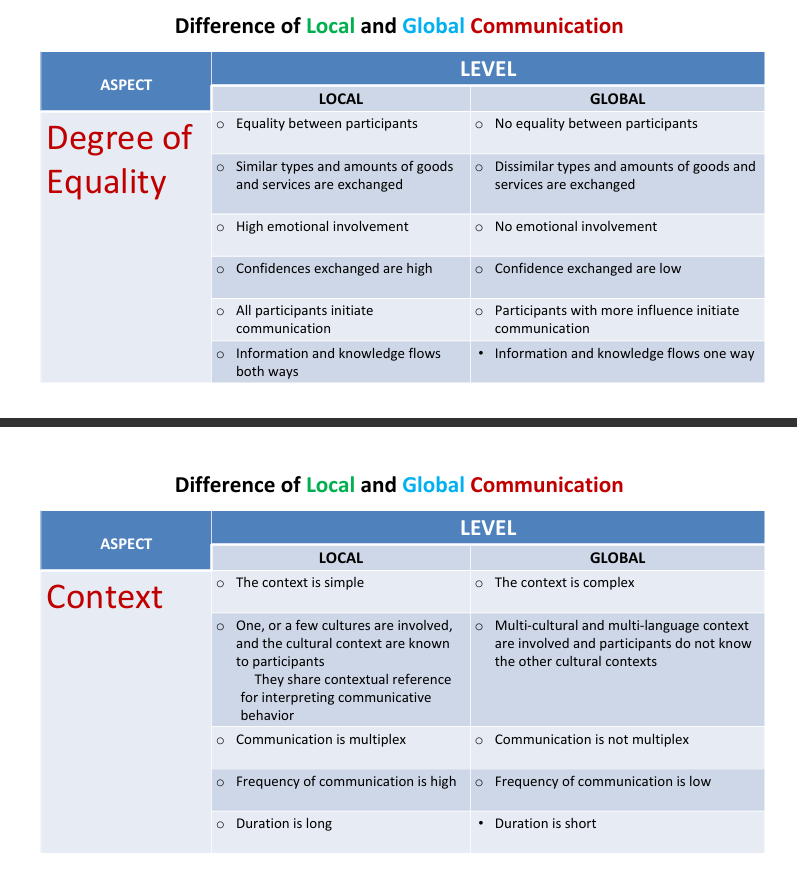
Local Communication:
May have uneven participation among individuals.
Global Communication:
More complex due to diverse contexts.
7. Challenges in Multicultural Communication
Importance of Communication:
Essential for understanding client needs in diverse workplaces.
Language Barriers:
Effective communication is challenging with language differences.
7.1. Factors Influencing Communication
Non-verbal Cues:
Gestures, tone, pauses, facial expressions, and body language significantly influence interactions.
Cultural Sensitivity:
Understanding cultural differences without assigning value; recognizing that all cultures are valuable.
8. Cultural Sensitivity
is being aware that cultural differences and similarities between people exist without assigning them a value- positive or negative, better or worse, right or wrong. a set of skills that allows you to understand and learn about people whose cultural background is not the same as yours.
8.1. What is Cultural Sensitivity in the context of a dominant culture?
In life and work environments, we frequently face situations where there is a dominant and a secondary culture.
Cultural sensitivity implies that both groups understand and respect each other’s characteristics.
This is always a challenge, and even more so in large corporations where the dominant culture is the one employee are expected to adopt.
9. Stages of Intercultural Sensitivity
9.1. Ethnocentric Stages
Denial:
people don’t recognize cultural differences and experiences
- they believe their culture is the only “real” one and they tend to interact in homogenous groups and to stereotype everyone else
Defense:
Viewing differences negatively; believing one's culture is superior.
people don’t recognize some differences but see them as negative because they assume that their culture is the most evolved and the best one.
Minimization:
Assuming cultural similarities are more important than differences.
individuals are unaware that they are projecting their own cultural values. They see their own values as superior. They think that the mere awareness of cultural differences is enough. - These people think we are all the same because we are more similar than different, we all have similar physical, biological, psychological needs.
9.2. Ethnorelative Stages
Acceptance:
Recognizing different cultural behaviors and meanings.
people are able to shift perspectives to understand that the same “ordinary” behavior can have different meanings in different cultures. - They are able to identify how experiences are influenced by one’s culture. - They may not agree or even like the differences they observe but they are interested in finding out and learning about another culture.
Adaptation:
Improving competence in communicating with other cultures.
individuals become more competent in their ability to communicate with other cultures. - They can evaluate other people’s behavior from these people’s frame of reference and can adapt behavior to fit the norms of a different culture.
Integration:
Seamless shifting between different cultural frameworks.
people are able to shift easily from one cultural frame of reference to another. - They develop empathy for other cultures.
10. Cultural Perspectives and Values
Cultural Views:
Emphasizing differences can exacerbate conflicts; understanding and respect foster positive outcomes.
11. Strategies for Effective Multicultural Communication
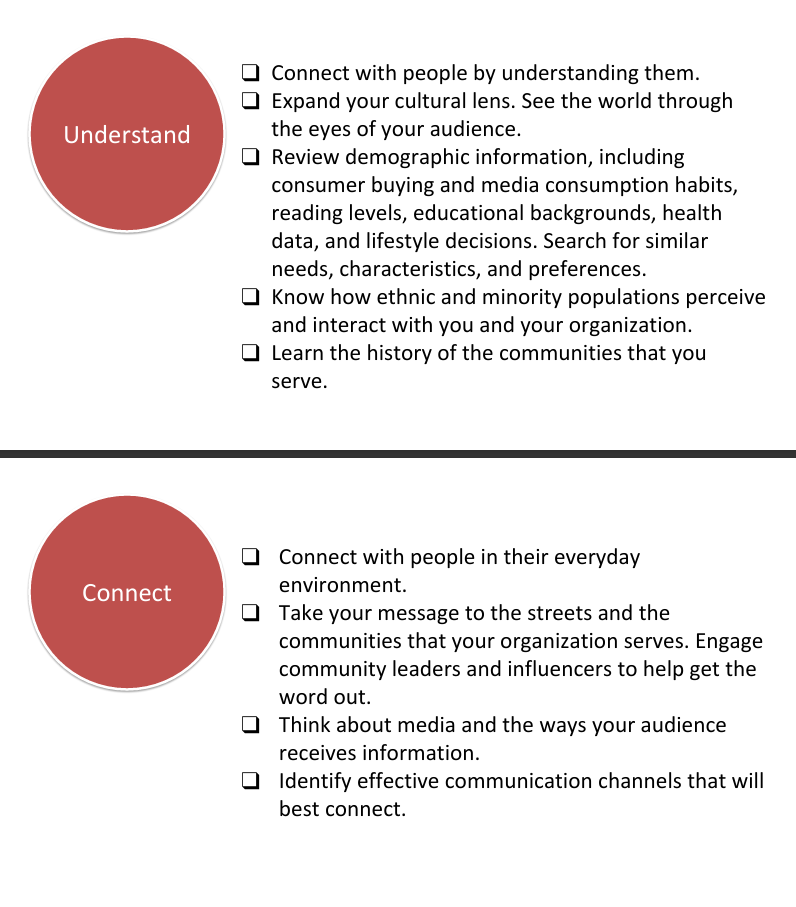
11.1. Understanding and Connecting
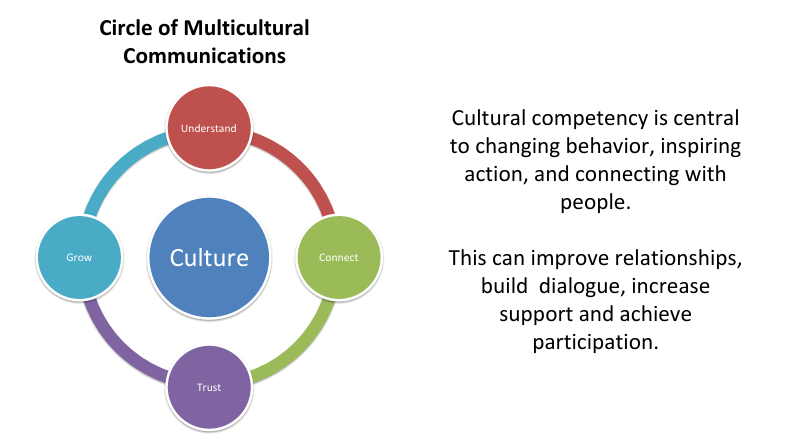
Understand:
Connect by expanding cultural lenses; gather demographic information about diverse communities.
Connect:
Engage with communities and use effective channels for messaging.
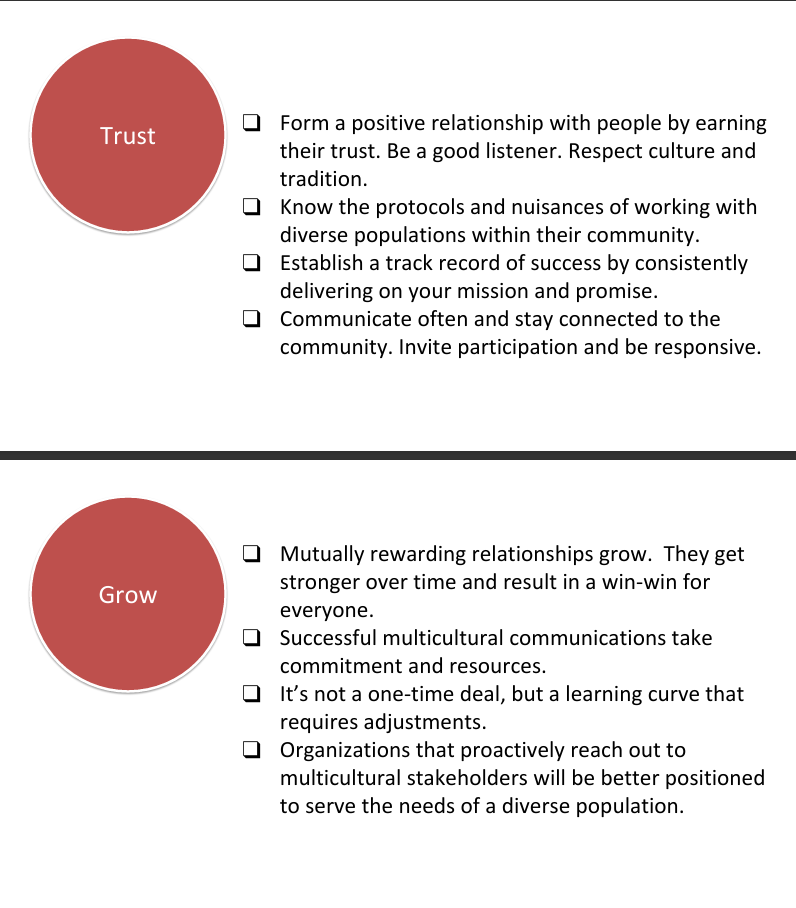
11.2. Building Trust and Relationships
Trust:
Earn trust through listening, respecting traditions, and maintaining community engagement.
Grow:
Develop strong, mutually beneficial relationships over time, recognizing that communication needs ongoing effort.
12. Cultural Ignorance and Sensitivity
Communicators can be judged as insensitive, ignorant or culturally confused when they fail to realize the people from different cultures and whom they interact with.
Culturally confused- lacking understanding of cultural difference
Cultural ignorance affects communication
12.1. Effects of Cultural Ignorance
Can lead to miscommunication and misunderstandings in multicultural contexts.
13. Forms of Multicultural Communication
Interracial:
interactants are of different races (physical attributes)
Interethnic:
communicating parties have different ethnic (cultural factors – nationality, regional culture, ancestry, etc.) origins
International:
Communication that crosses political or national boundaries.
Communication between persons representing political structures or nations, communication practice that occurs across international borders
Intracultural:
Communication among members of the same ethnic or cultural groups.
Intercultural:
Interaction with individuals from different cultures
Concerned with interpreting and sharing meanings between cultures.
14. Cultures and Co-Cultures
Culture is the system of knowledge, beliefs, values, customs, behaviors, and artifacts that are acquired, shared and used by its members during the daily living; within a culture as a whole are co-cultures.
Co-cultures are composed of members of the same general culture who differ in some ethnic or sociological way from the parent culture.
15. Marginalized Group and Dominant Culture
Marginalized group- group whose members feel like outsiders.
Dominant Cultures-being perceived as the majority of the population and having a significant presence in institutions.
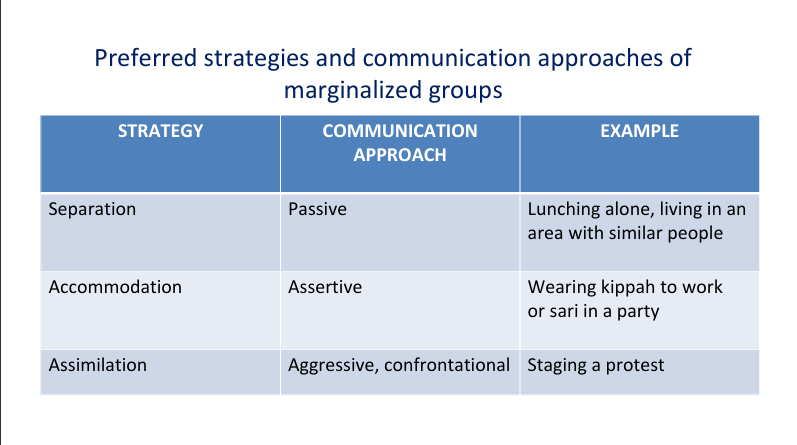
16. Strategies of co-culture members to join in the dominant culture
Assimilation- means by which co-culture members attempt to fit in with members of the dominant culture.
Accommodation – means by which co-culture members maintain their cultural identity while striving to establish relationships with members of the dominant culture.
Separation- means co-culture members use to resist interacting with members of dominant culture.
17. Culture guides communication
Culture is the lens through which we see the world
Ethnocentrism- tendency to see one’s own culture as superior to all.
Cultural relativism – the acceptance of other cultural groups as equal in value to one’s own.
18. DIVERSITY IN FOCUS
Melting-pot philosophy- the view that different cultures should be assimilated into the dominant culture
Cultural pluralism- adherence to the principle of cultural relativism
They advocate respect for uniqueness, tolerance for difference and adherence to the principle of cultural relativity
19. Exploring Cultural Dialectics
19.1. Individualism versus Collectivism
Individualistic cultures- cultures in which individual goals are stressed; cultivates individual initiative and achievement.
Collectivistic cultures- group goals are stressed; tend to nurture group influences
19.2. High context versus Low context
High context communication – a tradition- bound communication system which depends on indirectness; tradition bound; their cultural traditions shape the behavior and lifestyle of group members; over-polite and indirect in relating others; Asian cultures.
Low-context communication – a system that encourages directness in communication; exhibit a more direct communication style; tend to gather background information when meeting someone for the first time (Interview the person they talk to); feel that they have to explain everything rather than rely on non-verbal, contextual information; Western cultures
19.3. High power distance versus low power distance cultures
High power distance cultures - cultures based on power differences in which subordinates defer to superiors (Arabia, India and Malaysia); view power as a fact of life and are apt to stress its coercive or referent nature. (superiors and subordinates view each other differently; subordinates quick to defer to superiors)
Low power distance cultures - believe power should be used only when it is legitimate; they are apt to employ expert or legitimate power (Sweden, Israel and USA) (Superiors and subordinates emphasize their interdependence – consultation preference; subordinates will even contradict their bosses when necessary
19.4. Masculine versus feminine cultures
Highly masculine cultures- value male aggressiveness, strength and material symbols of success (Japan, Italy, Germany, Mexico and Great Britain); dominant and competitive; confront conflicts; win-lose strategy
Highly feminine cultures- value relationships, tenderness in members of both sexes, a high quality of life (Sweden, Norway, the Netherlands, Thailand and Chile); compromise; negotiation to resolve conflict; win-win solutions
20. Identifying Influences on Cultural Identity
Gender roles- refers to the way of presenting themselves
Racial and Ethnic identity- socially constructed; share experience of oppression
Religious identity- has to do with belief on faith issues •
Socioeconomic identity- related to the widening gap between the ultrawealthy, and middle and lower classes
National identity- refers to the legal status or citizenship
21. Identifying Impact of Stereotypes and Prejudice
Stereotypes- mental images or pictures that we believe on; shortcuts (positive or negative) that guide reactions
Prejudice- a positive or negative prejudgments; leads to the creation of in-groups and out-groups, with out-group members becoming easy for discrimination
22. Technology and Intercultural Communication
Virtual neighborhoods and communities- not face-to-face; online, surrogate communities.
Technology and computer networks are also changing the traditional definition of community
Internet may also help bring diversity and new culture to our lives
23. How to improve your ability to communicate interculturally
Refrain from formulating expectations based solely on your own culture
Recognize how faulty education can impede understanding
Make a commitment to develop communication skills and abilities appropriate to life in multicultural world
"To effectively communicate, we must realize that we are all different in the way that we perceive the world" — Anthony Robbins.