2) Resistance and V = IR
1. Formula for Potential Difference, Current, and Resistance
Ohm’s Law: V=I×R
V = Potential difference (volts, V)
I = Current (amperes, A)
R = Resistance (ohms, Ω)
Formula Triangle: Cover the variable you’re solving for to easily rearrange the equation.
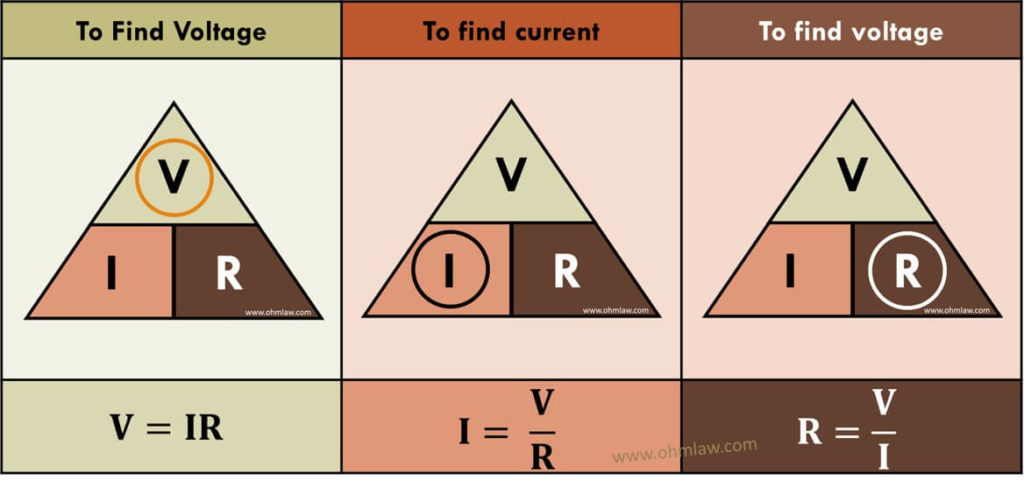
2. Example Problem Using Ohm’s Law
Example: A resistor with R= 4.0 Ω and V=6.0
Solution: I= V/R =6.0 V / 4.0 Ω= 1.5 A
3. Factors Affecting Resistance
Resistance changes based on:
Circuit Type: Series vs. parallel (affects total resistance).
Wire Length: Longer wires increase resistance.
Wire Diameter and Material: Thinner wires and specific materials also affect resistance.
4. Practical Investigation: Effect of Wire Length on Resistance
Equipment: Ammeter, voltmeter, ruler, crocodile clips, and a thin test wire.
Method:
Set up a circuit with the wire, ammeter in series, and voltmeter across the wire.
Start with one clip at 0 cm and another at a specific length (e.g., 10 cm).
Record current (A) and potential difference (V) for each length.
Move the clip to a new length (in steps of 10 cm) and repeat.
Calculations:
Use R=V / I to find resistance at each length.
Graph:
Plot resistance (y-axis) vs. length (x-axis).
A straight line through the origin indicates that resistance is proportional to length.
Note: Allow the wire to cool between readings to avoid heating effects.