NT Final Study Guide
BIBL106 New Testament Literature and Interpretation
Final Exam Review
Description
The final exam consists of 42 multiple-choice questions (2 points each) and 4 short answer questions (4 points each) designed to test students’ knowledge of the material covered in weeks 8–13.
5 Step Process
- Historical analysis
- Overviewing the context, date, author, social political context
- Literary analysis
- Analyzing symbols, metaphors, kind of writing, genre subgenre, form, location of the document, what surrounds it
- Detailed analysis
- Close analysis of the language of the passage, language structure grammar discourse
- Synthesize (+ canonical analysis)
- Your translation of what the main idea of the passage is.
- Embodiment
- To live out the text / scripture, what you think the text is saying to you today
Language Matters
- Language of the New Testament (what does this mean??)
- Greek
- What do we mean by semantic range?
- Capturing the range in which a word is used in a period of time
- Ex: translation of the Greek word translated or explained with several different english words
The sum of all potential meanings of a word or phrase based on language
- What do we mean by cultural encyclopedia?
- The overall framework you have within a culture that allows you to communicate (your culture)
codes of manners, dress, language, religion, rituals, norms of behavior such as law and morality, and systems of belief.
- What factors do we consider when assessing the meaning of a word?
- Immediate Context the author is using about this word
- Surrounding context
- Surrounding culture
- What are some of the main linguistic fallacies?
Etymological fallacy: the mistake notion that etymology is the key to meaning
- Drawing on the Root of word using incorrect associations without context
Dump truck fallacy: unloading all the possible meaning of a word at once
Picking and choosing: selecting the meaning that is most appealing to the interpreter
- Grammatical analysis and discourse analysis
- Grammar: study of words, their forms, and their relationships to one another in the formation of phrases, clauses, and whole sentences.
- Two independent clauses or a single independent clause
- Discourse: study of the formation of phrases, clauses, and whole sentences to distinguish semantic meaning from pragmatic effect.
- Setting, habitual events, character type, opponents, purpose
- Basically how it is being said
- Grammar: study of words, their forms, and their relationships to one another in the formation of phrases, clauses, and whole sentences.
- Various discourse functions: temporal, causal, result, etc.
- Connective: “and,” “also,” “in addition,” “moreover,” etc. What is being connected, and how?
- Contrastive: “but,” “rather,” “however,” etc. What is being contrasted, and how?
- Correlative: “both … and,” “neither … nor,” “as … so,” “not only … but also,” etc. What is the relationship of the elements being correlated?
- Comparative: “in the same manner,” “just as,” etc. What is being compared, and how?
- Causal: “because,” “since,” “for.” What is the statement supporting, and why/how?
- Purpose: “that,” “so that,” “in order that.” What is the action that brings about the intended goal?
- Result: “so that,” “with the result that.” What is the action that brings about a certain result?
- Conditional: “if … then.” What are the terms of the condition?
- Inferential: “thus,” “therefore,” “then.” What is the basis for the inference?
- Temporal: “when,” “at that time,” “never.,” etc. How does the adverb inform the verbal action?
- Important nouns: How are the primary actors? Are they accompanied by anyone? Who/what is being acted upon?
- Important verbs: What is the primary action of the clause/sentence?
- Prepositional phrases: typically adverbial; e.g., “in those days;” “by his blood;” “throughout the city.”
Conversation Matters
- New Testament use of the Old Testament: explicit vs. implicit use of Scripture
- Explicit: marked citations (“[just] as it is written”); unmarked citations (no source or citation formula)
- Implicit: Allusions (evoking a particular text); motifs and patterns (distinct to a certain strand of tradition)
- Uniqueness: the element is unique to an antecedent tradition
- Distinctiveness: The element is particularly associated with (though not necessarily unique to) an antecedent tradition
- Multiplicity: Several elements of an antecedent source appear in close proximity
- Thematic correspondence: Second temple authors show a remarkable penchant for drawing on texts that share a similar subject, theme, or argument with the text they are composing. (Tooman, 27-30)
- Jesus’s appeal to Deut 6:4-5 and Lev 19:18
- 4 “Hear, O Israel: dThe Lord our God, the Lord is one. 5 You eshall love the Lord your God with all your heart and with all your soul and with all your might.
- 18 sYou shall not take vengeance or bear a grudge against the sons of your own people, but tyou shall love your neighbor as yourself: I am the Lord.
- These are the two verses are how Jesus responds to what is the center of the Law
- New Testament use of the New Testament
- Cross referencing like in how acts is pt 2 of luke
- Key suppositions of early Christian hermeneutics (slide with 3 of the answers)
- Christocentric
- Chromatic insight (Double Check)
- Communal
- What do we mean by canonical context?
- Books of the bible that have been recognized by the church
- NT canon includes 4 gospels, acts, letters of the apostles, and revelation
Embodiment Matters
- Distinguishable features of premodern, modern, and postmodern interpretation
- premodern:
- Modern: heightened awareness / enlightenment against tradition (interest in history and origins and not indebted to religion/tradition)
- Postmodern: attention to identity of the interpreter,
- What are the benefits of reading the New Testament with diverse communities of interpreters?
- Different perspectives and interests
- Understanding the historical differences and similarities
- Also, shows us to the differences between cultures
- Premodern: allegory, typology, and fourfold approach
- Allegory: locates a deeper, “spiritual” meaning behind the characters and events in the biblical text
- Typology: Drawing points of connection within biblical history
- Fourfold: Literal, Moral, Allegorical (teaches a lesson), Anagogical (prophecies and deeper meaning)
- Interpretive location
- Where you are located in understanding / interpretation of the Bible
- Understanding and finding your predisposition
- Embodiment is both communal and individual
- Text commands and inspires a community and within the community there are individuals
- Feminist interpretation
- Feminist criticism: seeks to expose how the Bible and/or its interpreters inculcate attitudes and practices that are oppressive to women
- Interpretive disagreements are an opportunity for growth
- Augustine’s test for faithful interpretation (ON PAST STUDY GUIDE)
- Love of God and love of neighbor
- Love is the end goal above everything else
Independent New Testament Readings
- Prison Epistles
- Importance of unity in the church and following Jesus, example Philippians
- Philemon, Phillipians, Ephesians, Colosians
- Key themes of Hebrews
- Faith, endurance, bearing witness
- Sacrifice and priesthood
- Key themes of James
- Acting on faith
- Wisdom and justice of the community
- Key themes of 1 Peter
- Endurance through difficult trials
- Christian identity suffering as a Christian
- What are the Catholic Epistles?
- James, 1+2 Peter, 1+2+3 John, Jude, Revelation
- Primary source of Revelation’s imagery
- Daniel, Isaiah,
- St John
Miscellaneous
- Why is peer-reviewed scholarship of the Bible important? What does it ensure?
- Other schols-ars are reviewing and analyze an argument or piece of work
- It does not ensure that everything someone has written is correct but rather it shows how well argued a piece of writing is
- What is a scholarly (historical-critical) commentary?
- Commentary that focuses on the historical context, the language etc…
- Helpful tool in understanding the text with Historical context (tool to consult)
Short Answers
- Be able to describe why it is a good practice to compare different English translations of the New Testament.
- Lost in Translation information
- The translation may not share the same sentiment
- Every translation is an interpretation of the original language
- Be able to describe a “hermeneutics of suspicion” (pros and cons).
- Post modern
- Coming to the bible expecting the Bible to be instrument for power to remove us from oppressive ideology
- Lack of trust within the text and the need to be liberated from the bible (Biblical interpretive traditions)
- Not best for a Chrsitian
- Weaponization of the Bible
- Can alert readers to central core moral /ethical issues from the bible (allows us to grow in the understanding of the Bible)
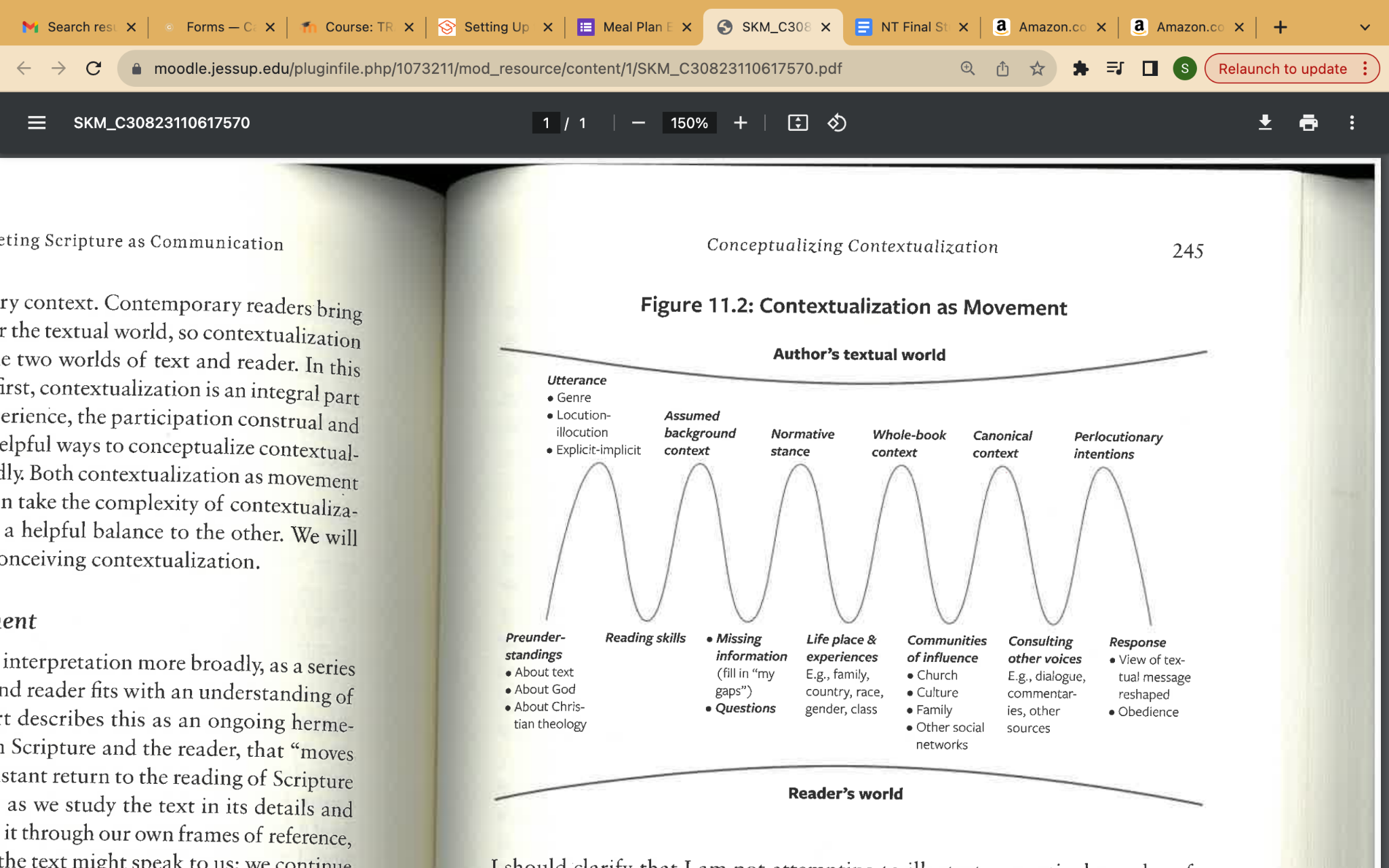
- Be able to describe embodiment as movement.
- We understand works through our own frame of reference
- Start with hypothesis: how the text might speak to us
- Return back to text to check our understanding (like a review)
- Exegetical and contextualization are a back and forth between the text and the reader
- Movement is essentially the reader's preliminary or provisional ideas to confirm or revise those interpretations. (this is not a linear process)
Be able to describe embodiment as participation.
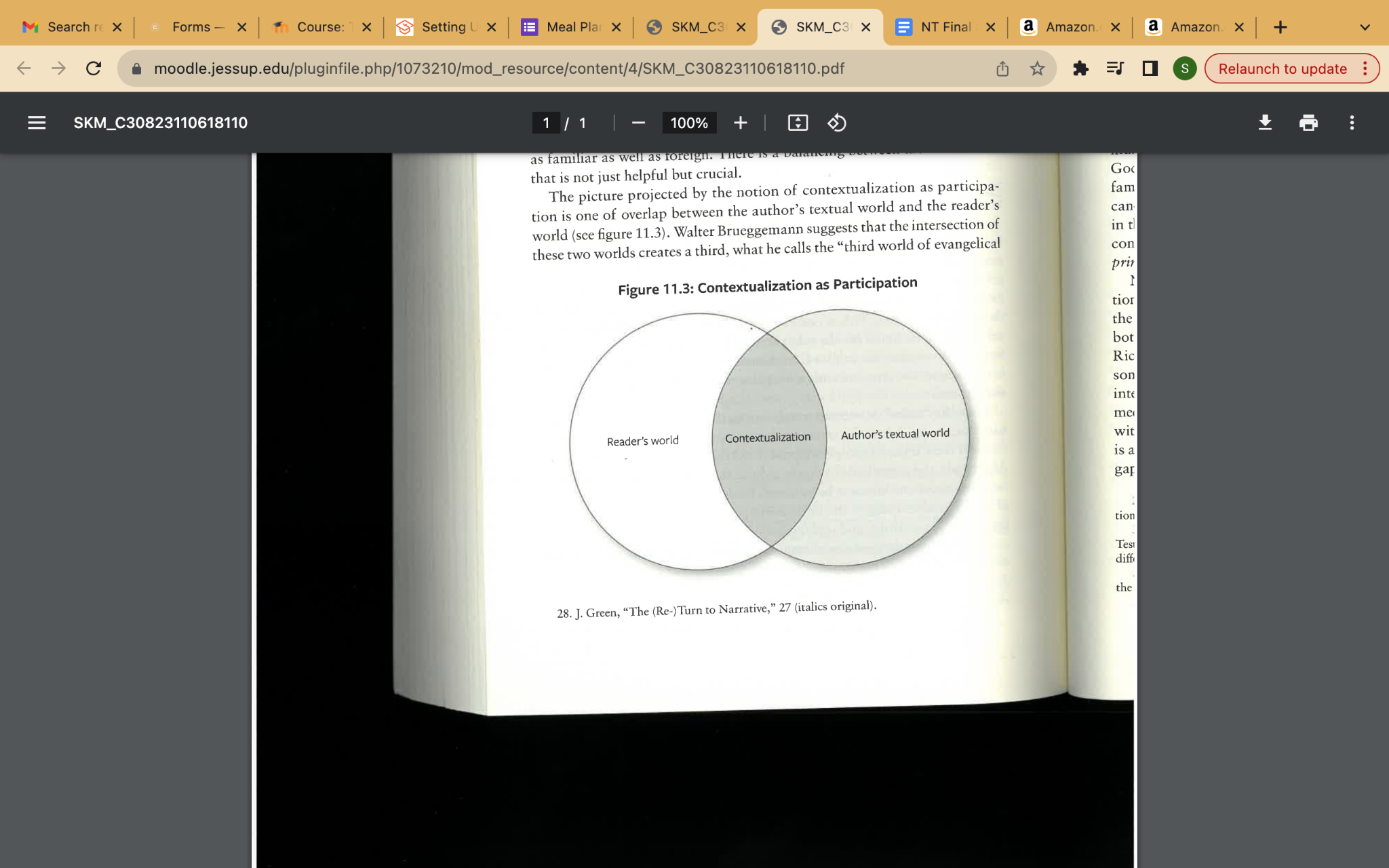
- The participation of reader and author with contextualization being a mediator
- Participation emphasizes that we are invited to hear Scripture if we are familiar with scripture or not
- The participation of reader and author with contextualization being a mediator