EU Midterm
I. Historical Background and Origins
The foundations of the European Union were built on the desire to ensure lasting peace and economic recovery following the destruction of World War II.
Early Milestones:
Post-WWII Reconstruction: The Marshall Plan and Truman Doctrine provided significant U.S. political and economic involvement in Western Europe.
The Schuman Declaration (1950): French Foreign Minister Robert Schuman proposed pooling French and German coal and steel resources to make war between the rivals "not merely unthinkable, but materially impossible."
European Coal and Steel Community (ECSC, 1951): The first concrete step toward integration, establishing a supranational organizational structure that served as the prototype for today's institutions.
The Cold War Context:
Division of Europe: The continent was divided into Western democracies (under American influence/NATO) and Eastern communist regimes (under Soviet influence/Comecon).
Integration as Security: The Cold War heightened Western European insecurity, driving momentum for further political and economic unity as a "third way" between the superpowers.
End of the Cold War (1989–1991): The collapse of communist regimes allowed Central and East European countries to eventually join the EU, moving the world from a bipolar to a multipolar order.
II. Institutional Framework
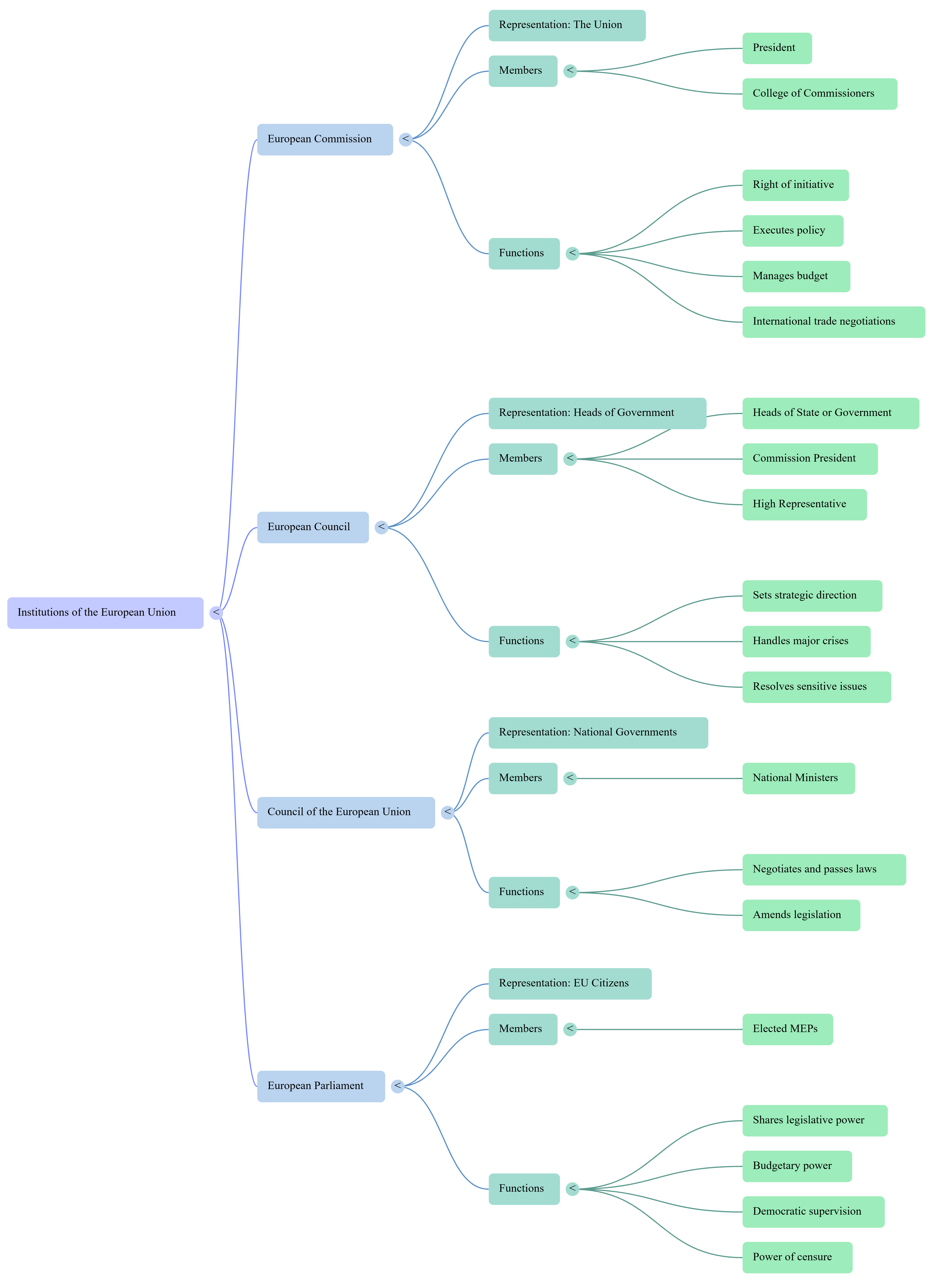
The EU operates through a unique hybrid of intergovernmental (representing member states) and supranational (representing the union as a whole) elements.
The European Commission:
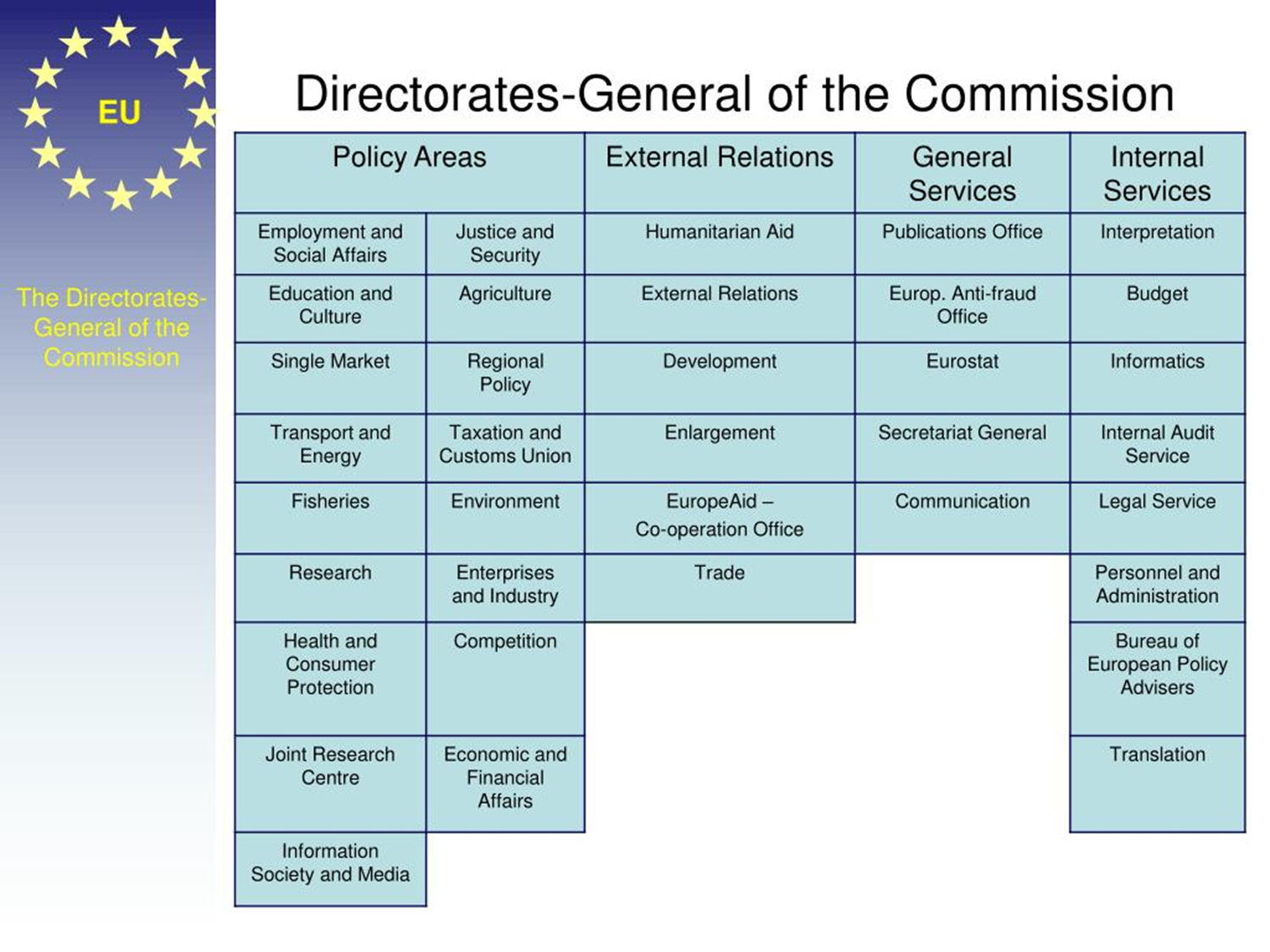
Role: Acts as the "executive" wing. It alone has the power to initiate policy proposals, manages European programs, and represents the EU internationally.
Structure: Composed of the President and a College of Commissioners. Commissioners are nominated by national governments but are strictly expected to act independently of national interests.
The Council of the European Union (Council of Ministers):
Role: Represents national governments and makes major policy and legislative decisions. It is the forum where national ministers meet to negotiate and adopt EU laws.
Structure: Varies by policy area (e.g., ECOFIN for finance, GAERC for external relations). The presidency rotates every six months.
The European Council:
Role: Comprised of Heads of State or Government; it provides the EU's overall political direction and "summits" provide the forum for breaking deadlocks on sensitive issues. It does not pass laws.
The European Parliament (EP):
Role: Directly elected by citizens since 1979; it shares legislative and budgetary power with the Council and exercises democratic supervision over the Commission.
The European Court of Justice (ECJ):
Role: Ensures that EU law is interpreted and applied consistently across all member states, acting as the final arbiter of legal disputes.
III. The Single Market and Economic Integration
Economic integration has progressed through several distinct stages, from preferential trading areas to complete economic union.
The Four Fundamental Freedoms: The core of the Single Market is the free movement of goods, services, persons, and capital.
Single European Act (SEA, 1986): This act re-launched the single market project and set a deadline of December 31, 1992, for its completion. It was a psychological breakthrough that shifted the EU toward a vital, modern entity.
Economic and Monetary Union (EMU):
Maastricht Treaty (1992): Officially established the path to the Euro.
The Euro: Introduced in 2002; it requires countries to meet strict "convergence criteria" regarding budget deficits, inflation, and public debt.
European Central Bank (ECB): Based in Frankfurt, it manages monetary policy and ensures price stability within the Eurozone.
IV. Foreign Policy and Enlargement
Common Foreign and Security Policy (CFSP):
Evolution: Evolved from the "light-touch" European Political Cooperation (EPC) of the 1970s to a more structured policy today.
Challenges: Decisions often require unanimity, meaning any single member state can veto action. This often results in slow or diluted responses to international crises.
EU Enlargement:
Growth: The EU has expanded from its original 6 members to 28 (prior to the UK's departure).
Criteria: Applicants must fulfill standards including being a liberal democracy, a market economy, and respecting human rights and the rule of law.
Major Waves:
1973: UK, Ireland, Denmark.
1981–1986: Greece, Spain, Portugal (Southern expansion).
2004: The "Big Bang" addition of 10 countries, primarily from Eastern Europe.
V. Key Challenges and Accomplishments
Successes: The EU has maintained peace on the continent for over 70 years, for which it received the Nobel Peace Prize in 2012. It has created the world's largest internal market.
Vulnerabilities: The Eurozone crisis highlighted the difficulty of managing a single currency without a unified fiscal policy. The reliance on consensus in foreign policy remains a significant hurdle to being a global geopolitical actor.
I. Foundational Treaties
These legal agreements established the institutions of the EU and defined the scope of its powers.
1951: Treaty of Paris
Established the European Coal and Steel Community (ECSC).
Pooled coal and steel resources between six founding members (France, West Germany, Italy, Belgium, Netherlands, Luxembourg) to prevent future conflict.
1957: Treaties of Rome
Created the European Economic Community (EEC) and the European Atomic Energy Community (Euratom).
Established the goal of a customs union and a common market. The **European Economic Community (EEC)** was established to promote economic integration among its member states by creating a common market, allowing for the free movement of goods, services, people, and capital. It aimed to strengthen economic ties and foster growth and stability in Europe. The **European Atomic Energy Community (Euratom)** was created to promote the use of nuclear energy for peaceful purposes, ensuring safety in nuclear energy production and managing the supply of nuclear fuel. Euratom aimed to foster collaboration in the nuclear sector and maintain a common regulatory framework for nuclear safety and radiation protection among member states.
1986: Single European Act (SEA)
The first major revision of the Treaty of Rome.
Set a firm deadline of December 31, 1992, to complete the Single Market.
Introduced "Qualified Majority Voting" in the Council to prevent single-country vetoes from stalling market legislation.
1992: Treaty of Maastricht
Formally created the European Union.
Established the "Three Pillars" structure (EC, Foreign Policy, and Justice/Home Affairs).
Set the roadmap for the Euro and introduced the concept of EU Citizenship.
II. Key Historical Milestones
1950 (May 9): The Schuman Declaration
The proposal by French Foreign Minister Robert Schuman that led to the ECSC; May 9 is now celebrated as "Europe Day."
1962: Common Agricultural Policy (CAP)
The launch of the EU’s first major common policy, aimed at ensuring food security and supporting farmers.
1970: The Luxembourg Report
Established European Political Cooperation (EPC), the predecessor to the modern common foreign policy.
1979: First Direct Elections to the European Parliament
Marked a shift from a nominated assembly to a directly elected democratic body.
1993 (January 1): Launch of the Single Market
The official start of the free movement of goods, services, people, and capital.
2002 (January 1): Introduction of Euro Banknotes and Coins
The physical currency replaced national currencies in 12 member states.
2009: The Eurozone Crisis Begins
Triggered by ballooning budget deficits (notably in Greece), testing the stability of the Economic and Monetary Union.
2012: Nobel Peace Prize
Awarded to the EU for its role in advancing peace, democracy, and human rights for over six decades.
III. EU Enlargement Waves
The expansion of the EU from 6 to 28 members is often categorized into these distinct phases:
1973: The First Enlargement
United Kingdom, Ireland, and Denmark join.
1981–1986: The Southern Expansion
Greece (1981), followed by Spain and Portugal (1986) after their transitions to democracy.
1995: The EFTA Enlargement
Austria, Finland, and Sweden join.
2004: The "Big Bang" Enlargement
The largest expansion in EU history, adding 10 countries: Cyprus, Czech Republic, Estonia, Hungary, Latvia, Lithuania, Malta, Poland, Slovakia, and Slovenia.
2007: Eastern Expansion
Bulgaria and Romania join.
2013: Most Recent Addition
Croatia joins as the 28th member state.
Here is a full EU exam cram study guide built from your notes but organized for fast memorization. The goal is that you can review this in ~30–45 minutes before the exam and recall the major concepts quickly.
European Union Exam Cram Study Guide
1. Why the EU Was Created
After World War II, Europe was devastated economically and politically. European leaders believed that economic cooperation would prevent future wars, especially between France and Germany.
Major motivations
Prevent another European war
Promote economic recovery
Counter Soviet influence during the Cold War
Increase political stability
U.S. involvement
Two major U.S. initiatives helped Western Europe rebuild:
Marshall Plan (1947) – economic aid to rebuild Europe
Truman Doctrine (1947) – U.S. commitment to stop the spread of communism
These policies helped stabilize Western Europe and supported economic integration.
2. The Schuman Declaration (1950)
Proposed by French Foreign Minister Robert Schuman.
Main idea
France and Germany would pool their coal and steel industries under a shared authority.
Why coal and steel?
These were the key materials needed to produce weapons and military power.
By sharing them:
War between France and Germany would become “not merely unthinkable but materially impossible.”
Result
This proposal led directly to the creation of the European Coal and Steel Community (ECSC).
3. First Step Toward Integration: ECSC
Treaty of Paris (1951)
Created the European Coal and Steel Community.
Members (the “Founding Six”)
France
West Germany
Italy
Belgium
Netherlands
Luxembourg
Importance
First supranational European organization
Countries agreed to share control of coal and steel production
Became the prototype for later EU institutions
4. Treaties of Rome (1957)
Created two new communities:
European Economic Community (EEC)
Goal: create a common market between member states.
This meant:
eliminating tariffs
allowing free trade
integrating economies
The EEC aimed to allow free movement of goods, services, people, and capital.
These are known as the Four Freedoms.
Euratom
The European Atomic Energy Community.
Purpose:
promote peaceful nuclear energy
coordinate nuclear research
ensure safety standards
5. The Four Freedoms (Core of the Single Market)
The EU’s internal market is based on four freedoms:
Free movement of goods
Free movement of services
Free movement of persons
Free movement of capital
This allows businesses, workers, and investments to move freely between member states.
6. Single European Act (1986)
The first major revision of the Treaty of Rome.
Main goals
Complete the Single Market
Remove remaining trade barriers
Improve economic integration
Important change
Introduced Qualified Majority Voting (QMV) in the Council.
This meant:
decisions no longer required unanimous agreement
reduced the ability of one country to veto legislation
Deadline
The Single Market was to be completed by December 31, 1992.
7. The Maastricht Treaty (1992)
One of the most important treaties in EU history.
Key outcomes
Officially created the European Union
Introduced EU citizenship
Established a roadmap for the Euro
Created the Three Pillar Structure
The Three Pillars of Maastricht
Pillar 1: European Community
Economic integration, trade policy, and the single market.
Pillar 2: Common Foreign and Security Policy (CFSP)
Cooperation on foreign policy and international diplomacy.
Pillar 3: Justice and Home Affairs
Cooperation on immigration, policing, and judicial issues.
8. Economic and Monetary Union (EMU)
Created by the Maastricht Treaty.
Purpose
Integrate European economies even further through:
a single currency
shared monetary policy
Requirements (Convergence Criteria)
Countries must meet strict rules regarding:
inflation
government deficits
public debt
exchange rate stability
9. The Euro
Introduced physically in 2002.
Importance
replaced national currencies in many EU countries
facilitated easier trade and travel
strengthened economic integration
Not all EU countries use the euro.
Countries using it are part of the Eurozone.
10. European Central Bank (ECB)
Located in Frankfurt, Germany.
Responsibilities
manage the Euro
control monetary policy
maintain price stability
manage interest rates
The ECB serves as the central bank of the Eurozone.
11. EU Institutions
The EU operates through a mix of supranational institutions and intergovernmental cooperation.
European Commission
Role: the executive branch of the EU.
Responsibilities:
proposes new laws
implements policies
manages EU programs
represents the EU internationally
Structure
President
College of Commissioners (one from each member state)
Commissioners must act in the interest of the EU, not their own country.
European Parliament
The only EU institution directly elected by citizens.
First direct elections
1979
Responsibilities
debates legislation
shares law-making power with the Council
approves EU budget
supervises the Commission
Council of the European Union (Council of Ministers)
Represents member state governments.
Structure
Different ministers attend depending on the topic.
Examples:
finance ministers (ECOFIN)
agriculture ministers
foreign ministers
Role
negotiate and adopt EU laws
coordinate national policies
European Council
Made up of:
heads of state or government
the European Commission president
Role
sets the overall political direction
resolves major disputes
does not pass legislation
European Council meetings are known as EU summits.
European Court of Justice (ECJ)
The EU’s highest court.
Responsibilities
interpret EU law
ensure laws are applied equally across member states
resolve disputes between institutions and countries
12. Foreign Policy: CFSP
The Common Foreign and Security Policy coordinates diplomacy between EU countries.
Challenge
Many decisions require unanimity.
This means any country can veto a decision, which can slow responses to international crises.
13. Enlargement of the EU
The EU has expanded from 6 founding countries to 28 members (before Brexit).
Enlargement Waves
1973 – First Enlargement
United Kingdom
Ireland
Denmark
1981–1986 – Southern Expansion
Greece (1981)
Spain (1986)
Portugal (1986)
These countries had recently transitioned from dictatorships to democracies.
1995 – EFTA Expansion
Austria
Finland
Sweden
2004 – “Big Bang” Enlargement
10 new members, mostly from Eastern Europe:
Cyprus
Czech Republic
Estonia
Hungary
Latvia
Lithuania
Malta
Poland
Slovakia
Slovenia
2007 – Eastern Expansion
Bulgaria
Romania
2013 – Most Recent
Croatia
14. Major EU Policies
Common Agricultural Policy (CAP) – 1962
One of the EU’s first shared policies.
Goals:
stabilize food supply
support farmers
keep food prices reasonable
15. Major EU Achievements
Peace
The EU has helped maintain peace in Western Europe for over 70 years.
Economic Integration
The EU created the largest single market in the world.
Nobel Peace Prize
Awarded to the EU in 2012 for promoting peace and democracy.
16. Major Challenges
Eurozone Crisis (2009)
Triggered by large government deficits, especially in Greece.
Revealed a key weakness:
Countries share a currency, but not a unified fiscal policy.
Foreign Policy Limitations
Because many decisions require unanimity, the EU can struggle to act quickly in global crises.
17. Key Timeline to Memorize
1950 — Schuman Declaration
1951 — Treaty of Paris (ECSC)
1957 — Treaties of Rome (EEC + Euratom)
1962 — Common Agricultural Policy
1979 — First European Parliament elections
1986 — Single European Act
1992 — Maastricht Treaty (EU created)
1993 — Single Market completed
2002 — Euro introduced
2012 — EU receives Nobel Peace Prize
18. Absolute Essentials to Memorize (Most Likely Exam Questions)
Institutions
Commission = proposes laws
Parliament = represents citizens
Council of EU = member state ministers pass laws
European Council = leaders set political direction
ECJ = interprets EU law
Treaties
1951 Paris – ECSC
1957 Rome – EEC
1986 Single European Act – Single Market
1992 Maastricht – EU + Euro
Core idea of EU
Economic integration → political stability → peace.
If you want, I can also give you a super condensed 1-page “night before exam cheat sheet” version that hits literally the 20 facts professors test 90% of the time.