Cognition

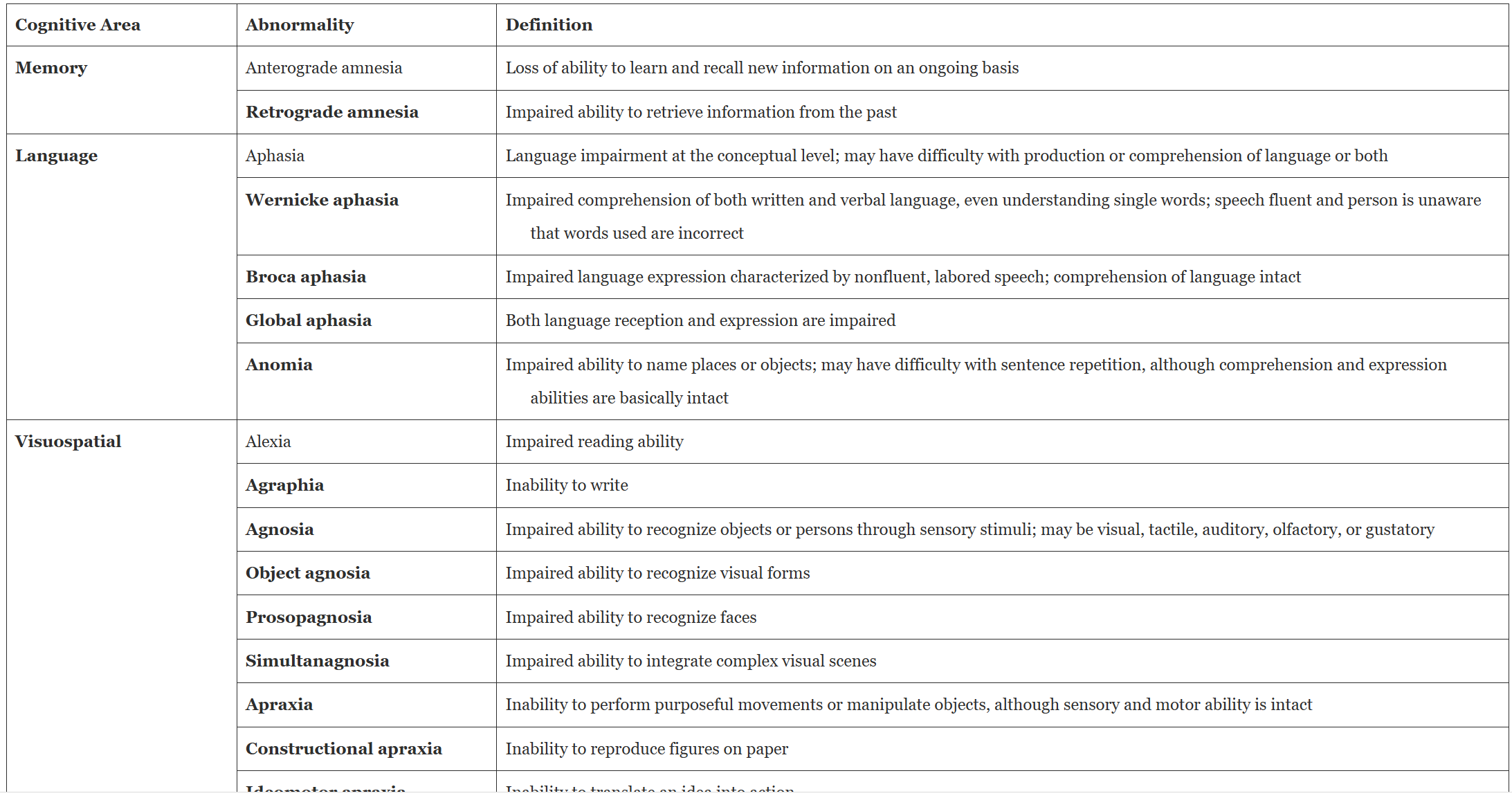
Wernicke= receptive aphasia (people can speak fluently but words make no sense)
Broca = expressive aphasia (people understand language but cannot produce speech)

Tools: Global Cognitive Screening & Performance Tools
Mini-Mental State Examination (MMSE): A 30-item, 10-minute standardized tool used across clinical settings to screen for dementia, detect cognitive decline during illness, and monitor response to treatment[1][2]. It tests time and place orientation, immediate recall, short-term memory, serial 7s, reading, writing, drawing, and verbal/motor comprehension[1]. A score below 27 indicates the need for further evaluation[1].
Montreal Cognitive Assessment (MoCA): A more challenging tool than the MMSE designed to detect early cognitive impairment, particularly in individuals with higher levels of education[1][2]. It evaluates executive function, higher-level language skills, and visuospatial abilities[1][2].
Confusion Assessment Method (CAM / CAM-ICU): A short screening test used to detect delirium in hospitalized patients, including an ICU version (CAM-ICU) for intubated or non-verbal patients[1].
Severe Impairment Battery (SIB): Designed for patients with significant cognitive impairment to evaluate lower levels of cognitive function, providing clarity for individuals scoring under 12 on the MMSE[1][2].
Memory-Specific Assessment Tools
Three Words Three Shapes Test: A simple tool measuring verbal and nonverbal memory, recall, and recognition by requiring the patient to recall three written words followed by three drawn shapes[1][2].
Fuld Object Memory Evaluation: Evaluates recognition, memory, and learning in older adults by asking them to identify ten objects in a bag by touch alone (stereognosis) and later recall them[2].
Executive Functioning & Motor Speed Tools
Controlled Oral Word Association Test (COWAT): Assesses executive function, attention, thought processes, and memory by having the patient generate as many words as possible starting with a designated letter within one minute[2].
Behavioral Dyscontrol Scale (BDS): A 9-item screening tool evaluating motor control processes, insight, and an older adult's capacity for independent functioning[2].
Hand Tapping Test: Evaluates motor speed by assessing hand tapping, where slowed speed is correlated with cognitive impairment[2].
Staging & Rating Scales
Global Deterioration Rating Scale (GDRS): A behavioral rating scale used to stage cognitive impairment across three phases: forgetfulness, confusion, and dementia[2].
Diagnostic & Age-Specific Evaluations
Formal Neuro-psychometric Testing: Detailed standardized testing conducted by a neuropsychologist to identify mild cognitive impairment and clarify whether psychiatric or mood disorders are contributing to mental alterations[1].
Brain Imaging: Magnetic Resonance Imaging (MRI) and Positron Emission Tomography (PET) scans help identify structural brain abnormalities such as intracranial tumors, vascular infarcts, or frontotemporal lobe atrophy[1].
Developmental Milestone Screening: Used in infants and young children to assess achievement of age-appropriate behavioral, cognitive, and psychosocial milestones to identify developmental delays[1][3].