Small populations and genetic drift
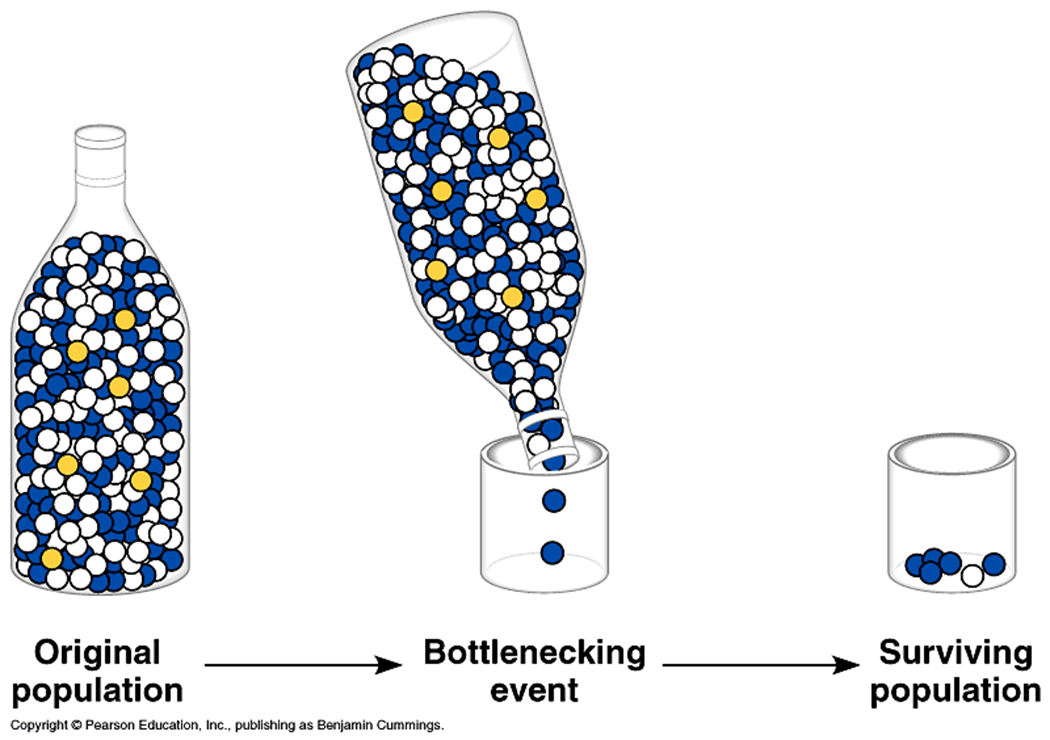
Small pops and bottlenecks
small pops often the result of a bottleneck effect
defined as a decrease in pop size
may last from one gen to many gens
size and duration of the bottleneck are extremely important
ex. black-footed ferret
reduced to fewer than 100 individuals
most endangered spp have been bottlenecked:
endangered = small pop size by definition
Ex. of bottlenecked species
arabian oryx
european bison
indian rhino
California condor
Whooping crane
Size of the bottleneck: the more individuals lost, the greater the immediate loss of genetic variation.
Bottlenecks and genetic variation in seals
comparison of genetic variation in six seal species for a panel of the same 24 microsatellite loci.
Genetic drift and random sampling of alleles
genetic drift: chance changes in allele frequency that result from the sampling of alleles from generation to generation in a finite pop
the finite number of alleles transmitted to progeny will be an imperfect sample of the allele frequencies in the parents
allele frequencies will change, variation will be lost
violates HW assumption of infinite pop size
Genetic drift and pop size
small pops drift more than large pops
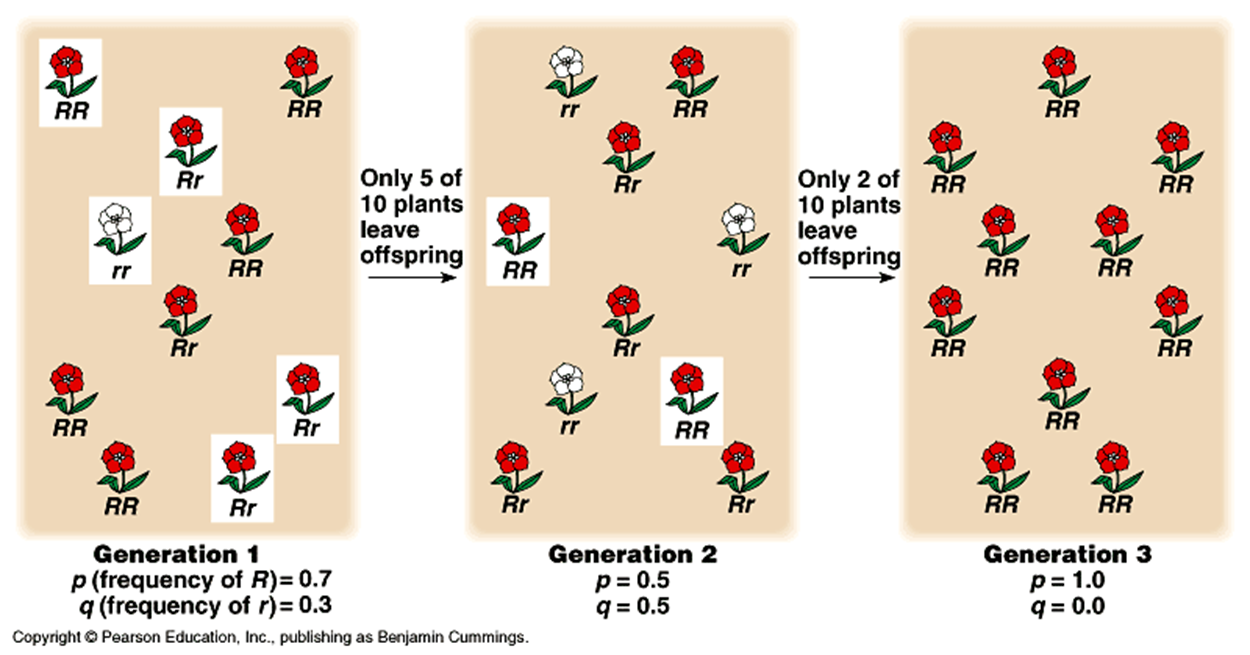
Drift ex - we assume that none of the 3 alleles A1, A2, and A3 has a selective advantage
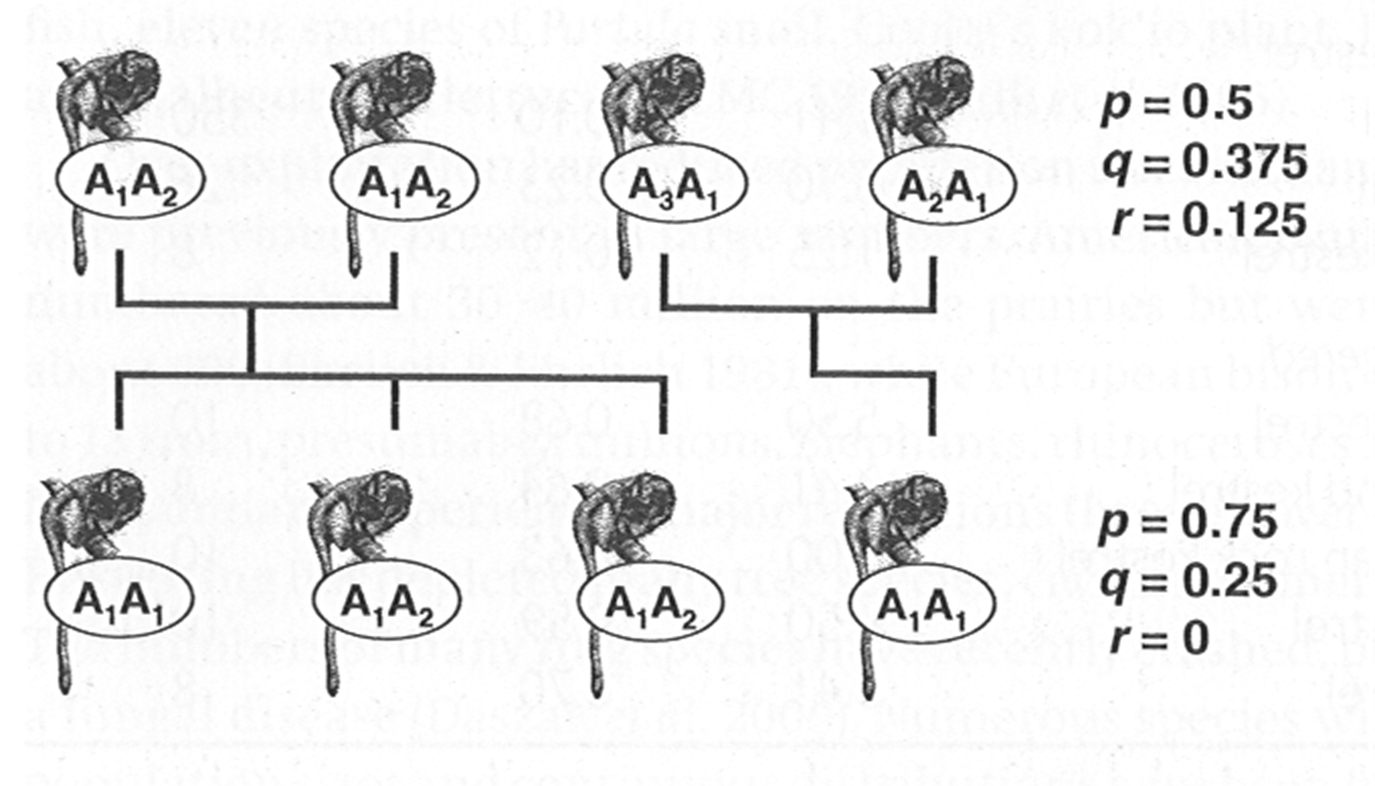
Random sampling of gametes: the kid on the right got A1 from both parents.
Differential reproduction due to chance.
Genetic drift and bottleneck duration
generation interval is the average age of reproduction - used instead of years
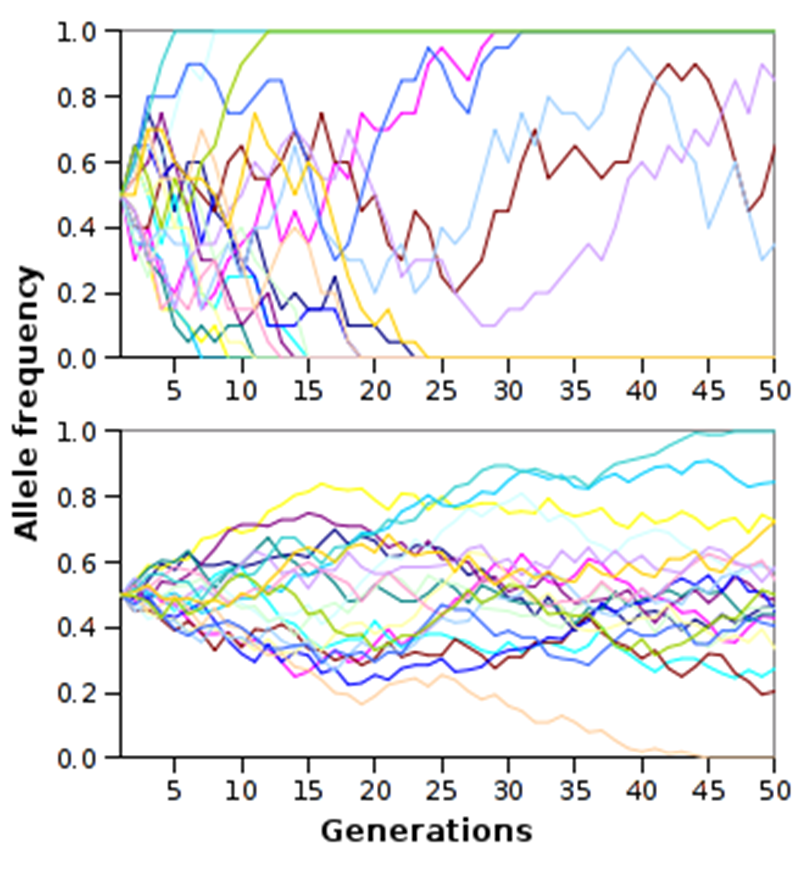
Size and duration of the bottleneck
severe bottleneck, large initial loss of alleles
loss of alleles thru drift more likely in small pops
long bottleneck duration, loss of alleles more likely than short bottleneck duration
changes in the genetic structure of a pop due to random sampling of alleles and differential reprod of adults
results in:
loss of genetic diversity (fixation)
random changes in allele frequencies
differentiation among pops
Expected loss of heterozygosity due to drift in one gen:
proportion of heterozygosity remaining after 1 gen = 1 - 1/2n
pop size: 2, 10, 25, 50, 100
proportion heterozygosity remaining: 75%, 95%, 98%, 99%, 99.5%
issue: bottlenecks usually last for multiple gens
(1-1/2N)^t
so even a pop maintained at n=500 will retain only 95% of its diversity for 50 gens
NB: Rate at which genetic variation is lost following genetic drift depends on the locud
Diploid: -1/2N
Haploid = -1/N
Maternally inherited plastid/mtDNA = -1/N_f
Loss of allelic diversity
allelic diversity is another way to measure loss of genetic variation
expected loss of heterozygosity:
insensitive to sample size, comparisons between pops or spp more meaningful
insensitive to effects of bottlenecks - 75% retained even thru an extreme bottleneck of 2 individuals
expectation is (1-1/2N) regardless of the number of alleles present and their frequencies
2 individuals possess a max of 4 different alleles, so a lot of variation can be lost if many alleles are present at a locus in a pop
difference between H and A is greatest in small pops
effect of bottleneck on number of alleles depends on numbers and frequencies of alleles
E (A’) = A - ∑ a j=1(1 – pj)2N
where A is the initial number of alleles, pj is the frequency of the jth allele, N=number of individuals, E(A’) is the total expected number of alleles remaining
Ex: 1 locus, 2 alleles, frequencies of 0.9 and 0.1, bottleneck of 2 individuals
E(A’) = 2 - (1 - 0.9)^4 - (1 - 0.1)^4 = 1.34
if both allele frequencies were 0.5 E(A’) = 1.88
rare alleles are likely to be lost during bottlenecks
loss of rare alleles has little effect on heterozygosity
Founder effect
special case of genetic drift
founding new pops with a small number of individuals will cause changes in allele frequencies and loss of genetic variation
Fitness effects of genetic drift: changes in allele frequence
changes in allele frequency likely in small pops
may increase frequency of harmful alleles
harmful alleles usually recessive
continually produced by mutation but kept at low frequencies by selection
in small pops, drift can cause harmful alleles to be fixed
selection less effective in small pops
Bottleneck of 2 individuals
most rare alleles lost
any allele for which one of the 2 fouunders is heterozygous will be found in new pop with a frequency of 25%
most loci in 2 founders will not carry a harmful allele but every individual carries harmful alleles at some loci
can’t predict which harmful alleles will increase in frequency
but can predict that several harmful alleles that were rare will be found at higher frequencies
ex. dalmations
few founders
susceptible to kidney stones bc excrete high amounts of uric acid
due to a recessive allele at a single locus
Fitness and drift: loss of allelic diversity
drift has a greater effect on allelic diversity than on H if many alleles at a locus
Mhc loci highly diverse and related to disease resistance and immune response
bottleneck of 2 individuals: dozens to hundreds of alleles reduced to a max of 4
small pops more susceptible to disease epidemics
Fitness and drift: inbreeding
increased homozygosity
relatives tend to have the same alleles
if they mate together, likely to be homozygous
recessive harmful alleles expressed
reduced heterozygosity
lose any heterzygote advantage