Chapter 7
Media: Print and digital forms of communication, including television, newspapers, radio, the Internet, and social media sites that convey information to large audiences.
Principled Journalism: Reporting that involves being as accurate, fair, and balanced as possible, relying on sources, being transparent about siding, sources, and presenting multiple viewpoints.
Adversarial Journalism: A form of reporting in which the media adopt a skeptical or hostile posture toward the government in public officials.
Citizen Journalism: News reporting and political commentary by ordinary citizens and bystanders, advocacy groups, and eyewitnesses to a crisis, often using cell phone images or video and distributed via social media.
Opinion-Driven Journalism: Political blogs and talk shows, where the writer or host provides highly opinionated personal commentary, usually through conversations with guests, these formats blur the boundaries between objective journalism and subjective reporting.
Journalism of Assertion: The publishing or broadcasting of information or opinion as quickly as possible with minimum fact-checking.
Journalism of Affirmation: The putting forth of opinion and information that is consistent with the consumers ‘ pre-existing beliefs.
Media Monopolies: Giant, global corporations that control a wide area of media, including television networks, movie studios, record companies, cable channels, book in newspaper, publishers, and digital media outlets.
Agenda Setting: The media's designation of some issues, events, or people as important in others not.
Framing: The process of presenting information from a certain perspective to shape the audience’s understanding of that information.
Priming: The process of calling attention to some issues and not others when reporting on political events and officials.
Mainstream News Organizations: Organizations that adhere to the principles of journalism by doing original, balanced, factual reporting using unpaid, credible sources, conducting interviews ethically, and avoiding personal bias by editors or reporters.
Partisan Media: News organizations that make opinion-driven journalism with factual reporting to appeal to consumers who are ideologically liberal or conservative, often characterized by ideological agenda, priming, and framing.
Broadcast Media: Communication methods, such as television and radio. They tend to take the form of one publisher to many.
News Websites: Digital sites that are owned in managed by newspapers. Follow the principle of journalism and deliver content like that of print newspapers, with a similar story layout for all users.
News Aggregators: Websites that pull together news from a wide range of online sources and make them available on one platform or page; can be a way to avoid partisan or filtered news, providing a broad overview of the news of the day from many sources.
Algorithms: Software programs that analyze the viewing, liking222, and commenting data of all of a platform’s users, as well as individual users’ prior data, to present users with additional content tailored to their individual interests instead of ordering posts based on the most recently published.
Confirmation Bias: The tenancy to favor information that confirms a person’s existing beliefs. It involves discounting evidence that could disprove or challenge those beliefs.
Filter Bubbles: Partisan media environments in which users are exposed primarily to opinions and information that conform to their existing beliefs, constructed by algorithms that analyze and then personalize each user's online experience.
Misinformation: False, inaccurate, or misleading information in the media, especially social media, often targeting political candidates and leaders. Misinformation can include manipulated or fabricated content, satire, and parody content to the public.
Disinformation: Misinformation with the intent to deceive.
Equal Time Rule: The requirement that broadcasters provide candidates for the same political office with equal opportunities to communicate their messages to the public.
Right of Rebuttal: A federal communications commission regulation, giving individuals the right to respond to personal attacks made on a radio or television broadcast.
The Media In American Democracy:
Freedom of the press is protected under the First Amendment along with the most cherished individual rights in American democracy, including freedom of speech and religion.
Political speech is especially protected.
In the United States, individuals, groups, private organizations, and companies have the right to publish news, information, and opinion without government censorship and with few government restrictions.
In many authoritarian countries, however, there is no freedom of the press, and governments control news and political information through state-sponsored media.
Under British rule, before the American Revolution, freedom of speech and the press did not exist in the American colonies.
Criticizing the British king was a crime punishable, in some cases, by death.
Today, the same thing happens in some nondemocratic countries with authoritarian governments.
When the colonists won their independence, they wanted to be able to express their political opinions freely without fear of retaliation.
The first of 10 amendments to the U.S. Constitution adopted during the Founding period states, “Congress shall make no law respecting an establishment of religion, or prohibiting the free exercise thereof; or abridging the freedom of speech, or of the press; or the right of the people peaceably to assemble, and to petition the Government for a redress of grievances.”
Even today, most Americans believe that freedom of the press is essential for maintaining a strong democracy.
Key Roles Of The Media:
Inform the public about current issues and events.
Provide a forum for candidates, politicians, and the public to debate polices and issues.
Act as a watchdog on the actions of politicians and the government.
In the first of these roles, the media serve as a type of public square where citizens become informed about their government, political leaders, societal problems, and possible solutions—a forum where information necessary for democracy is exchanged.
After all, information presented by the media helps citizens form opinions about policy issues and make decisions in elections.
And part of informing the public involves providing a variety of perspectives and fact-checking sources to ensure unbiased coverage of current events.
The news media help level the playing field between political elites who have high levels of political knowledge and information and “the people,” thus giving citizens a more powerful voice.
Without the news media, the public would not know as much about the actions of political leaders, corporations, or foreign governments and would have less opportunity to challenge them in the face of corruption.
Journalists (people trained to report the news) give ordinary people information, and this information ultimately becomes power.
In their third role, the media serve as a watchdog for the public, scrutinizing the actions of elected officials on behalf of citizens, most of whom do not closely follow the actions of politicians and government.
The media notify the public of government actions that may affect them and about what policy issues are at stake in terms of changes in laws and regulations.
They reveal which individuals and groups are exerting power in politics, what their goals and strategies are, and what arguments they are using.
The media often expose ties between financial interests and political leaders, or corruption or scandalous behavior on the part of elected officials.
By reporting the news in the public interest, the media continuously monitor the actions of public officials and strive to protect citizens from government overreach and corruption by serving as a check on political power.
Journalism:
Most journalists are trained in schools of journalism and mass communication.
They are guided by standards in reporting the news in the public interest, known as the principles of journalism.
Above all, journalists seek to report the truth by fact-checking information, using unpaid sources, verifying sources as legitimate and credible, engaging in investigative journalism conducted lawfully and ethically, and vetting content before it is published to avoid libel laws.
The traditional news media aim to balance coverage of current events by providing factual reporting that carefully avoids including the personal views of reporters or editors.
Adversarial Journalism:
Early in the 1900s, by communicating directly to the electorate through newspapers and magazines, presidents Theodore Roosevelt and Woodrow Wilson established political constituencies independent of political parties, and thereby strengthened their own power relative to that of Congress.
Subsequent presidents used the news media to enhance their popularity, and a key strategy was establishing friendly relationships with journalists and the media.
This type of journalism is a legacy of late-1800s reform-minded efforts to expose corruption, scandal, and other wrongdoing in politics and the corporate sphere.
During the early stages of U.S. involvement in Vietnam, American officials there who disapproved of the way the war was being conducted leaked to reporters information critical of administrative policy and exposed the horrors of war to the public.
As the war dragged on, adverse media coverage fanned antiwar sentiment among the public and in Congress.
A series of investigations led by the Washington Post uncovered various crimes of which Nixon was guilty, leading to threats of impeachment and his subsequent resignation.
Thereafter, a generation of journalists developed a commitment to adversarial journalism.
Political journalists sometimes rely on leaks, the disclosure of confidential government information to the news media.
Leaks may originate from a variety of sources.
These include “whistleblowers,” lower-level officials who publicly expose their bosses’ or the government’s improper activities.
Without rigorous investigative and adversarial journalism, citizens would not have the means (and information) necessary to hold their elected representatives accountable.
Adversarial journalism is a critical part of what makes democratic governments work.
Citizen Journalism:
Cell phone cameras give people the capacity to quickly and easily provide eyewitness accounts of events.
At the same time, social media allows users to upload videos that can be viewed by hundreds of thousands of subscribers or relayed by the mainstream media for even wider dissemination.
Citizen journalism enriches media coverage and provides a key alternative to mainstream news, filling in gaps, exposing corruption or injustice, and even uncovering major factual errors in mainstream media reports.
But because citizen journalism is not regulated or professionally edited, reports from non-journalists may unintentionally spread distorted or false information.
Opinion-Driven Journalism:
Traditional print newspapers—and today’s digital news websites and apps—have separate sections for news reporting and opinion pieces.
But as the news media have fragmented and gone online, the distinction between reporting and opinion has blurred.
Digital media have given rise to a massive increase in political commentators (also called pundits) and opinion-driven journalists who provide their own perspective on topics of the day rather than doing original reporting, citing sources, and fact-checking content.
A report from the American Press Institute found that more than half of internet users reported that they could not easily tell the difference between news reporting and opinions about the news, particularly on social media.
Nearly half of Americans have difficulty identifying whether news sources conduct their own reporting.
While pundits and opinion-driven journalists do draw attention to political debates, providing entertainment often takes precedence over conveying factual information, and this can lead to confusion among consumers.
The Profit Motive:
In the United States, the media are not part of government and are not subject to checks and balances like Congress, the presidency, and the courts.
Most media in the United States are privately owned for-profit companies, like AT&T, Verizon, the New York Times Company, Meta/Facebook, Fox Corporation, CNN, or Apple. These companies often prioritize profits—by growing audience shares and selling ads—over principled journalism and high-quality news.
Therefore, the profit motive is an important factor in how—and how well—the media deliver the news.
Public broadcasting refers to television, radio, and digital media that receive partial funding from license fees and government subsidies.
In most other democratic countries, public broadcasting, such as the British Broadcasting Company (BBC), plays a major role in informing the public about politics and current events.
In contrast, public broadcasting in the United States—such as National Public Radio (NPR) or the Public Broadcasting Service (PBS)—plays a smaller role in the nation’s media system and receives very little funding from the government.
Because higher ratings generate more advertising revenue.
Because of the need to reach wide audiences to sell ads, the U.S. media are more focused on “soft news,” such as entertainment, sports, and celebrity news, than are European media, which provide more “hard news” coverage of politics and government.
This may help explain why political knowledge is higher in some European countries than in the United States.
Mass Media Ownership:
One noteworthy feature of the traditional media in the United States is the concentration of their ownership.
A small number of giant, global corporations control a wide swath of media, including television networks, movie studios, streaming video, record companies, cable channels and local cable providers, book publishers, magazines, newspapers, and online and digital media outlets.
As media outlets fall into fewer hands, politicians and citizens who express unpopular viewpoints will likely have increasing difficulty finding a public forum.
More than three-fourths of the daily print newspapers in the United States are owned by large media conglomerates such as Hearst Communications, McClatchy, and Gannett. Much of the national news that is published by local newspapers is provided by one wire service, the Associated Press.
Sinclair Broadcasting Group and Nexstar are the two largest local broadcast television station owners in the United States that carry local evening news programs, with 191 and 197 stations, respectively.
Nonprofit Journalism:
In addition to public broadcasting like NPR, other sources of nonprofit journalism include nonprofit organizations and advocacy groups that provide in-depth news, which in some cases leads to changes in government policy.
Yet these nonprofit journalists acknowledge that they are not a replacement for traditional news organizations, as they are not full-time journalists.
Some losses in journalism can be offset by nonprofits and advocacy groups, but because the groups have a self-interest, they don’t always provide unbiased information.
How The Media Shape News & Information:
The content and character of news programming—what the media choose to present and how they present it—can have far-reaching consequences in setting the political agenda for the nation.
The media can shape and modify, if not fully form, the public’s perception of events, issues, institutions, and individuals.
At the same time, the media are influenced by the individuals or groups who are subjects of the news.
The president, in particular, has the power to set the news agenda through speeches, actions, and social media posts.
Most politicians try to shape their media images by cultivating good relations with reporters and by leaking news and staging news events.
In American political history, the media have played a central role in many major events.
The power of all media lies in their ability to shape what issues Americans think about (through agenda setting or gatekeeping) and what opinions Americans hold about those issues (through framing and priming).
Agenda Setting:
The mass media act as a gatekeeper with the power to bring public attention to particular issues and problems.
Advocacy groups, business leaders, or political leaders who wish to generate support for policy proposals seek media coverage.
If the media are persuaded that an idea is newsworthy, such as climate change, a refugee crisis, or inflation, then they may declare it an “issue” that must be confronted or a “problem” to be solved, thus helping it clear the first hurdle in the policy-making process.
Political scientists have shown that the media have two “modes”: an “alarm mode” for breaking stories and a “patrol mode” for covering them in greater depth.
The financial incentive to reach a wider audience often sets off the alarm mode around a story, after which news outlets go into patrol mode to monitor what effect (if any) the story has on government policy—until the next big story alarm goes off.
This pattern results in skewed coverage of political issues, with a few issues receiving most of the media’s attention while others receive none at all.
Political candidates also need the media’s agenda-setting role to win elections.
Candidates who receive positive news coverage gain momentum: they pick up political endorsements, attract campaign contributions, and win more support from voters.
What the mainstream media decides to highlight and what they ignore or downplay have important implications.
Without rigorous adversarial, investigative, and citizen journalism, the people will remain uninformed and unable to participate effectively in politics.
Framing:
Each issue or event can be presented and described through many possible frames, each with a slightly different spin (or slant) that can influence how people understand that issue or event.
Frames, which political leaders and groups also help to develop, shape the meaning that individuals perceive from words or phrases, photographs, or videos.
Media coverage can either legitimize or delegitimize government policies, political leaders, or events. The media framing of recent mass protests illustrates this.
Photographic journalism can aid framing; when covering the BLM protests, liberal-leaning news organizations tended to use a wide camera angle to highlight the size of the crowds, while conservative media zoomed in on individual protesters.
Priming:
Through priming, the media have the power to alter how voters make choices.
While agenda setting is about how the media gatekeeps what issues are covered, framing and priming involve filtering the news and providing cues to the public for how to interpret those issues.
As with agenda setting and framing, news media are not alone in priming; elected officials, interest groups, and other political players apply all three strategies in hopes of influencing public opinion.
Media priming can occur when an issue becomes important in evaluating political candidates.
In these cases, the public is likely to judge a politician according to the media’s attention to one issue, event, or policy over another.
Mainstream News Organizations:
They use unpaid sources, engage in investigative journalism, conduct lawful and ethical interviews, and vet content before it is published to comply with libel laws and avoid defamation lawsuits (defamation is the oral or written communication of a false statement about another person that unjustly harms their reputation and is a crime).
To serve the public interest, they aim for balanced and factual reporting that avoids expressing any personal bias on the part of reporters or editors.
But even scholars of journalism and the media don’t agree on which sources of news fall into the “mainstream.”
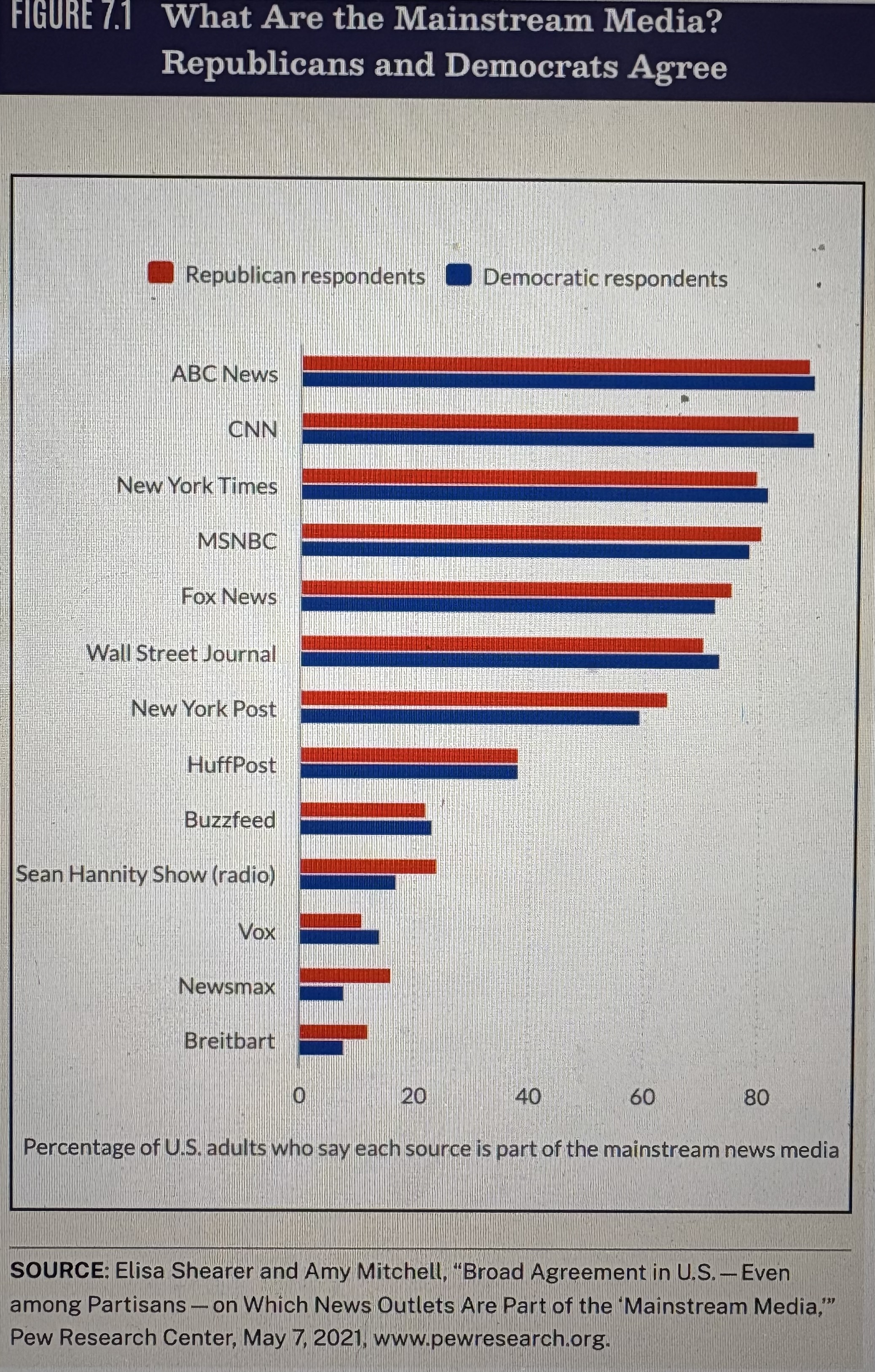
The Pew Research Center conducted a large survey of the American public to uncover what most Americans think is the mainstream media, so it can be more concretely defined.
The survey found that a majority of Americans consider seven news outlets to be part of the mainstream.
Remarkably, both Republicans and Democrats widely agree on these assessments.
When asked to name their main source for political news, about two-thirds of Americans (53 percent of Republicans and 78 percent of Democrats) cite mainstream news sources.
Partisan Media:
Partisan media also use agenda setting, priming, and framing ideologically.
Conservative media may not cover new stories or events important to liberals, and vice versa.
Conservative media tend to paint the actions of Democrats Joe Biden and Kamala Harris negatively, while liberal media provide negative coverage of Republicans, including President Trump
How The News Is Delivered:
Today, digital media can be communicated and shared in many ways by many people and organizations, leading to fragmentation in how people get political information.
News Websites:
Eighty percent of Americans get their news digitally.
Two-thirds get their news often or at least sometimes from news websites.
Digital delivery of news is a relatively recent phenomenon.
Just over two decades ago, most Americans said that, after television, print newspapers were their main source for news, and under 20 percent read the news online.
As the news media have moved online, so has revenue generated from advertising.
Today, two-thirds of all ad revenue in the United States is from digital advertising.
News media are mostly privately owned, for-profit companies, and they need to make revenue to survive.
If customers are going online, then the news and revenue-generating ad content need to be delivered online as well.
Traditionally, U.S. newspapers made more revenue from advertising than from circulation (subscriptions), but in 2020, for the first time, newspapers made more money from circulation than from ad revenue.
News Aggregators:
Websites such as Google News show content from a wide range of online sources, thus providing a broad perspective across partisan and mainstream media.
Stories that appear at the top of news aggregators are those that have been the most read or watched.
Aggregators deliver thousands of news stories each day, as well as the latest public-opinion polls and their own synthesis of the headline news.
Using news aggregators can be a way to avoid partisan or filtered media, and it is particularly effective for learning about American politics and the world from an international perspective.
Social Media:
Social media sites are diverse, interactive, and convenient sources for breaking news.
While social media often refer users to mainstream news stories, they also deliver posts from friends and influencers (about politics, sports, or anything else), opinion pieces, citizen journalism, and almost any other content you can think of.
Social media feeds thus reflect a blend of objective reporting and factual information with opinion-driven and personal commentary.
Although consumers of television, radio, and most news websites see or hear roughly similar content regardless of their geographic location or individual demographics, that is not the case for social media.
Instead of ordering news stories based on which were most recently published, as traditional broadcast media do, algorithms analyze “engagement data” to present each user with a unique set of additional news stories and other content tailored to the user’s preferences.
Social media presents the news as a personalized blend of politically relevant news, influencer opinions, and discussion, so that scrolling through a news feed triggers negative attitudes about those with whom we disagree about politics.
When combined with algorithms that feed users partisan information, social media platforms may encourage partisan disagreement.
But research suggests that social media are not the only cause of polarization.
Television:
After social media, television commands larger audiences than other news sources.
In general, though, Americans’ reliance on television as a news source is likely to continue.
Radio & Podcasts:
The popularity of podcasts has led to significant growth in audio news.
Podcasts are especially popular with young people, but they are growing in popularity among every age group.
Hundreds of local and regional radio and television stations also make up the U.S. public broadcasting sector.
Newspapers:
Newspapers are the oldest medium for the dissemination of news, though today most Americans read digital rather than print versions.
This approach proved successful in attracting readers, and for a long time, most cities and towns in the country had their own newspaper, and often more than one.
However, for most traditional newspapers, recent decades have been financially challenging.
Competition from broadcast media and new online content sources has resulted in declines in advertising revenue and circulation levels, thus changing the traditional business model of newspapers.
The Rise Of Media Technology Companies:
Editors choose stories and titles based on consumer interests, and companies want their advertisements where they will be visible to as many consumers as possible.
The Effect Of Big Tech On The Media:
The interdependence of technology and media companies continues to grow.
Social media algorithms have a profound effect on what constitutes the news and political information.
The Quality Of Political News & Information:
While digital media can improve citizens’ access to political information, the shift toward online media also raises several major concerns.
These include the accuracy and depth of news content, the rise in misinformation, growing gaps in political knowledge between the informed and the uninformed, the prominence of partisan media, and the negative effects on civic engagement and people’s tolerance of each other.
What Americans Think Of The Media:
Views about the influence of the media in American politics have shifted dramatically over the past few decades.
Though it had been growing before, distrust in the news media increased significantly with the Trump presidency.
Trump waged an unprecedented war on the American media, frequently referring to major newspapers and broadcast media as “fake news.”
In a tweet shortly after Trump’s inauguration in 2016, he even called the press “the enemy of the American people.”
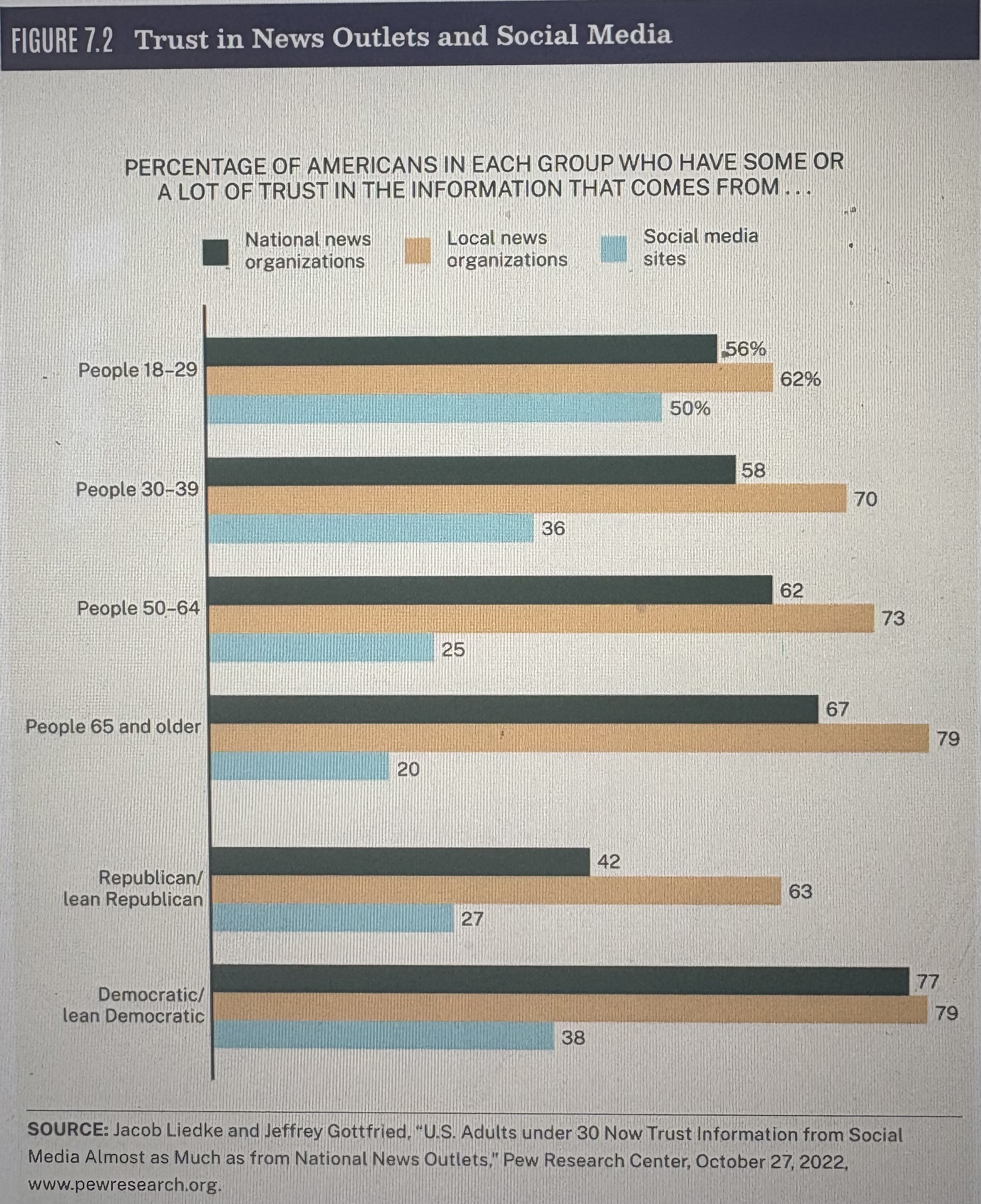
There is growing trust in news from social media among young people.
Trust in information from local and national news organizations is generally higher than in social media, in part because of problems with misinformation.
However, people under 30 now trust information from social media almost as much as from national news outlets.
Adults in all other age groups remain considerably less likely to trust information from social media than from local and national news.
Polarized Information Environments & Media Bias:
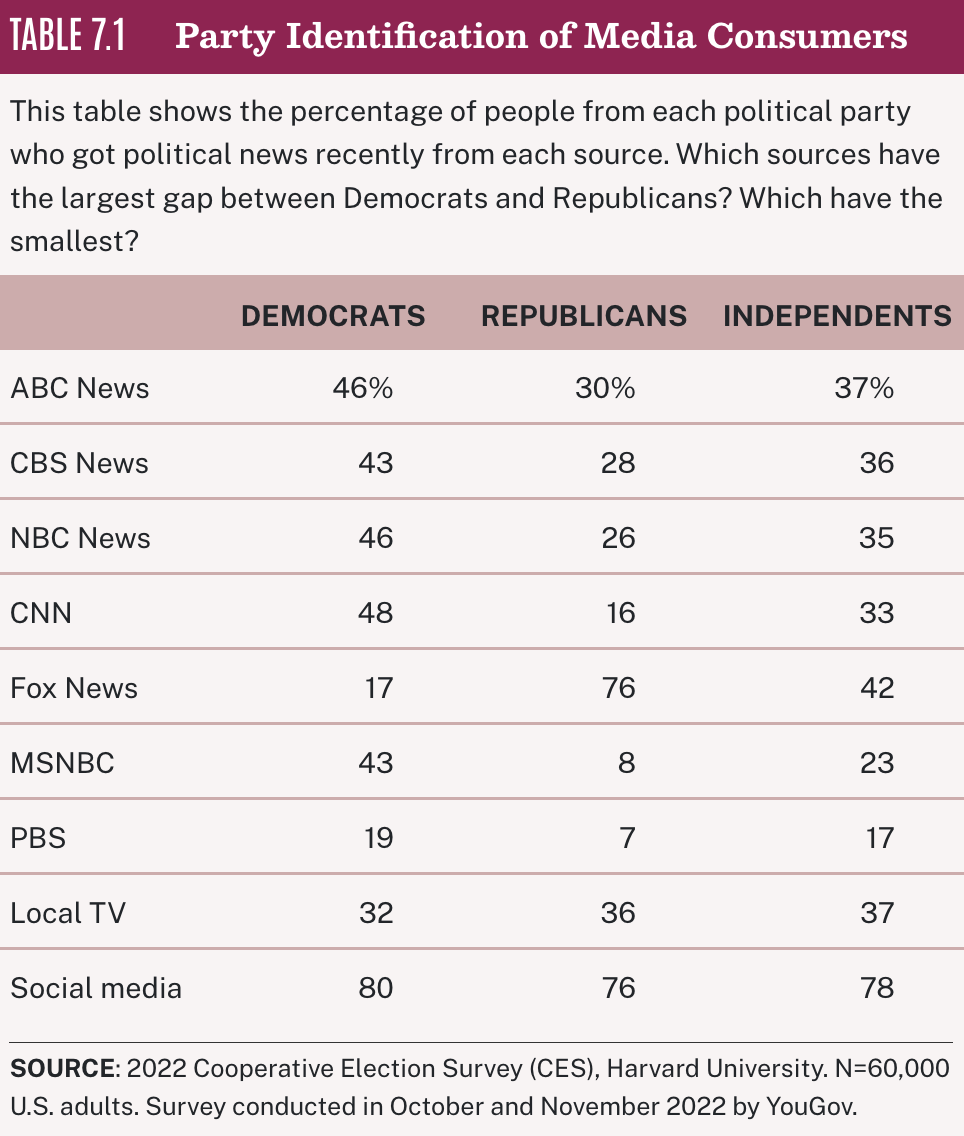
Many news sources today are perceived as distinctly left- or right-leaning.
People tend to select sources that conform with their political beliefs due to the phenomenon of motivated reasoning: individuals will seek out information in favor of the conclusions they want to believe.
Both motivated reasoning and confirmation bias contribute to the creation of partisan news bubbles.
By participating in a filter bubble, people can seek out information that reinforces their existing views without encountering opposing views.
Misinformation & Disinformation:
The growing diversity of digital news sources has led to substantial variation in the quality of political information.
Multiple perspectives create a livelier marketplace of ideas, but misleading content, fabricated content, hate speech, unsubstantiated rumors, and factual errors can overwhelm expression based in fact, especially in anonymous online forums.
This can influence public opinion, posing challenges for democratic government if people are misinformed.
Political candidates and leaders are particularly susceptible to online attacks because negative stories about them can easily go viral, spreading quickly without being fact-checked.
The posting or publication of false stories circulated to benefit one candidate or party over another, or just to generate ad revenue, is a serious problem.
Government Regulation Of The Media:
In the United States, print and online media are essentially free from government regulation, whereas broadcast radio and television are regulated by the Federal Communications Commission (FCC).
Radio and TV stations must have FCC licenses, which must be renewed every five years.
Through regulations prohibiting obscenity, indecency, and profanity, the FCC has sought to prohibit radio and television stations from airing explicit sexual and excretory references between 6 A.M. and 10 P.M., the hours when the audience is most likely to include children.
Generally speaking, FCC regulation applies only to the over-the-air broadcast media and not to cable television, the internet, or satellite radio.
When Congress passed the Telecommunications Act of 1996, a broad effort to end most regulation of business practices and mergers, it allowed the formation of media tech giants and media conglomerates.
The legislation loosened restrictions on media ownership and allowed telephone companies, cable television providers, and broadcasters to compete with one another to provide telecommunication services.
Following the passage of this act, mergers between telephone and cable companies and different entertainment media produced the concentration of media ownership we see today.
In radio, for example, a 40-station ownership cap was lifted, leading to an unprecedented consolidation. ClearChannel Communications (rebranded as iHeartMedia in 2014) grew from 40 to 1,200 stations.
Although the government’s ability to regulate the content of the internet is limited, the FCC has used its licensing power to impose several regulations that can affect the political content of radio and TV broadcasts
Under the terms of the Telecommunications Act of 1996, during the 45 days before an election, broadcasters are required to make time available to candidates at the lowest rate charged for that time slot.
Effects On Knowledge & Tolerance:
Perhaps the greatest concern about politics in the digital age is that the very diversity of digital media may lower tolerance for social, religious, and political diversity, leading to more partisan polarization and societal conflict.
Eighty-five percent of Americans believe that the tone of political debate in the United States has become more negative in recent years—as well as less respectful, less fact based, and less focused on policy issues.
This is partly attributable to the fact that digital media and social media do not abide by traditional media’s principle of objective journalism.
Some liberals and conservatives alike can self-select media that are consistent with their beliefs and avoid exposure to information that might challenge these.
Such self-selection has become even easier as search engines and social media algorithms cater to our individual preferences.
Despite the dramatic rise in available political information, average levels of political knowledge in the population have not increased, although young people are more interested and more likely to vote today than in the past.
Today’s greater access to all types of information online means that education and critical thinking among citizens are more important than ever before.