24- lake victoria
The Great Rift Valley
A rift valley is a linear shaped lowland between several highlands or mountain ranges created by the action of a geologic rift or fault.
The Great Rift Valley contains:
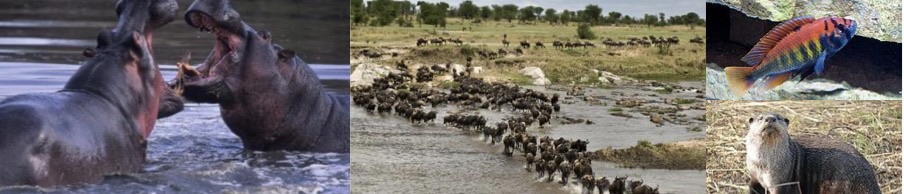
100s of endemic cichlid species;
100% of world’s mountain gorillas and eastern lowland gorillas;
most of world’s wild eastern chimpanzees;
and much much more precious biodiversity.
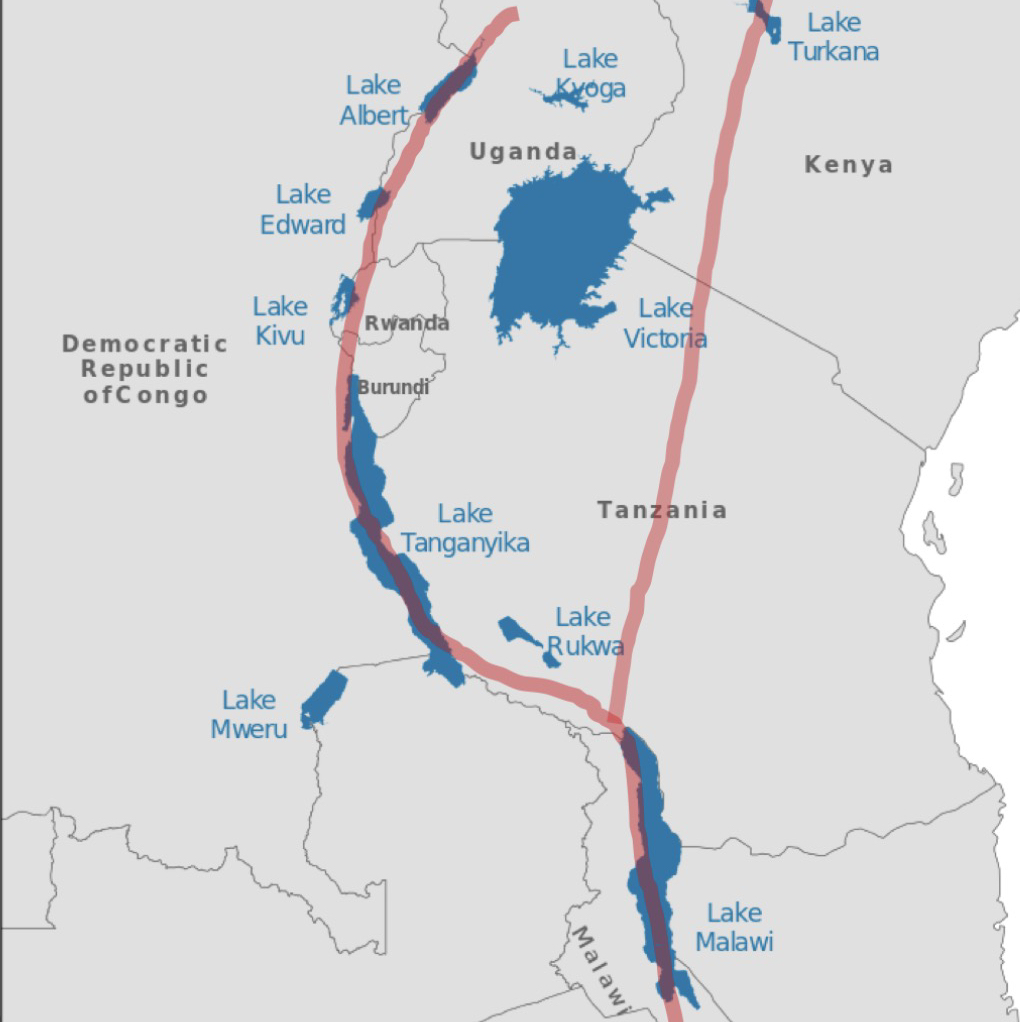
Believed to be where Homo first evolved.
Has very fertile farmland but very high human birth rates in the 9 African Rift Valley nations:
from 3.6bpw (Kenya) to 6.0bpw (D.R. Congo).
Lake Victoria (LV) is one of three great lakes of the African Rift Valley:
a huge and important ecosystem in its own right. LV holds a world-famous example of adaptive radiation; and at least two world-famous examples of disastrous invasive species.
Lake Victoria Info
~40 million people live near and depend on this lake.
Surface altitude: 1135 metres (much higher than Snowdon).
Surface area: approx. 60,000 km2 (45% the size of England!)
Mean depth c. 40 metres & max depth c. 80 metres: 14% as deep as Lake Malawi and 7% as deep as Lake Tanganyika.
Source of the river Nile (the Lake’s only outflow).
Lake Formation & Water Levels
Formed only ~400,000 years ago.
Has dried out and refilled at least 3x since then (most recently: 17,500 to 14,700 years ago).
Tectonic movements thought to have changed direction of flow of LV’s western inflowing rivers. May have allowed River Congo cichlids to spread into the lake.
LV is shallow so has considerable fluctuations in water quality and biotic and abiotic factors.
Some changes are due to climate but most due to humans (esp. irrigation, damming and deforestation).
Water Levels
Frequent floods. Precipitation accounts for 85% of the inflow.
Nutrient-loaded inflow causes eutrophication, increased by invasive Water Hyacinth.
Early 1960s: heavy rain raised water levels up by an astounding 2 meters.
2006: satellites recorded the lowest water level ever: 10.4 metres.
Remarkable rainfall meant a new record (13.4 metres on meter) in May 2020.
2006 to 2020 change is approx. 7.5% volume change!
Wildlife
Midge Burgers
Lake Victoria has “the largest midge swarms in the world”
(how would one quantify this?!)
They are made into burgers by people living around Lakes Victoria, Nyasa and Malawi
We can now see why the many insectivorous cichlids thrived, until the Nile perch arrived, at least.
Aquatic Invertebrates & Schistosomiasis
Many crabs, shrimps, snails and bivalves species inhabit the lake.
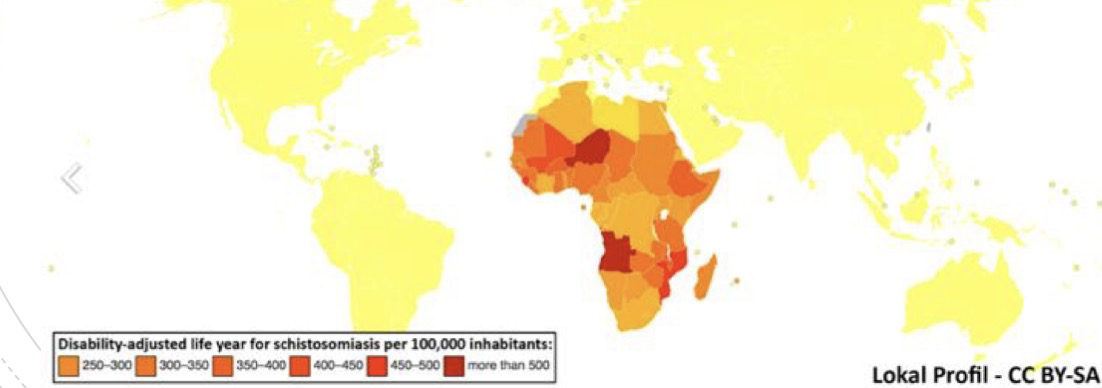
Snails, inc. Biomphalaria (see left) are hosts of bilharzia (causes schistosomiasis).
The disease affects 250 million people annually worldwide.
It is classed as a hugely damaging “neglected tropical disease” (i.e. a tropical disease that receives far less funding than the “big 3” (HIV, tuberculosis and malaria).
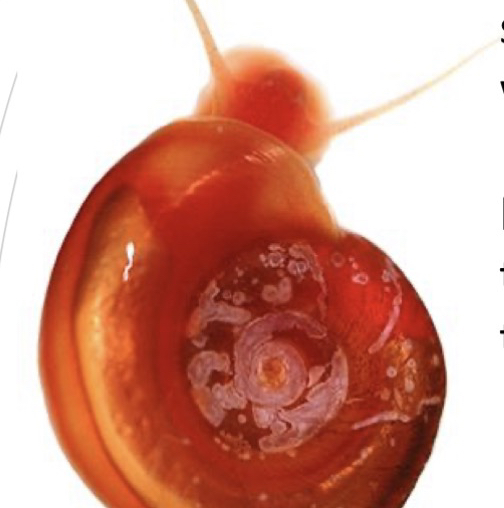
SNAILS
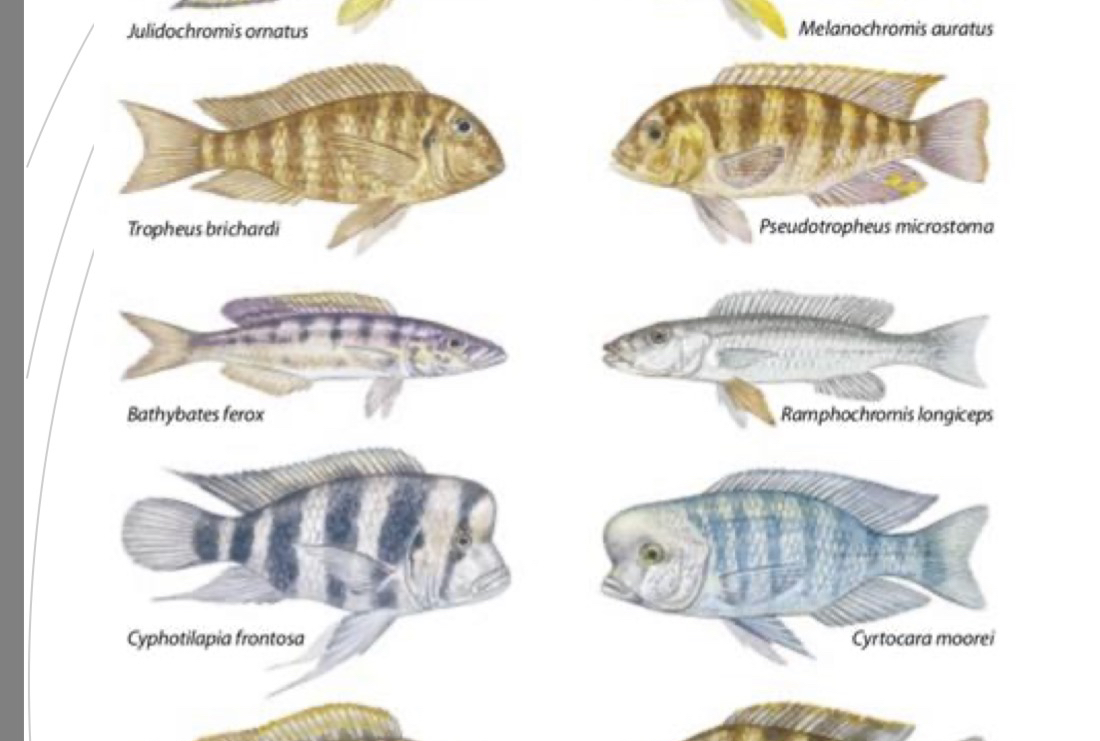
Cichlids
Remarkable adaptive radiations and convergent evolution of very similar physiologies in African Great Lakes.
All LT cichlids more closely related to each other than all LM cichlids and vice versa, yet evolved remarkable similarities, see left.
LV used to have c. 500 to 600 ENDEMIC
Haplochromine cichlid species. Almost all evolved after last dry period (c. 17,500 to 14,700 years ago) when a few species entered the lake
Cichlids
LV cichlids then underwent the quickest largest SPECIATION (radiation) to fill different ecological niches ever observed in nature.
LV cichlids descend from a long ago interbreeding of Upper Nile and Upper Congo cichlids.
An estimated 50% of LV cichlid species vanished in/since 1980s: they’re disappearing 10x faster than they can be described.
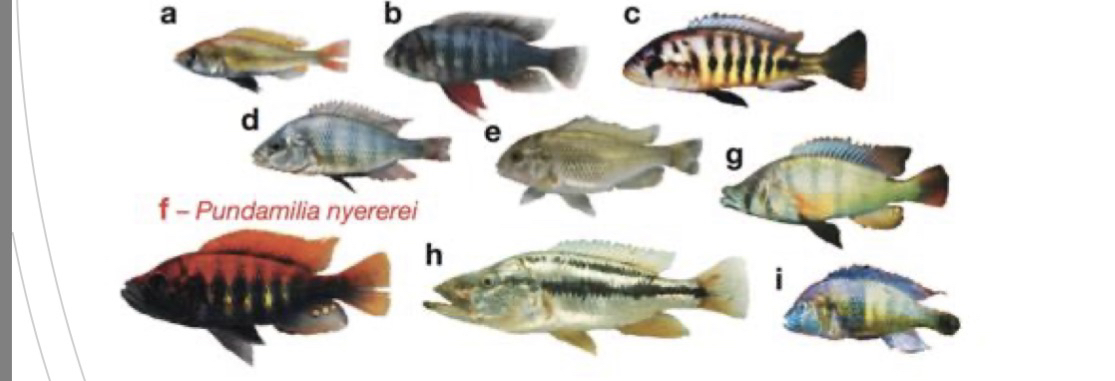
Many cichlids have lost ability to differentiate between a brightly coloured male of their own species and another, because of lowered clarity water: hybridisation more likely.
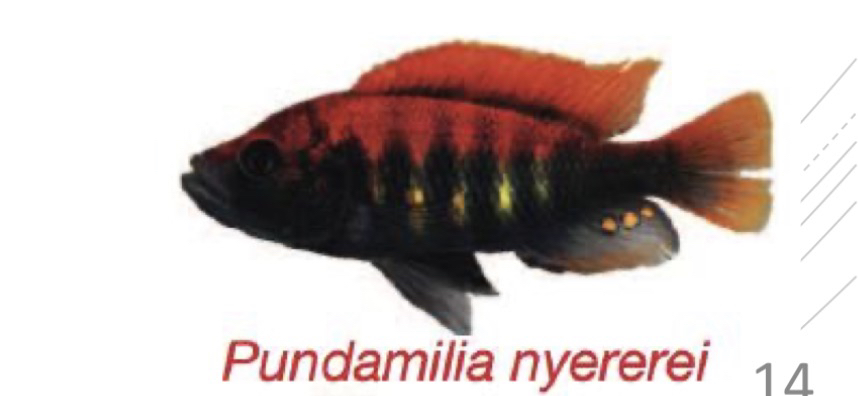
Pundamilia nyererei is still common. Its eyes are particularly sensitive to light, especially red. Red colours are less affected by decreased water clarity.
One source of lowered water clarity: increased erosion caused by deforestation, related to need for firewood to preserve Nile perch (by smoking).
Nile Perch, Lates niloticus
Introduction suggested 1920s onward:
warned about by conservationists: no predator of Nile Perch in LV.
Introduced 1950s for commercial fisheries.
Voracious predator, thought to be largely responsible for steep decline of native cichlids (50% of species lost).
1955: Nile Perch introduced to Lake Victoria
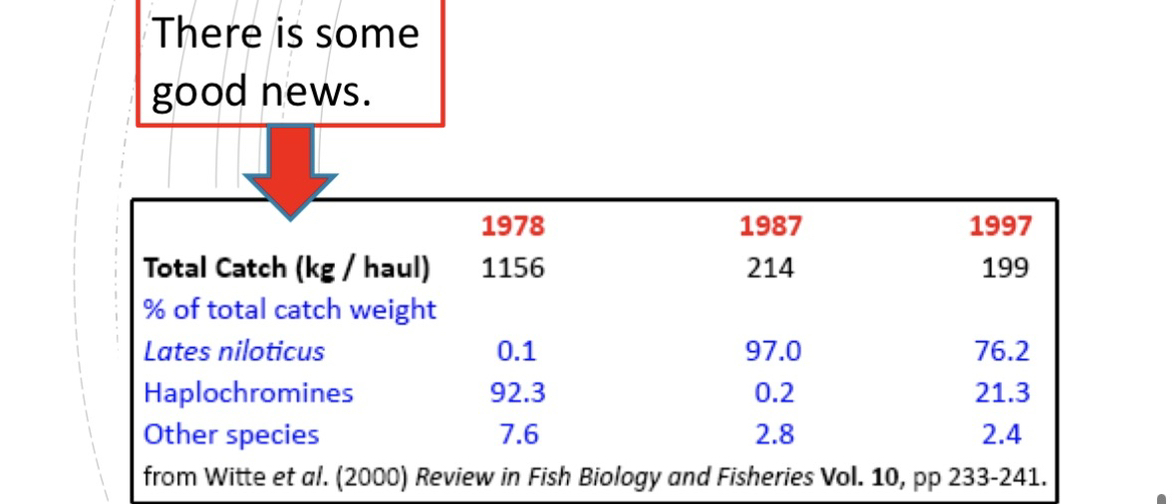
1969-70: Haplochromine cichlids: 83% biomass. Nile perch: 0.05%
1980s: Nile perch: 80% biomass. Haplochromine cichlids: <1%
Early 1990s: peak LV Nile Perch yield : c. 500,000 tonnes per annum
Removal of alga-eating cichlids has increased algal loads, raising the amount of deep water organic detritus and so reducing O2 levels except at the surface: Lake Victoria has lost a huge amount of its deep water biota.
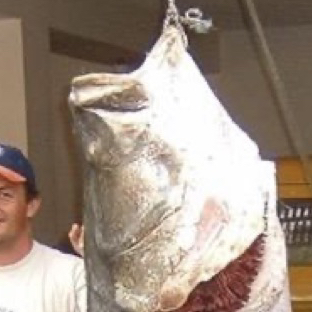
its q very big fish
Nile Perch, Lates niloticus
Local fisheries previously depended on endemic lungfish, tilapia, carp and catfish:
these. In recent decades these yields have been negligible.
Nile perch:
- readily destroy locals’ fishing gear,
- require smoking for preservation (this increases local deforestation),
- are not popular amongst local people.
Therefore much is exported to wealthy countries, with locals seldom receiving much income from this.
Having devastated the cichlids in a few decades, Nile perch are declining and increasingly cannibalistic: they are likely not a huge source of food forever, anyway.
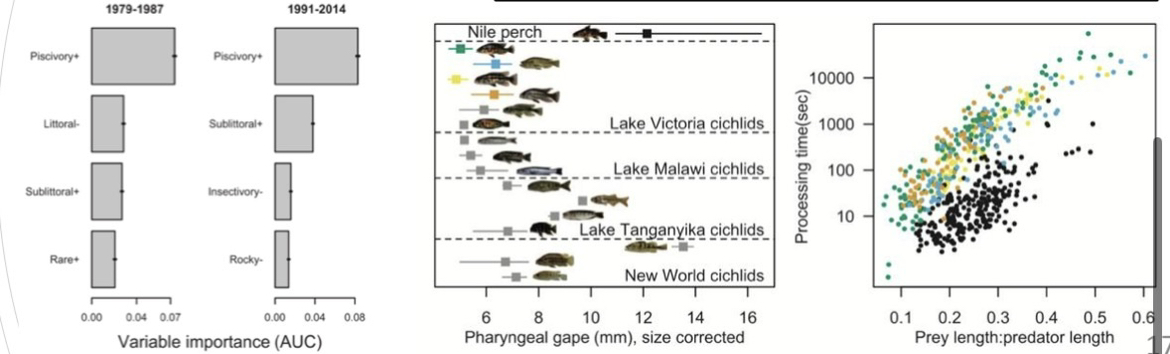
The adaptations that made cichlids so adaptable in Lake Victoria left them with abnormally small pharyngeal gapes (see centre),
so they cannot swallow large prey as rapidly as Nile Perch can (see right).
Piscivory (fish-eating) is the dominant factor for predicting cichlid extinction (see left). So perhaps the Nile perch didn’t so much eat the cichlids, as out - eat them?
Lake Victoria Fisheries
LV has Africa's largest inland fishery (as of 1997).
Used to be made up of native species. Some had already declined in early 20th century due to overfishing.
Since 1955 (see above) another major problem developed.
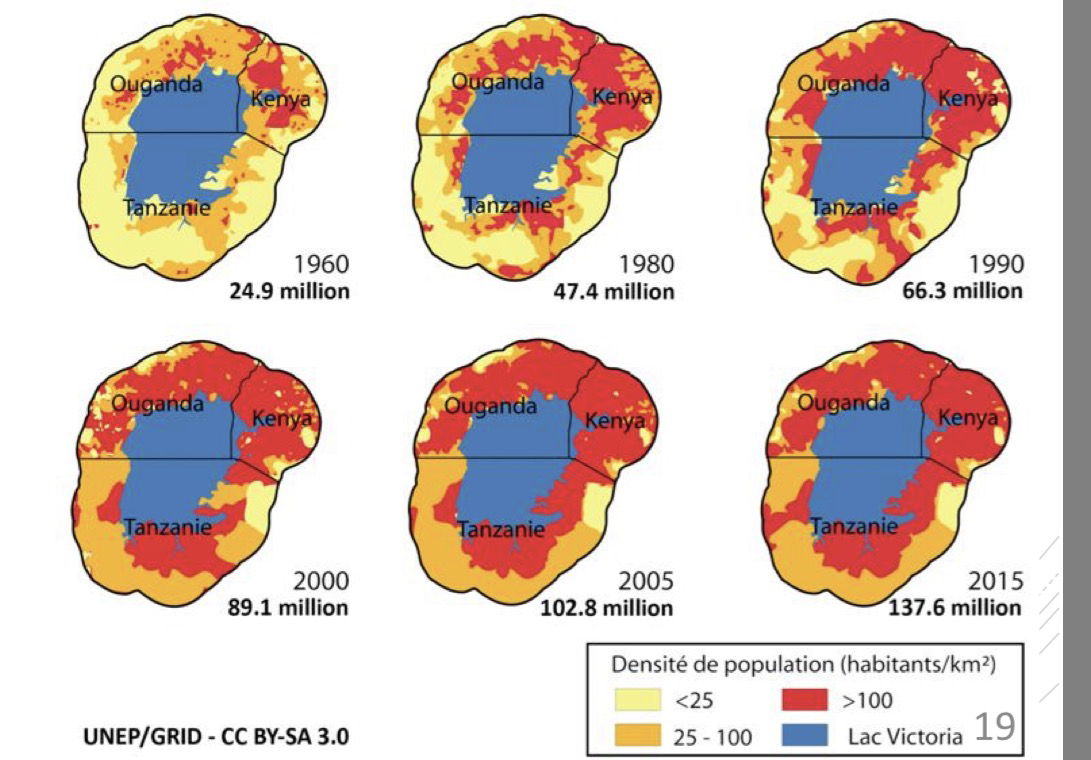
Human Population Changes
Collapse in locally available fish coincided with major increase in human population density around LV.
The sum of the total populations of Uganda, Kenya & Tanzania is included (see right). It has risen 450% in 55 years.
If LV basin population scales with 3 nations’ total population then LV basin population has risen from 7 to 40 million in 55 years.
Water Hyacinth – The Invasion
Native to South America. A major threat to LV. Introduced by Belgian colonists to Rwanda to beautify garden and parks.
Had spread naturally to Lake Victoria by 1988.
Few local herbivores consume it. Abundant space and resources boost its growth, hence > exponential growth.
Grows rapidly, and is remarkably resilient: can grow at many temps, in a 2.5 pH range and in brackish water.
Contains beneficial N-fixing bacteria and has prickly crystals, hydrogen cyanides, alkaloids and triterpenopids for defence.
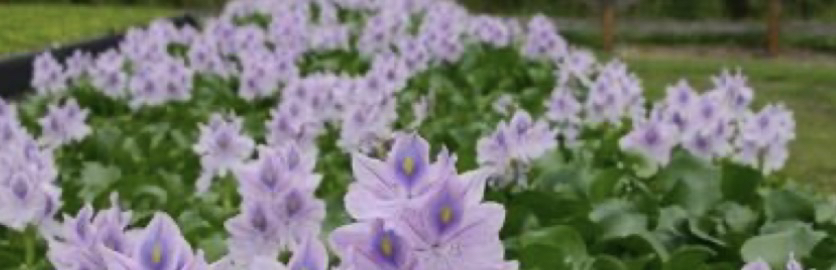
-Crowds out native vegetation.
-Removes O2 from water when it rots: effect can kill fish.
Its presence promotes disease vectors inc.
mosquitoes and snails that cause rashes, malaria, encephalitis, schistosomiasis, etc.
Absorbs vast quantities of H2O so can greatly reduce lake volume.
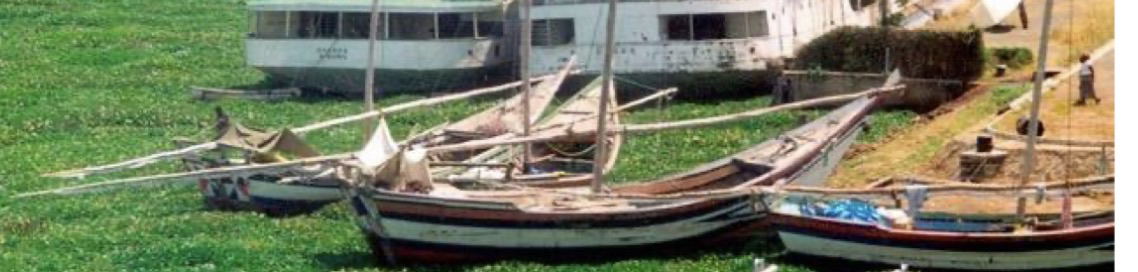
Has clogged ports inc. Kisumu (left): a city with 1.5 million inhabitants!
Reaches 40,000 tonnes/km3 in India! If 5% of Lake Victoria were covered: 138 million tonnes of water hyacinth.
Water Hyacinth: Control Efforts
Physical extraction & removal.
-A weed-clearing machine can only clear approx. 10 hectares per day. On decomposing at a dumping site, it releases CO2, CH4, and nitrogen oxides.
Chemical methods.
-Expensive and likely to have very damaging ecological side-effects.
Biological Control.
inc. water hyacinth weevil used in c. 35 countries.
Introduce Hippos?!
- This failed to pass through the US Congress by just a single vote in 1910!
Negative Frequency Dependent Selection in a Lake Tanganyika Cichlid
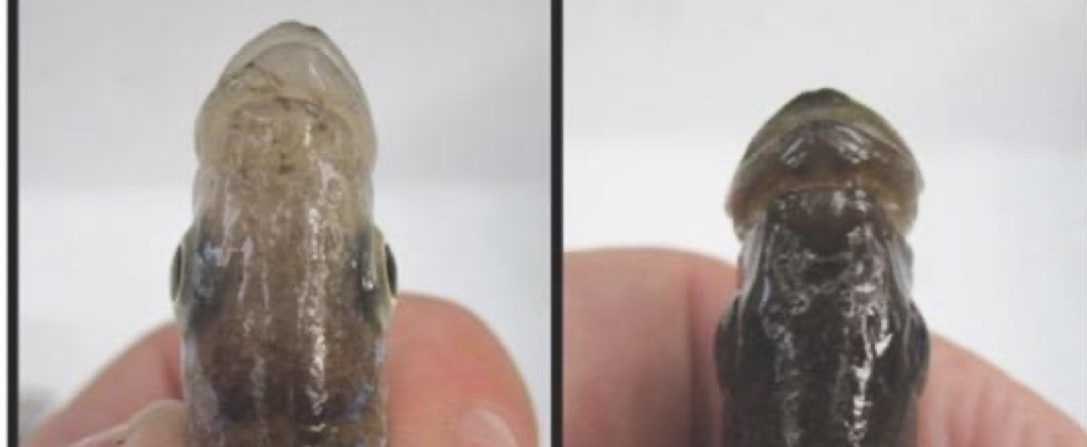
P. microlepis is a scale-eating parasitic cichlid.
Each individual’s mouth bends to L (good at attacking hosts to L) or R (good at attacking hosts to R).
Hosts dislike having scales bitten out of them (no surprise!) and look mostly left or right, depending on which type of P. microlepis is locally common.