Learning and Memory
Long Term Potentiation (LTP)
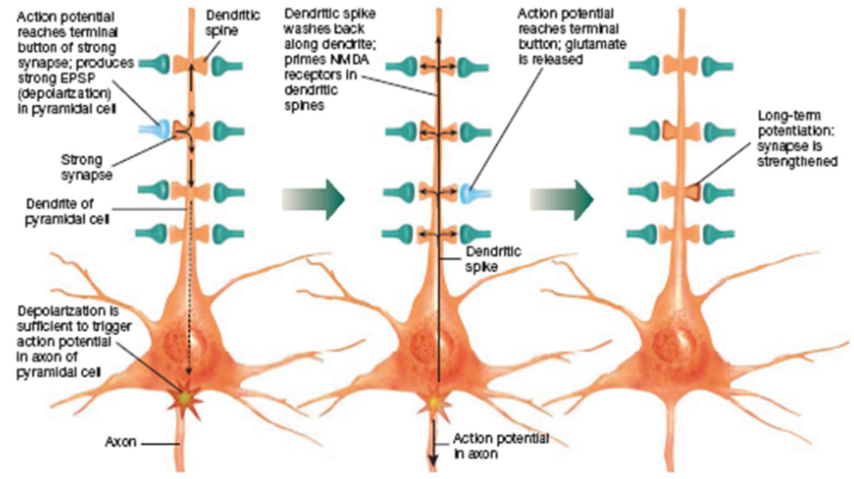
The process where a weak synaptic input pathway strengthens its connection by being activated at the same time as a strong, neighbouring input pathway
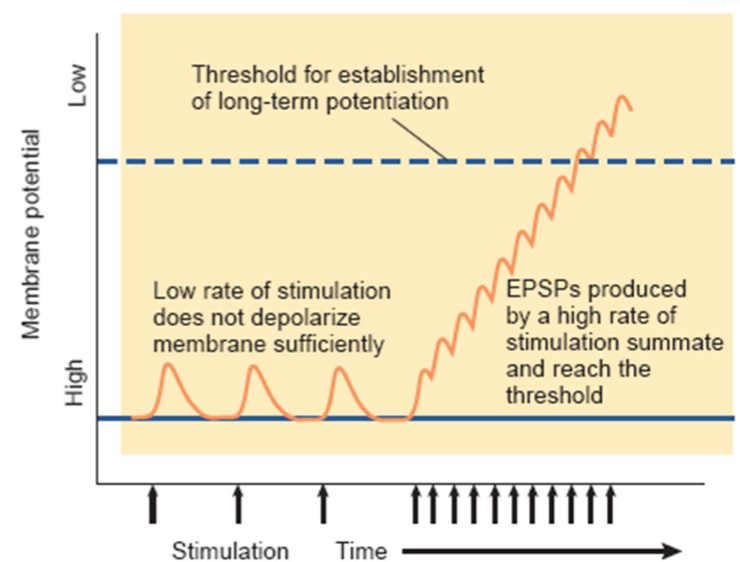
Long-term increase in excitability of neuron caused by repeated high-frequency activity of that input
Achieved at postsynaptic terminal via excitatory postsynaptic potentials (EPSPs)
Requires high frequency to create summation
Hebbian or Associative Learning
Hebb’s rule (Donald Hebb, 1949) → “Cells that fire together, wire together”
The theory → Any two cells or systems that are repeatedly active at the same time will tend to become ‘associated’ so that activity in one facilitates activity in the other.
This causes changes in structure or chemistry of synapse making them stronger and more likely to produce EPSPs
LTP and Hebbian Learning in Action
Hippocampus - Entorhinal cortex region
Stimulate the perforant path axons
High frequency train of stimuli to increase EPSPs amplitude
Resulting EPSPs recorded in dentate gyrus
Pre and postsynaptic cell become active at same time
Known as ‘population EPSP’ – synapses of perforant path axons and dentate granule cells.
Synaptic strengthening occurs when synapses are active, and membrane of the postsynaptic cell is depolarized
Glutamatergic System, NDMA Receptors and LTP
in the hippocampus → CA 1 field
NDMA receptor control calcium ion channel → cause post-synaptic depolarisation
Typically blocked by magnesium → prevents influx of calcium when activated by glutamate
Depolarising postsynaptic membrane ejects magnesium and calcium ions to enter through NMDA controlled receptor
Voltage dependent ion channel
Pre- and Post-synaptic changes due to LTP
Presynaptic
Increases amount of Glutamate → Nitric oxide, a gas neurotransmitter, communicates retrograde messages from one cell to another
Free floating nitric oxide activates nearby dendrites to produce LTP induction
Postsynaptic
Changes in size and shape of dendrites
e.g. enlargement of thin dendrites into mushroom shaped ones
Growth continues up to 19hrs later

Amnesia
Anterograde amnesia
Difficulty in learning new information
Deficit in complex relational memory
Damage to temporal lobes → patient HM
Reterograde amnesia
Inability to remember events before the brain damage occurred
Korsakoff’s syndrome
Severe anterograde amnesia
May be caused by alcoholism
Patient HM
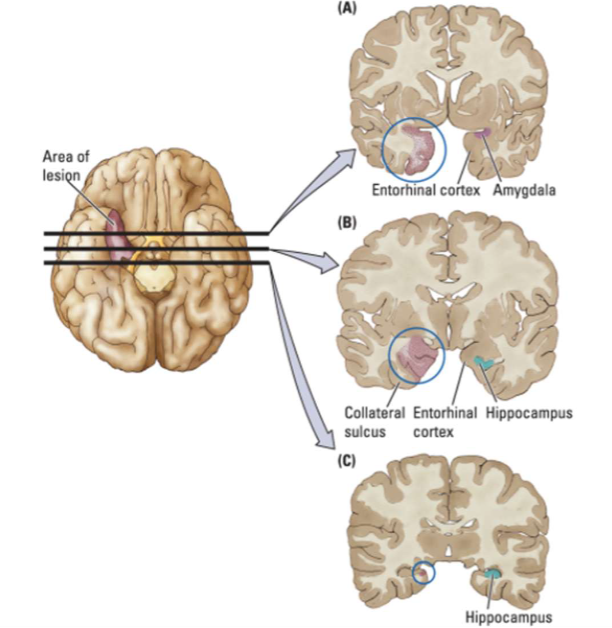
What we can learn from this
Hippocampus is…
Not the location of LTM or retrieval of LTM - HM remembered events from early life and could talk
Not the location of STM - HM would not have been able to carry on conversations
Involved in converting STM to LTM
STM of event retained by neural activity, with LTM in permanent biochemical or structural changes e.g. LTP
Morris Water Maze
A behavioural test used in neuroscience, primarily with rodents, to study spatial learning and memory.
The procedure involves a pool of opaque water with a submerged escape platform. The animal must use external cues in the room to locate the platform, and its performance is assessed by tracking how quickly it finds the escape route over multiple trials.
part 2 not uploaded yet