BBC Radio
Component 1 Section B Radio Industry
With Radio, you might get asked on:
Historical, industrial and social/cultural context ownership
Funding and its importance in the creation, distribution and production of media products
Regulation
The impact of technology
Global production and distribution
PSB- Public Broadcasting Service
Niche Audience- A niche audience is a relatively small audience with specialised interests, tastes & backgrounds.
Mainstream Audience- A broad audience. A text with mainstream appeal will appeal to a broad range of people.
Global Audience- Audiences from around the world. In the digital age, distributing to global audiences is much easier but it means constructing texts that may have more global appeal.
BBC
The British Broadcasting Corporation (BBC) is a public service broadcasting corporation of the United Kingdom.
The BBC is the worlds oldest national broadcasting organisation and the largest broadcaster in the world.
It’s main responsibility is to provide impartial PSB in the UK.
BBC deals with products such as broadcasting, radio & web portals.
The BBC was formed on 18 October 1922.
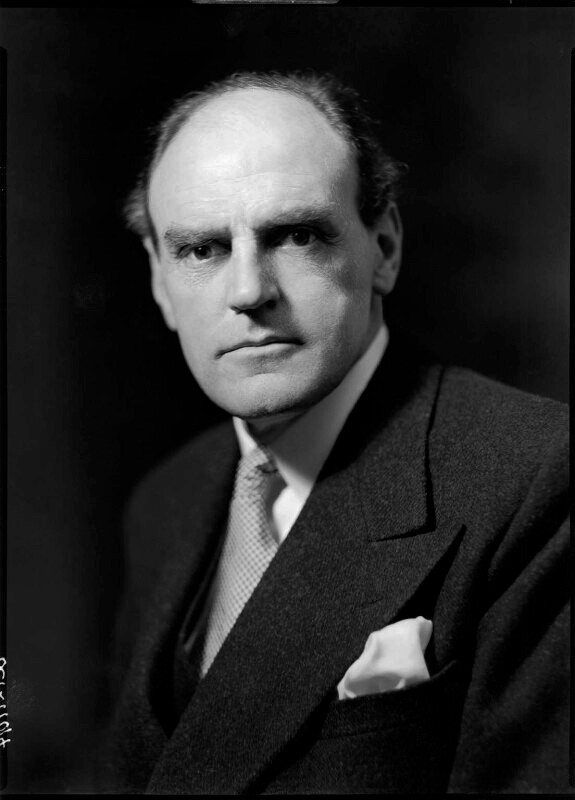
John Charles Walsham Reith became general manager of the BBC on 14 December 1922.
There were no rules, standards or established purpose to guide him.
Lord Reith wanted the BBC to belong to the British Public.
John Reith- BBC Founder | What he believed |
|---|---|
|
|
BBC Charter/ Royal Charter
The Charter includes both a mission & a purpose.
The BBC’s mission is:
‘‘To act in the public interest, serving all audiences through the provision of impartial, high-quality & distinctive output & services which inform, educate & entertain.’’
This is reflected in their purposes which are:
To provide impartial news & information to help people understand & engage with the world around them.
To support learning for people of all ages. e.g. BBC Bitesize
To show the most creative, highest quality & distinctive outputs & services. e.g. smaller creators
To reflect, represent & serve the diverse communities of all the United Kingdom’s Nations Regions & in doing so, support the creative community across the UK. Similar to Channel 4.
To reflect the United Kingdom, its culture & values to the world.
What is PSB today?
The BBC is totally subject to PSB rules:
No adverts – only trailers for their own shows
Funded by the licence fee (£169.50 per year)
This pays for 9 TV channels (BBC1,2,3,4, HD, CBeebies, CBBC, News and Parliament), national radio (BBC1 to 7, 1Extra, 4extra, 5live Sports Extra, Asian Network) and around 40 local radio stations, plus huge online presence – iPlayer, etc)
Public Service Broadcasting vs Commercial Broadcasting
PSB | CB |
|---|---|
Public Service Broadcasting is owned by the public. | Commercial Broadcasting is privately owned by media firms, private limited companies & more recently by corporate houses. |
Serve the public. | Make money. |
Licence fee. | Advertising/Horizonal Integration. |
They do not make profit e.g. through commercials/adverts |
Does the BBC serve Diverse Communities?
The BBC is too white and middle-class.
In 2017, an Ofcom report stated that there was too little diversity both on and off-screen. young people and ethnic minorities felt particularly alienated from BBC content.
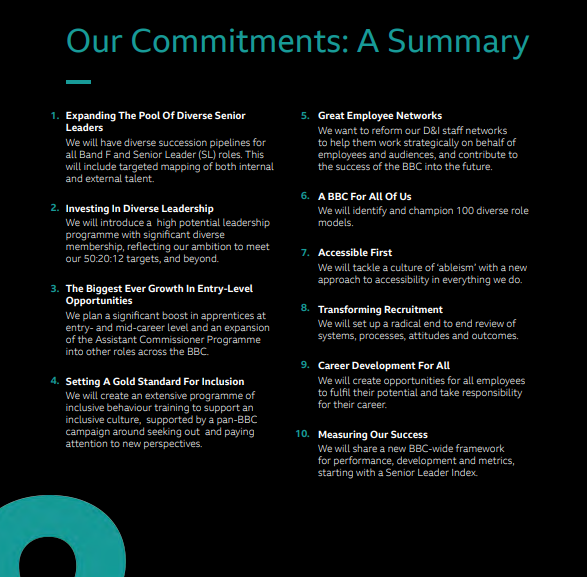
In 2021 Diversity and Inclusion Plan was launched – employment and content.
Part of this strategy is to have a 50:20:12 target;
i.e. 50% of the workforce to be women, 20% POC and 12% disabled.
BBC Sounds
|
|
Historical contexts:
• The BBC is often accused by its critics of being too white and middle-class. In 2017, an Ofcom report stated that there was too little diversity at the corporation, both on and off-screen. It also reported that young people and ethnic minorities felt particularly alienated from BBC content.
• In 2021, the BBC launched a Diversity and Inclusion Plan, overhauling recruitment and commissioning content that “authentically and accurately represents diversity in the UK”.
• Part of this strategy is to have a 50:20:12 target, i.e. 50% of the workforce to be women, 20% people of colour and 12% disabled
REGULATION
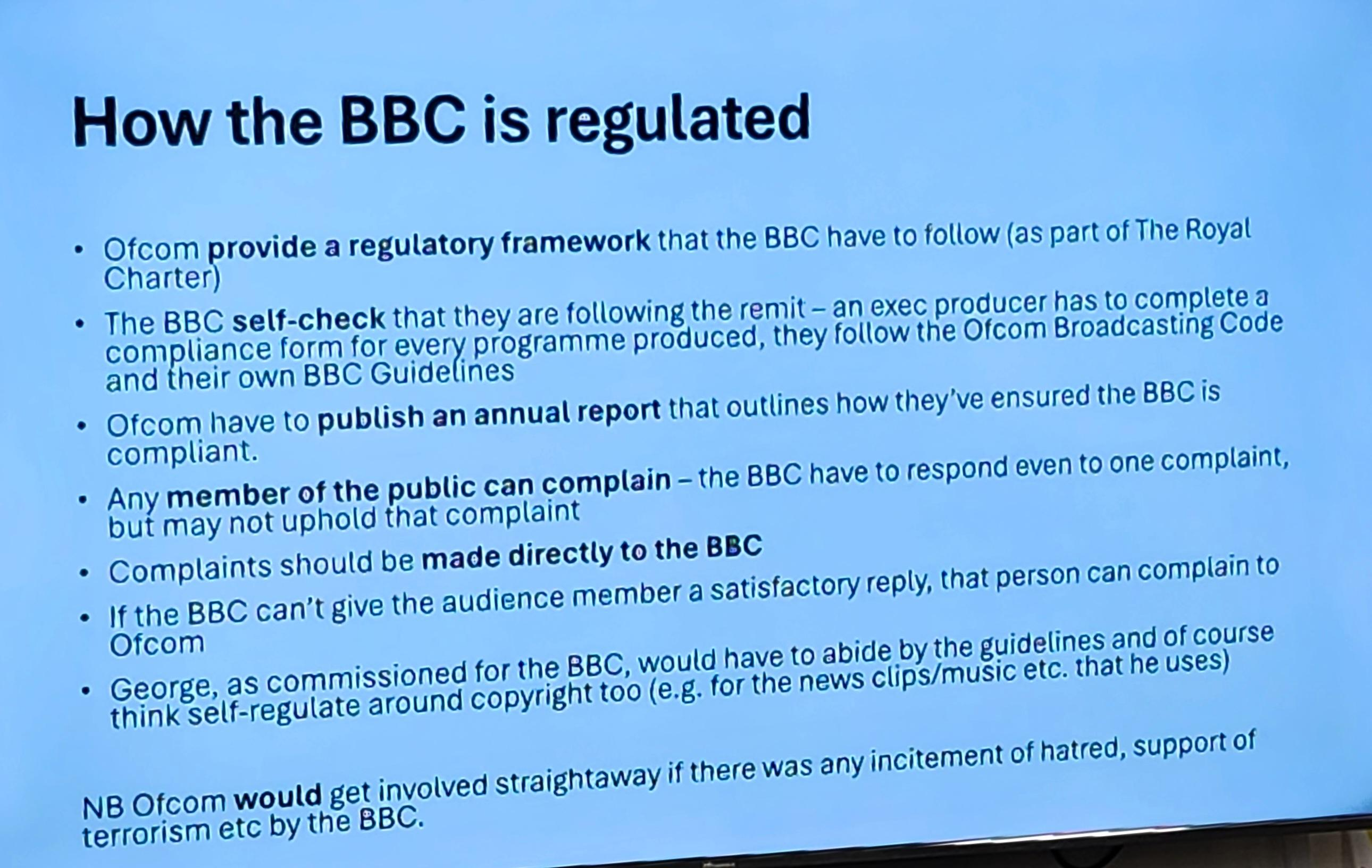
gOVERNED BY THE rOYAL cHARTER- REMIT TO ‘INFORM, EDUCATE AND ENTERTAIN’ SET DOWN BY lORD rEITH (oFCOM CHECK IT IS ENFORCED)
% of it shows have to be produced outside of M25/London and they have to show the cultural diversity of the UK and the regions of the UK
Have to produce shows utilising talent from across the UK
Programmes for all kinds of specialist groups due to funding by license fee
The BBC mainly regulate themselves- they check they are following Ofcom guidelines and their remit-editors are involved
Ofcom ensures that the BBC conform to their remit/public duty, as per the requirements of The Royal Charter
The public can complain so they play a part in the regulatory role
The govt can pass bills that then impact on the BBC and Ofcom e.g. with it’s new Online Safety Bill
NB Ofcom regulate commercial radio stations directly
BBC need to be accountable to license fee payers and play a key democratic role
REGUALTION PROCESS