ID 4741: Exam 2 Notes (Darius Email)
For Part I (8 IDs - Remember, a minimum of 4 identifiers needed: (1) architect’s/designer’s/artist’s name, if applicable, (2) title, (3/4) location (if architecture) or technique/material (if furniture, art, artifacts), (5) approximate date:
African materials: A view of a structure, interior space, or an architectural component (e.g. a door frame)
Renaissance: Two IDs, one of a piece of furniture for seating, the other of an interior with wooden paneling
Baroque: 2 or more IDs; know the Vatican and Versailles and their spaces and interiors; Know what Boulle-type furniture is. One piece of furniture associated with Versailles, but Louis XV
Rococo: Definitely an emphasis. ID of three interior spaces in France and German-speaking countries. Includes Vienna and Würzburg. Know what Boulle-type furniture is. In addition (see above, Baroque): one piece of furniture associated with Versailles, but Louis XV
Neoclassicism: One example of the plans for Utopian architecture and interiors by Ledoux and Boullée (b/w prints); Percier and Fontaine’s Empire interiors for Malmaison
(British and U.S. materials from lecture 14 are NOT on the test.)
Revival styles of the 19th century (still to be covered this week): one ID, dealing with a famous interior using cast iron architectural elements
For Part II (2 sets of Images, ID as in Part I & short Compare and Contrast essay):
All 4 views are interiors, their description included above, under Part I
For the first pair: one Baroque and one Rococo interior, France and Austria
BAROQUE ROCOCO INTERIORS:
Rococo style: Rocaille (small shell) incorporates shell decorations and features heavy ornamentation, with individualism enforced through asymmetry.
FRENCH ROCOCO INTERIORS:
By the time of the French Revolution, the Rococo Style is spread to the bourgeoisie and to the working classes.
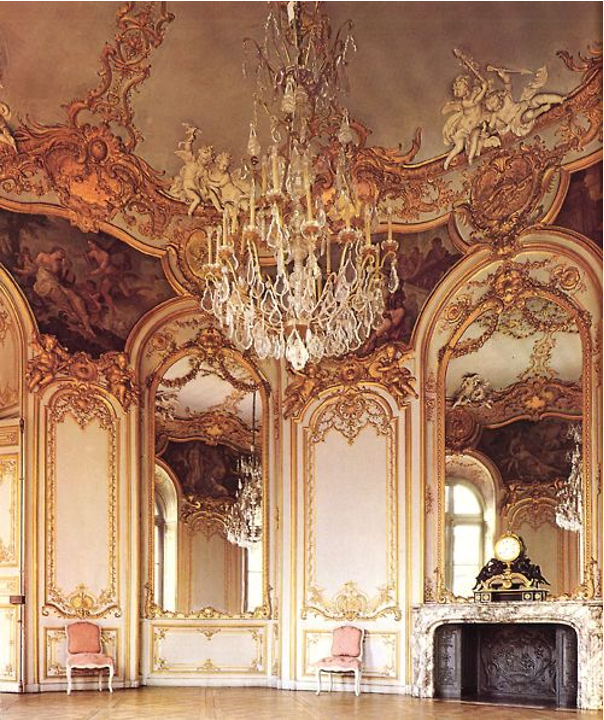
Salon de la Princesse, Germain Boffrand, Hôtel de Soubise, Paris, 1737-1740
“ we are approaching the dawn of modernity.”
Pleasure, sensuality, and indulgence in luxury become fashionable. Music, making theater, and paintings play new and important roles in lifestyle. An absence of worries and timelessness is emphasized.
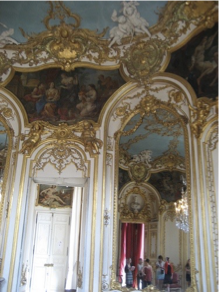
Hôtel de Soubise, Paris, 1737-1740
gilded plaster moldings and has a strong contrast with the blue ceiling that imitates the sky. Mirrors used as a luxury fashion aesthetic started in Versailles.
For the second pair: one Rococo and one Empire (Napoleonic) interior, both French
Hôtel de Soubise, Paris, 1737-1740 NAPOLEONIC TOO
gilded plaster moldings and has a strong contrast with the blue ceiling that imitates the sky. Mirrors used as a luxury fashion aesthetic started in Versailles.
For Part III, essay: see the topic choices on Moodle. Choice between two topics on the exam.
Be familiar with Boucher’s The Breakfast, for instance.
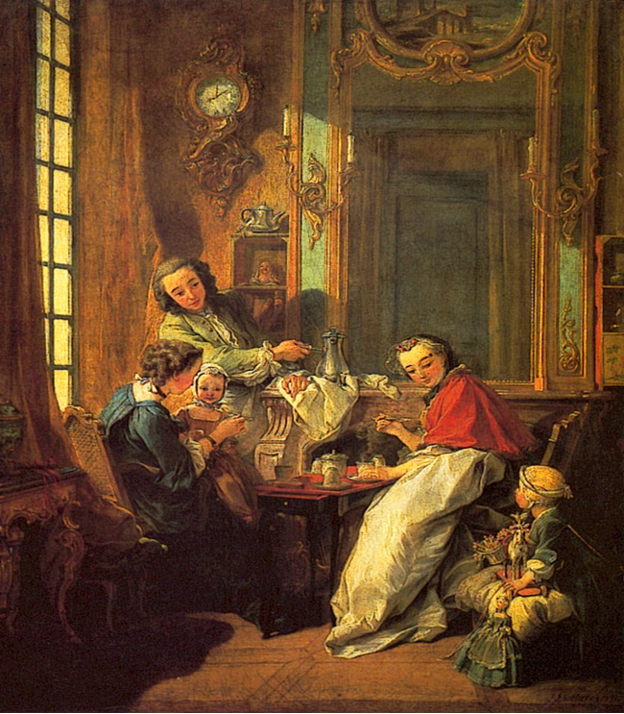
Le Dejuner (The Breakfast), oil painting, Francois Boucher, 1739
The enlightenment period during the 17th and 18th century. during this period, there was a revaluation on childhood and is recognized as an important stage in human development.
Boucher broke the common rose-colored nudes with this painting.
The scene is of the Boucher’s family life with his wife and 2 daughters. The interior is upper bourgeoisie and not aristocracy. He was financially successful as an artist and was able to afford a well-off bourgeois lifestyle.
The setting is a boudoir: a room between a living room and bedroom. This had a greater sense of intimacy and is a smaller space.