Lipids
What elements make up lipids?
- Carbon, hydrogen and oxygen
What functions do they have?
- Waterproofing, energy stores, Insulation
What makes up lipids?
- Fatty acids and glycerol
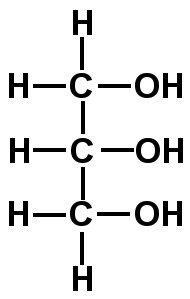
- Glycerol's structure
- Standard fatty acid

- Saturated fat
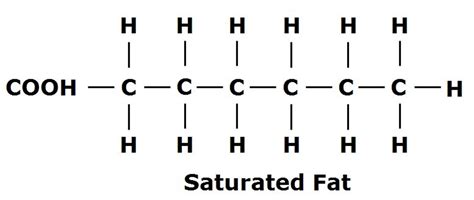
- What does saturated mean - every carbon is joined by single bonds
- What does unsaturated mean - at least one C=C bond
- Polyunsaturated - the term for Multiple C=C bonds?
- Most plant fat's are unsaturated and most animal fat's are saturated
What is a triglyceride?
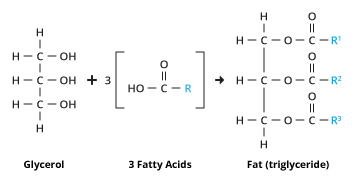
- A molecule mad up of a glycerol and 3 fatty acids
- How do they bond together - By condensation reactions
- What is this bond called? - An ester bond
- The reaction occurring
- What makes lipids good as energy stores?
- They can be oxidized during respiration to release energy
- They release more than 2x the energy of carbs
- Energy is released more slowly (sustained)
- Hydrophobic - no osmotic effect on cell
- What makes lipids good a waterproofing and how?
- Hydrophobic as the lipid tail is non polar and water is polar
- Oil is used in fur/feathers of animals whereas plants use wax
- What makes lipids good insulators?
- Poor conductors of heat
- Fat reserves have poor blood supplies so little heat gets released to the fat
- Myelin is a lipid and as it is non polar it prevents the passage of hydrophilic ions (eg Na & K and others dissolved in water) and this results in insulation and faster conduction down nerve fibers
Phospholipids
- Formation
- one of the fatty acids is substituted for a phosphate group
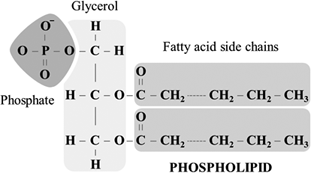
- Some of the fatty acid chains may be unsaturated creating kinks preventing tight packing resulting in fluid like motion
- Why is the membrane selectively permeable?
- Due to the polar head an the nonpolar tail it prevents polar molecules (i.e ions in water) moving through (unless the cell creates special structures to allow this which it can regulate) but lipid soluble ions can pass between the cell and the outside unaffected
- Why are phospholipids special?
- They have a hydrophilic (polar)[water loving] head and a hydrophobic (non polar)[water hating] tail, this allows them to form phospholipid bilayers which make up cell membranes.