week 11 - episodic memory
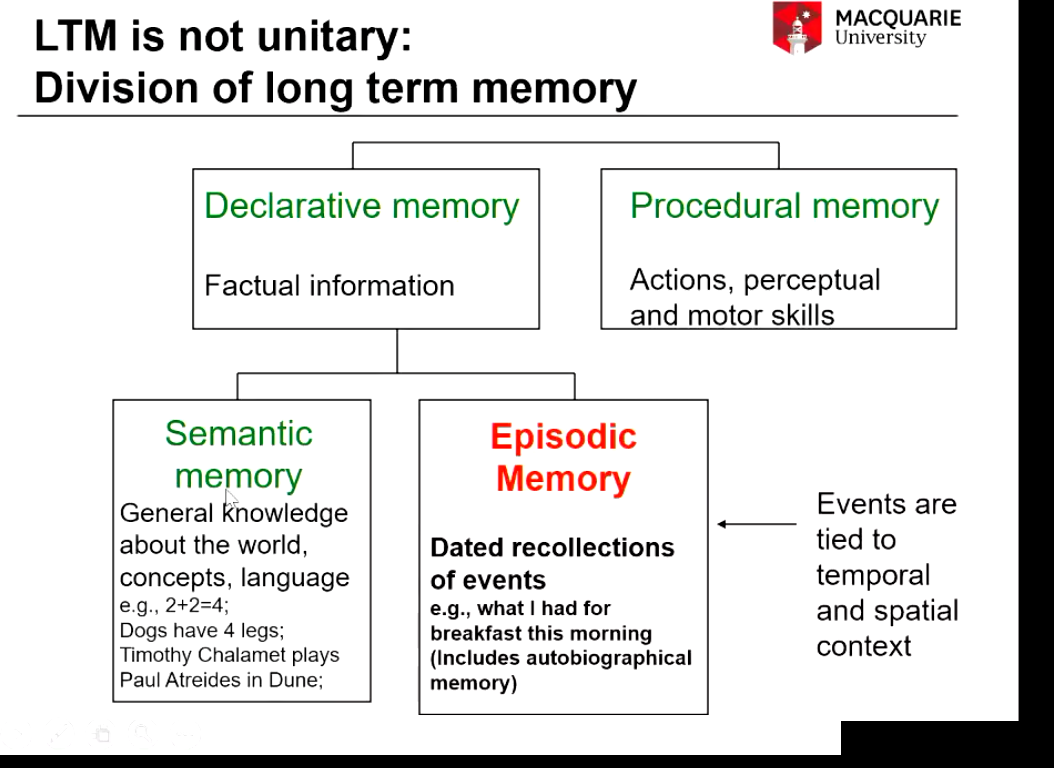
events that are temporal and spacial context - autobiographical memory
memory processing:
encoding - transformation into a suitable format
retrieval: getting the info out of storage
Generative = summarising, concept mapping which is deeper processing
non-generative = verbatim copying = shallow processing
Limitation of LOP1:
levels don’t determine everything - whether the item or orienting question requires a YES or NO question
LOP that require a yes answer is bigger than compared to NO
Spread of processing (elaboration - words than don’t fit the sentence can be elaborated) - elaboration makes the item more distinctive (unique)
Limitation of LOP2:
bunch of non verbal stimulis; whole bunch of doors, whole bunch of clocks and then menu items (ingredients pea and bacon soup etc)
2 non verbal + verbal
2 levels of processing
deep processing - pleasant vs unpleasant
shallow processing - bigger than the standard clock, door and more than 3 words
found that the non verbal items did not have LOP
levels of processing is much more smaller for non verbal - more effective for non verbal items than verbal (another limitation of LOP)
Retrieval:
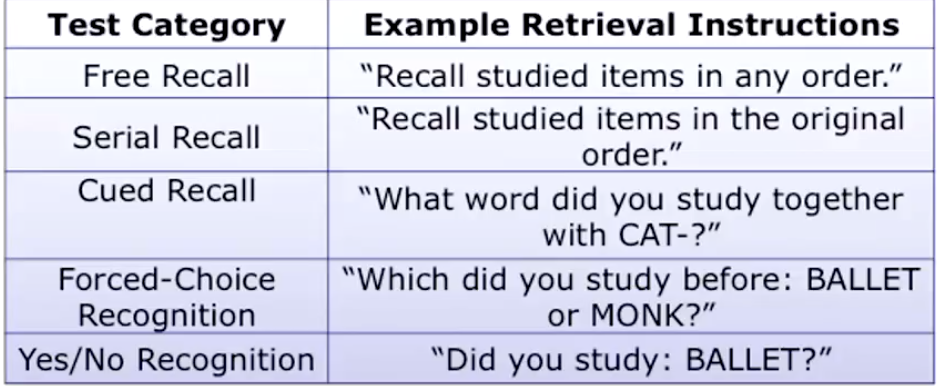
encoding specificity principle (Tulving 1978)
cue dependent forgetting; forgetting occurs when there is a poor match between memory-trace info and infor available at retrieval
memory performance is better when the context at encoding (study) and the context at retrieval (test) match
ENVIRONMENTAL CONTEXT STUDY
Godden and Baddeley (1975): Conducted an experiment with divers, where participants learned lists of words either on land or underwater. Results showed that recall was better when the learning and testing environments matched, emphasising the role of environmental context in memory retrieval.
recall vs recognition
recall is self generating and recognition is retrieval cues
Implicit memory and amnesia
picture identification test
word fragment completion test
word stem completion test
repetition priming - better performance as a result of prior exposure
AMNESIA
retrograde vs anterograde amnesia
ANTEROGRADE
inability to retain new facts (learned since trauma)
intact STM
can learn new skills
show repition primig in implicit memory tests