3.06 Social-Emotional Development Across the Lifespan
Essential knowledge)
Explain how social development relates to behavior and mental processes
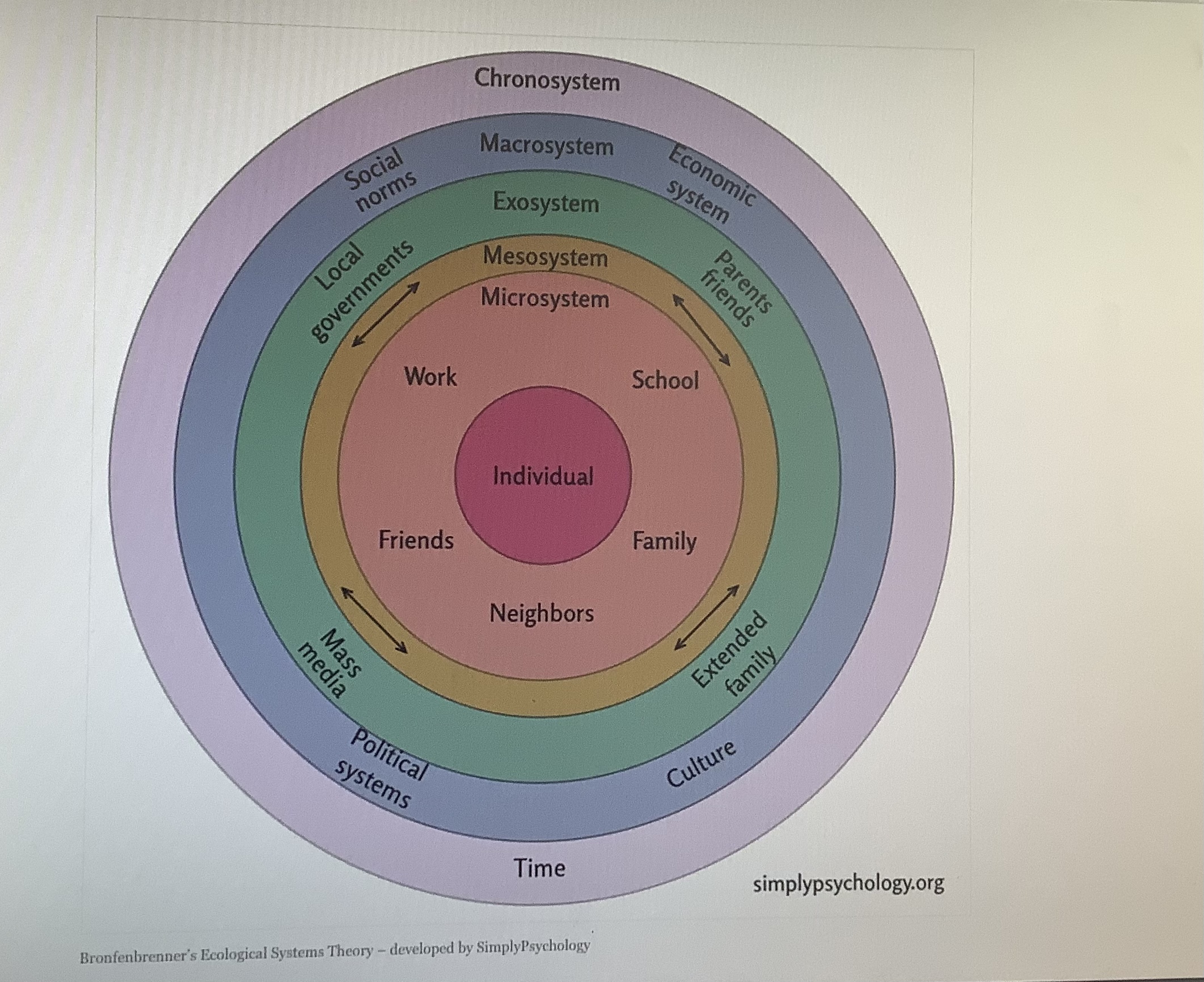
3.6.A.1 = the ecological systems theory explores how the social environment influences development. The five systems in this theory)
microsystem = groups that have direct contact with the individual
mesosystem = the relationships between groups in the microsystem
exosystem = indirect factors in a individual’s life
Macrosystem = cultural events that affect the individuals and others around them
chronosystem = the individual’s current stage of life
3.6.A.2 = Research has identified different parenting styles of caregivers, authoritarian, autrhoritative, and permissive. Cultural differences exist in ways these parenting styles affect outcomes in caregivers and children.
3.6.A.3 = Research has identified different attachment styles demonstrated by infants and children, which vary by culture. The types of attchment infants and children display include secure and insecure( avoidant, anxious, and disorganized). Temperament is related to how children attach to caregivers.
Seperation anxiety = when a children express heightened anxiety or fear when away from a caregiver or in the presence of stranger.
studies with monkeys demonstrate the importance of comfort over food in attachment
3.6.A.4 = Developmental psychologist study how peer relationships develop over time.
Children engage with peers via play (parallel and pretend)
Adolescents gradually rely on peer relationships as they age. As asolescents interact with peers, they demonstrat a type of egocentrism that is often demonstrated via the imaginary audience and the personal fable.
3.6.A.5 = developmental psychologists study how adults develop socially over time.
culture plats a role in determining when adulthood begins and when major life events occur (social clock). Some cultures allow for a time of emerging adulthood as a transition from adolescence to adulthood.
relationships with other adults result in adults forming families or family-like relationships that should provide mutual support and care. Childhood attachment styles can affect how adults form attachments to other adults.
3.6.A.6 = psychosocial development proposes taht people must resolve psychosocial conflicts at each stage of the lifespan. The stages are as follows:
Trust and mistrust
autonomy and shame and doubt
intiative and guilt
industruy and inferiority
identity and role confusion
intimacy and isolation
generativity and stag
erik erikson proposed the psychosocial theory of development
jean piaget developed cognitive theory of developement
lev vysgotsky developed sociocultural theory of development
lawrence kohl berg developed moral theory of development
ecological systems theory | proposes that our development as an individual is influenced by a series of interconnected environmental systems, from our immediate family environment to the broader soietal/cultural environment | |
microsystem |
| |
mesosystem |
|
|
exosystem | does not directly interact with the child but influences how other systems interact with the child. | ex) a parent’s stressful work environemnet affects their availability, mood, and resources, so it wields and indirect influence on the child. |
macrosystem | focuses on how cultural elements affect a child’s development
| |
chronosystem |
| ex) beginning a new school could faill into this system
|
 | ||
attachment bond |
| |
seperation anxiety |
| |
attachment styles | behavior when a caregiver left baby with stranger | behavior when caregiver returned |
secure | upset - cried when caregiver left and refused comfort from stranger | made immediate effort to physcially touch caregiver; returned to playing |
insecure-anxious | very upset and distressed | ambivalent and resentful toward caregiver |
insecure-avoidant | indifferent to caregiver leaving | indifferent toward caregiver return; may seek physical contact but then pull away |
insecure-disorganized | confusing and inconcisstent behavior with caregiver; fearful at times. | inconsistent behavior; may freeze or avoid contact with caregiver |
temperament | measure of a child’s activity level, sociability, and emotionality. Three styles of temperament
| |
easy temperament | calm and predictable | |
diffucult temperament | less predictable and more irritable | |
slow-to-warm-up temperament | hesitant to interact with new people/situations, but eventually adapt. | |
parenting styles |
| |
authoritarian | dictatorial beacsue they enforce rules upon their children and expect obedience, primarly as a means of protecting them. | insecure-anxious |
permissive | neglectful behavior toward their children, leaving children to “make thier own rules” or they may be indulgent, seeking friendships with their children and allowing them to set their own boundaries. | insecure-avoidant |
authoritative | tend to combine the tendencies of the previous two styles. They set rules and boundaries upon children, but they are not as rigid and inflexuble as authoritarian parents. This parenting tsyle encourages open communication between parent and child. | secure |
psychosocial development theory |
| |
trust vs. mistrust | ( birth-1year)
| |
automony vs. shame/doubt | ( 1-3 yrs)
| |
initiative vs. guilt | ( 3-6 yrs)
| |
industry vs inferiority | (6-12 yrs)
| |
idnetity vs. role confusion | (12-18 yrs)
| |
intimacy vs. isolation | (20-40 yrs)
| |
generativity vs. stagnation | ( 40-60 yrs)
| |
integrity vs. depsair | (60- end of life yrs)
| |
adolescent identity formation theory |
| |
idnetity confusion/ diffusion |
| |
identity foreclosure |
| |
identity moratorium |
| |
achievemnt |
| |
peer relationship development | - | |
pretend play | in which each child takes on a role in an imaginary situation | |
parallel play | in which two or more children play side-by-side without interacting | |
adolescnece |
| |
egocenterism |
| |
personal fable |
| |
adverse childhood experiences |
| |
adults |
| |