intergrated marketing comms
The Place of Useful Learning: Marketing Communications in the Digital Age Lecture 1.2: Integrated Marketing Communications
Andrew Davis
Email: andrew.davis@strath.ac.uk
Date: 26th September 2025
Overview of Marketing Communications
Marketing communications play a pivotal role in shaping how companies engage with consumers. The purpose of marketing communications can be distilled into three primary objectives:
Creating Awareness: This involves cognitive capabilities where potential consumers recognize and recall a brand or product.
Changing Attitudes: In the affective dimension, it aims to alter consumers' perceptions and feelings regarding a product or service.
Motivating Action: Behavioral changes are encouraged, driving consumers to make a purchase or engage with the brand.
Elaboration Likelihood Model (ELM)
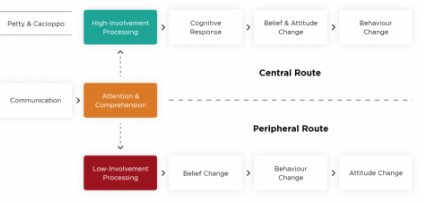
The Elaboration Likelihood Model proposed by Petty & Cacioppo outlines two distinct routes through which attitudes can be changed and signifies different involvement levels of consumers:
High-Involvement Processing: In this central route, consumers engage deeply with content, leading to a change in beliefs, attitudes, and behaviors through cognitive responses.
Low-Involvement Processing: This peripheral route relies on superficial cues leading to changes primarily in beliefs, followed by behaviors and attitudes.
Behavioral Change Stages
Attention & Communication - Initial engagement with communications.
Central Route - In-depth processing for high-involvement decision-making.
Peripheral Route - Simple cues in low-involvement scenarios.
Market Adoption Curve
The market adoption curve categorizes consumers based on their readiness to adopt new products:
Innovators (2.5%): First to adopt, characterized by risk-seeking behaviors.
Early Adopters (13.5%): Opinion leaders who embrace change swiftly.
Early Majority (34%): Deliberate adopters who adopt after seeing early adopters' success.
Late Majority (34%): Skeptical consumers who adopt due to peer pressure.
Laggards (16%): Last to adopt, often resistant to change.
Marketing Communications Mix
The marketing communications mix encompasses various tools and channels used to convey messages to consumers, including:
Advertising
Sales Promotion
Public Relations
Personal Selling
Direct Marketing
This mix is often referred to as a promotional mix, and it includes digital marketing strategies as well.
Table 1.3: Marketing Communications Tools
Different authors have categorized marketing communication tools:
Spark (2020): Advertising, direct marketing, internet marketing, sales promotion, public relations.
Fill (2013): Includes personal selling and interactive marketing amongst other tools.
Belch & Belch (2011): Adds events and experiences into the mix.
Taylor (2002): Highlights sponsorship and exhibitions.
Shimp (2010): Introduces a wider variety such as internal marketing and customer service.
Egan (2023): Expands further on digital relevance.
AIDA Model
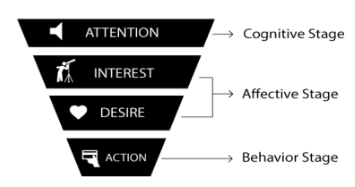
The AIDA model breaks down the marketing process into four critical stages:
Attention (Cognitive Stage): Attracting consumer awareness.
Interest (Affective Stage): Building an emotional connection.
Desire (Affective Stage): Creating a ‘want’ for the product.
Action (Behavior Stage): Prompting the purchase.
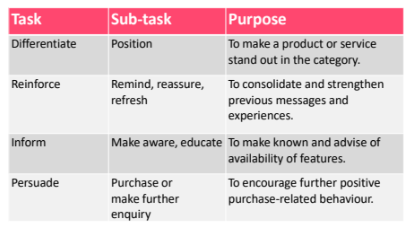
DRIP Model of Communications
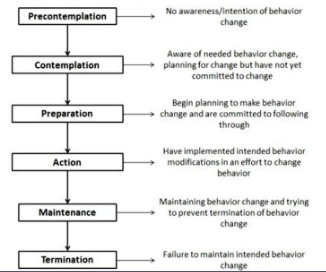
Six Stages of Behavior Change Model
Customer Journey Map Example: Online Grocery Store
Stages and Touchpoints
Awareness: Consumers become aware through word-of-mouth, traditional ads, and social media.
Consideration: Evaluation of alternatives using word-of-mouth and online comparisons.
Decision: Adding groceries to a shopping cart, finalizing order.
Delivery & Use: Experience encompasses receiving goods and customer service engagement.
Loyalty & Advocacy: Repeat purchases and sharing experiences with others.
Business Goals
Increase awareness and interest
Boost website visitors and engagement
Enhance conversion rates for purchases and reorders.
Brand Experience
It is essential for consumers to have consistent branding experiences:
Positive experiences enhance brand allegiance.
Negative reactions may arise due to inconsistent messaging or low exposure.
The concept of “wear-out” emerges when consumers become desensitized to repeated messages.
Integrated Marketing Communications (IMC)
The necessity for a cohesive strategy that synergizes various communication channels is vital. Key points include:
Coherence: Messages should logically connect with branding efforts.
Consistency: Reinforced communications that are coherent over time.
Complementarity: Each channel should work in synergy with others, leading to an overall greater impact.
Economical & Efficient: The approach should maximize resources effectively.
Effective: Achieving campaign objectives through strategic communication.
Synergistic: The collective impact of communications exceeds the sum of its parts.
Systemic: All efforts form a unified system contributing to the brand message.
Media Types in IMC
Earned Media: Refers to organic mentions and social sharing.
Paid Media: Includes traditional and digital advertising.
Owned Media: Refers to brands' platforms such as websites or apps.
Objectives of Integrated Communications
Build category desires.
Create robust brand awareness.
Improve brand perceptions.
Influence purchasers’ intentions.
Facilitate the purchasing process effectively.
Conclusion: Key Success Factors in IMC
Successful integrated communications campaigns depend on:
Complementarity - Ensuring messages supplement each other.
Continuity - Maintaining a consistent narrative flow.
Consistency - Reinforcing core messages and values across platforms.
Coherence - Ensuring logical connections across all communications.
References
De Keyser, A., et al., 2020. Moving the customer experience field forward: introducing the touchpoints, context, qualities (TCQ) nomenclature. Journal of Service Research, 23(4), pp. 433-455.
Pickton, D., & Broderick, A. (2010). WHAT IS INTEGRATED MARKETING COMMUNICATIONS? Integrating ‘integrated marketing communications’: 3 Models, 4Cs, 4Es, 4Ss, and a Profile, Academy of Marketing Conference.
Prochaska, J.O., & DiClemente, C.C., 1982. Transtheoretical therapy: Toward a more integrative model of change. Psychotherapy: theory, research & practice, 19(3), p.276.