Chapter 10: Introduction to Macroeconomics - Measuring a Nation's Income
Chapter 10: Introduction to Macroeconomics - Measuring a Nation's Income
Key Questions Addressed in This Chapter
What is Gross Domestic Product (GDP)?
How is GDP related to a nation’s total income and spending?
What are the components of GDP?
How is GDP corrected for inflation?
Does GDP measure society’s well-being?
Income and Expenditure
Gross Domestic Product (GDP) measures:
Total income of everyone in the economy.
Total expenditure on the economy’s output of goods and services (g&s).
Important Concept: For the economy as a whole, income equals expenditure because every dollar a buyer spends is a dollar of income for the seller.
Active Learning - Income Equals Expenditure
Scenario: Nalah pays James $50 to mow her lawn.
Question A: What happens with total expenditure?
Question B: What happens with total income?
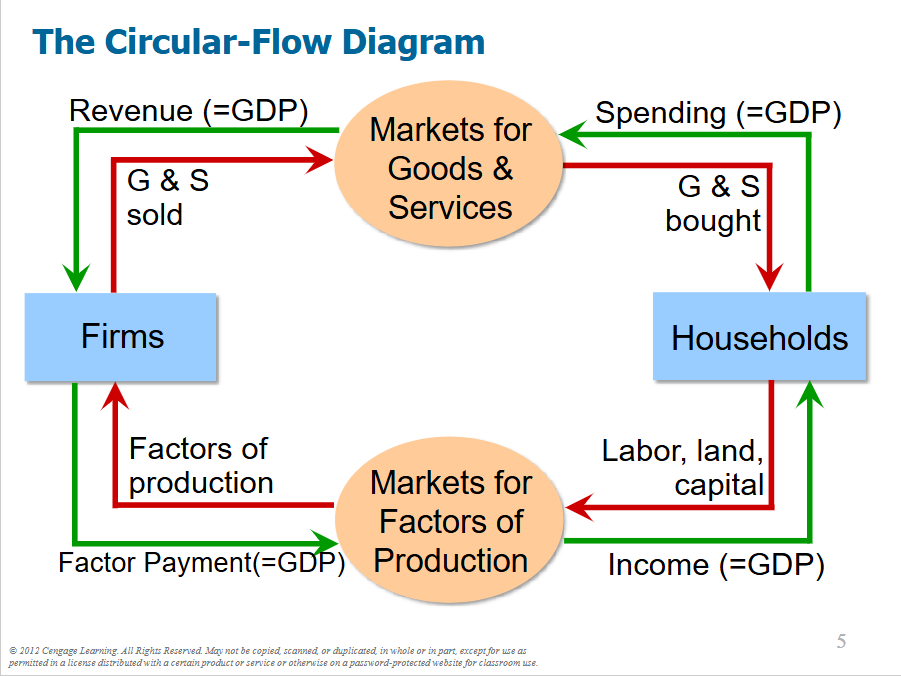
The Circular-Flow Diagram
A simple depiction of the macroeconomy illustrating GDP as:
Spending
Revenue
Factor payments
Income
Preliminaries:
Factors of production include inputs like labor, land, capital, and natural resources.
Factor payments refer to payments to the factors of production, such as wages and rent.
Diagram Elements:
Markets for Factors of Production
Households and Firms
Income (= GDP)
Factor Payment (= GDP)
Goods & Services (g&s) bought/sold
Spending (= GDP)
Revenue (= GDP)
Omissions from the Circular-Flow Diagram
The government:
Collects taxes.
Buys goods and services.
The financial system:
Matches savers’ supply of funds with borrowers’ demand for loans.
The foreign sector:
Trades goods and services, financial assets, and currencies with the country’s residents.
Definition of Gross Domestic Product (GDP)
GDP is defined as:
The market value of all final goods and services produced within a country in a given period of time.
Important characteristics of goods measured in GDP:
Valued at market prices; all goods are measured in the same units (e.g., dollars in the U.S.).
Excludes items without market value (e.g., housework).
Types of Goods Included in GDP:
Final goods: Intended for the end-user.
Intermediate goods: Used as components in the production of final goods (not included in GDP).
Types of Products Included in GDP:
GDP includes both tangible goods (e.g., DVDs, mountain bikes, beer) and intangible services (e.g., dry cleaning, concerts, cell phone service).
GDP measures currently produced goods, not past production.
GDP includes only production within the country’s borders, regardless of whether it is performed by citizens or foreigners.
GDP is typically expressed on a per year or per quarter basis.
Active Learning - What is included in GDP?
Scenario: Nalah pays James $50 to mow her lawn.
Question A: What happens with GDP?
Question B: How would your answer change if Nalah and James are married?
Components of GDP
Overall Definition: GDP is total spending, calculated by four main components:
Consumption (C)
Investment (I)
Government Purchases (G)
Net Exports (NX)
Equation representing GDP:
Breakdown of Components:
Consumption (C)
Total spending by households on goods and services.
For renters, consumption includes rent payments.
For homeowners, consumption includes the imputed rental value of the house—which does not include the purchase price or mortgage payments.
About 2/3 of all GDP comes from consumption, highlighting its crucial role in the overall economy.
Investment (I)
Total spending on goods that will be used in the future to produce more goods.
Includes spending on:
Business capital (business structures, equipment, intellectual property).
Residential capital (landlords' buildings or homeowners' residences).
Inventory accumulations (goods produced but not yet sold).
Note: “Investment” does not refer to the purchase of financial assets like stocks and bonds.
Government Purchases (G)
Includes all spending on goods and services purchased by the government at federal, state, and local levels.
Excludes transfer payments (e.g., Social Security, unemployment insurance).
Net Exports (NX)
Calculated as:
Exports represent foreign spending on the economy's goods and services.
Imports account for the portions of C, I, and G that are spent on goods and services produced abroad.
This yields the complete GDP equation:
U.S. GDP and its Components (2021 Data)
Metric | Value (in Billions) | % of GDP | Per Person |
|---|---|---|---|
Y (GDP) | $22,996 | 100.0 | $69,132 |
C (Consumption) | $15,742 | 68.5 | $47,323 |
I (Investment) | $4,120 | 17.9 | $12,386 |
G (Government) | $4,053 | 17.6 | $12,184 |
NX (Net Exports) | $-918 | -4.0 | $-2,760 |
Active Learning - GDP and Its Components
Case A: Debbie spends $200 at a restaurant.
This transaction contributes directly to the GDP as it falls under personal consumption expenditures, highlighting the role of consumer spending in economic measurement.
Case B: Sarah spends $1800 on a new laptop from China.
This expenditure contributes to the GDP as well, but it is categorized under imports, which are subtracted from the overall GDP calculation, demonstrating the balance between domestic consumption and foreign trade.
Case C: Jane spends $1200 on a local computer.
This purchase boosts the GDP positively as it is counted under domestic production, illustrating the significance of supporting local businesses in stimulating the economy.
Case D: General Motors produces $500 million in cars, selling $470 million.
This reflects a scenario where a portion of the production is not sold, and thus, the remaining inventory could influence future GDP measurements as it may indicate production over sales. The $500 million in vehicles emphasizes the importance of manufacturing in driving economic growth.
Classification of GDP
Real vs. Nominal GDP
Nominal GDP:
Values output using current prices.
Not corrected for inflation.
Real GDP:
Values output using prices from a base year.
Is corrected for inflation.
Example Calculations
Example 1A: Calculating Nominal GDP
Nominal GDP for each year calculated as:
2021: $15 x 300 + $2.50 x 1,000 = $7,000
2022: $16 x 400 + $3.00 x 1,200 = $10,000
2023: $17 x 500 + $3.50 x 1,300 = $13,050
Example 1B: Calculating Real GDP (Base Year 2021)
Real GDP calculated as:
2021: $15 x 300 + $2.50 x 1,000 = $7,000
2022: $15 x 400 + $2.50 x 1,200 = $9,000
2023: $15 x 500 + $2.50 x 1,300 = $10,750
Correcting for Inflation
Nominal GDP Change/Real GDP Change:
Nominal GDP reflects both price and quantity changes.
Real GDP changes reflect quantity changes without price changes (i.e., zero inflation).
Tables summarizing changes in nominal and real GDP and their respective percentages.
GDP Deflator
Definition: A measure of the overall level of prices.
Calculated using the formula:
Example 1D: Calculate GDP Deflator for each year:
2021: 100 x ($7,000/$7,000) = 100
2022: 100 x ($10,000/$9,000) = 111.1
2023: 100 x ($13,050/$10,750) = 121.4
GDP and Economic Well-Being
Real GDP per capita is key for assessing average living standards.
Standard of living is defined as the average consumption of goods and services.
GDP Per Capita: Though GDP is the main indicator of economic well-being, it is not perfect.
Notable Quotes
Senator Robert Kennedy (1968):
“GDP does not include important qualitative aspects of life, such as the health of children, education quality, joy, or integrity of public officials.”
Limitations of GDP
GDP does not account for:
The quality of the environment.
Leisure time.
Non-market activities (like home childcare).
Equitable distribution of income.
Importance of GDP
Uses of Real GDP include:
Comparing living standards over time.
Tracking business cycle fluctuations.
Comparing living standards among countries.
Business Cycle: Fluctuations of economic activity over time.
Potential GDP: The value of real GDP when all economic factors are fully employed.
Correlation of High GDP with Quality of Life Indicators:
Countries with higher GDP often exhibit longer life expectancy, higher literacy rates, and better internet usage.
Data Visualizations
Charts displaying relationships between GDP per capita and:
Life expectancy.
Average years of schooling.
Overall life satisfaction.
Consequences of Low GDP per Person
Associated with:
Higher infant mortality rates.
Limited access to safe drinking water and education.
Fewer resources like paved roads, electricity, etc.
Alternative Measures of Income
GNP (Gross National Product):
Total income earned by a nation's permanent residents, including income earned abroad by citizens and excluding income earned by foreigners in the U.S.
Other metrics include NNP, National Income, and Personal Income.
Chapter Summary
GDP measures a country’s total income and expenditure.
The four components of GDP are: Consumption (C), Investment (I), Government Purchases (G), and Net Exports (NX).
Nominal GDP: Current prices. Real GDP: Base year prices corrected for inflation.
GDP is the primary indicator of a country’s economic well-being, albeit with certain limitations.