Chapter 32: Plant Responses
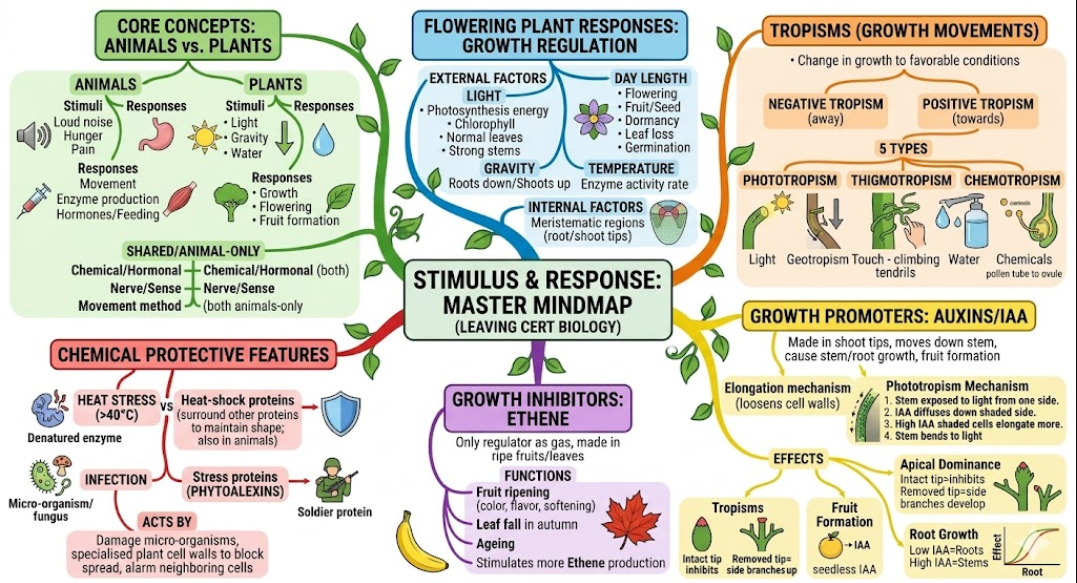
Stimulus and Response
Animal Stimuli:
Loud noise
Hunger
Pain
Animal Responses:
Movement
Production of Enzymes
Hormones and Feeding
Plant Stimuli:
Light
Gravity
Water
Plant Responses:
Growth
Flowering
Fruit Formation
Structures Required for Response
A chemical or hormonal system (present in plants and animals)
A nerve and sense organ system (animals only)
A method of movement, which includes growth along with muscular and skeletal system (animals only).
A defence or immune system.
Responses in Flowering Plants
Growth Regulation
Controlled by external and internal factors.
External Factors
Light
Provides energy needed for photosynthesis, in turn supplies energy rich molecules needed for growth.
Needed to produce chlorophyll, fully formed chloroplasts, normal sized leaves and strong stems.
Day Length
Plays a role in causing plants to flower.
Has a role in fruit and seem fromation, dormancy, leaf loss and germination.
Gravity
Can cause roots to grow down into the soil, while shoots grow upwards.
Temperature
Affects rate of enzyme activity.
Internal Factors
Plants produce growth regulators in meristematic regions e.g. root tip or shoot tip.
Tropism
A change in growth of a plant in response to an external stimulus.
Allows plants to obtain more favourable growth conditions.
Negative Tropism
When growth is away from the stimulus.
Positive Tropism
When growth is towards the stimulus.
Phototropism
Change in growth of a plant in response to light, usually from one direction.
Geotropism
Change in growth of a plant in response to gravity.
Thigmotropism
Change in growth of a plant in response to touch.
Hydrotropism
Change in growth of a plant in response to water.
Chemotropism
Change in growth of a plant in response to chemicals.
Growth Regulators
Chemical that controls the growth of a plant.
Can behave as growth promoters or growth inhibitors.
Growth Promoters
Auxins and Indolecetic Acid (IAA)
Is made in shoot tips, young leaves, and seeds. It moves down the stem by an unknown mechanism. Auxins cause stem and root growth and stimulate fruit formation.
Functions:
Stimulating stem elongation
Stimulating root growth
Causing cells to form into different structures
Developing fruit
Inhibiting side branching in stems
Causing phototropism
Causing geotropism
Effects
Tropisms
Apical Dominance
If apical bud is intact, auxin produced in the tip will pass down the stem and inhibit lateral buds and any side branching.
If apical tip is removed side branches are allowed to develop.
Fruit Formation
IAA is made in developing seeds. It stimulates food to form in the fruit that surrounds the seeds.
Root Growth
At low concentrations, IAA causes roots to grow.
At high concentrations, IAA causes stems to grow.
Mechanism of Phototropism
Auxin loosens cell walls, which allows them to expand. Cell elongation is essential for normal growth and tropisms.
IAA is produced in the meristems.
If the stem is exposed to light from one side IAA will diffuses fown the shaded side.
The concentration of IAA present in the shaded cells causes them to elongate more than the cells on the bright side of the stem.
As a result of uneven elongation, the stem bends towards the light.
Growth Inhibitors
Chemical that causes reduction in growth of plants e.g. ethene, abscisic acid.
Ethene
Only growth regulator that is gas.
Made by plants in stem nodes, ripe fruits, and decaying leaves.
Functions:
Ripening fruits
Causing fruit colour to form, fruit flavour to develop and fruit tissues to soften.
Stimulating leaves to fall in autumn.
Ageing of plants.
Stimulating more ethene production.
Chemical Protective Features
Excessive heat may cause plant enzymes to lose shape and become denatured. This may harm or even kill plants.
Many plants form special heat-shock proteins once the temperature rise above about 40oC. They normally surround other proteins and help them to maintain their shape.
Also formed by animcals and micro-organisms that are subjected to high temperatures.
When a plant is infected by a micro-organism the plant is sometimes able to produce stress proteins. Some of these stress proteins are called phytoalexins.
Act by:
Damaging the micro-organisms by attacking their cell walls.
Stimulating the formation of specialised plant cell walls that prevent the spread of the micro-organism.
Stimulating nearby plant cells to respond to the micro-organism.