eukaryotes
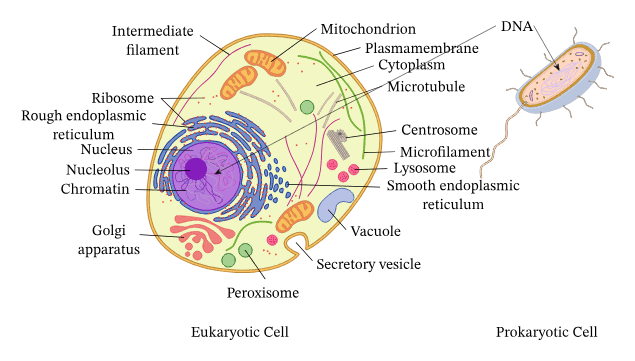
Overview of Eukaryotes
Eukaryotes are organisms whose cells contain a nucleus and other membrane-bound organelles. They can be either unicellular or multicellular. This domain of life includes animals, plants, fungi, and protists.
Key Features and Organelles
Nucleus
Serves as the control center of the cell.
Contains the genetic material () organized into linear chromosomes.
Surrounded by a double-layered nuclear envelope with pores for regulated transport.
Mitochondria
Often referred to as the "powerhouse" of the cell.
Sites of cellular respiration where oxygen is used to generate adenosine triphosphate ().
Endomembrane System
Endoplasmic Reticulum (ER):
Rough ER: Studded with ribosomes; involved in protein synthesis and modification.
Smooth ER: Lacks ribosomes; involved in lipid synthesis and detoxification.
Golgi Apparatus: Modifies, sorts, and packages proteins and lipids for secretion or delivery to other organelles.
Lysosomes: Contain digestive enzymes to break down waste materials and cellular debris.
Cytoskeleton
A network of protein fibers (microtubules, microfilaments, and intermediate filaments).
Maintains cell shape, enables movement, and facilitates intracellular transport.
Comparison with Prokaryotes
Size: Eukaryotic cells are typically much larger, ranging from to , whereas prokaryotes are usually to .
Complexity: Eukaryotes possess membrane-bound organelles, while prokaryotes do not.
DNA Structure: Eukaryotic is linear and associated with histones; prokaryotic is circular.
Reproduction: Eukaryotes undergo mitosis or meiosis; prokaryotes reproduce primarily through binary fission.
Plant vs. Animal Cells
Plant Cells:
Possess a rigid cell wall made of cellulose.
Contain chloroplasts for photosynthesis.
Usually have a large central vacuole for turgor pressure.
Animal Cells:
Lack a cell wall and chloroplasts.
Contain centrioles, which are involved in cell division.
Have smaller, temporary vacuoles.
Eukaryotes
- Oldest prokaryotes > 3.7 billion years ago
- Oldest definitive fossil evidence of eukaryotes is a lot later - 1.6 billion years old
Eukaryotes:
- are diverse
- have complex cells
- have complex life cycles
- include multiple groups that have evolved multicellularity
oldest known eukaryote fossil 1.65 billion years old
Arguably the most distinctive feature of eukaryotes (**absent in prokaryotes**) is the presence of a nucleus — membrane-bound organelle containing most of the cell’s DNA.
The nucleus separates the processes of DNA replication and transcription (in the nucleus) from translation (in the cytoplasm) — allows extra regulation of gene expression.
Eukaryotes have their nuclear DNA organized into multiple, linear chromosomes (**unlike the single circular chromosome of most prokaryotes**)
Genome sizes of eukaryotes are typically larger than those of prokaryotes
- Prokaryotes:
- Smallest ~0.5 Mbp (million base pairs)
- Largest ~15 Mbp
- E. coli (typical) bacterium ~5 Mbp
- Variation of ~30x
- Eukaryotes:
- Smallest ~2 Mbp
- Largest ~150 Gbp (billion base pairs)
- Humans ~3000 Mbp or 3 Gbp
- Variation of 64,000x
——————————————————————
Characteristics of eukaryotic cells: Sexual reproduction
In general, eukaryotic cells are either haploid (single copy of each chromosome) or diploid (two copies of each chromosome).
Sexual reproduction involves two major processes:
- Meiosis: haploid cells formed from diploid cells (e.g., sperm and egg cells are haploid)
- Fertilization: two haploid cells fuse to form a diploid cell (e.g., fertilization of egg by a sperm)
Process = sexual reproduction
Sexual reproduction promotes genetic variation (can combine DNA from different individuals)
Characteristics of eukaryotic cells: the mitochondrion, site of cellular respiration
mitochondria are present in most eukaryotes — some eukaryotes without mitochondria may have lost them (e.g., some parasitic species)
Characteristics of eukaryotic cells: the chloroplast, site of photosynthesis
chloroplasts and related structures (= plastids) are present in plants and several other groups of eukaryotes (e.g., various algae)
Where did mitochondria and plastids come from?
- In 1967, Lyn Margulis (1938-2011) proposed that mitochondria and plastids were once free-living bacteria that became incorporated into eukaryotic cells — the endosymbiotic theory
Evidence for the "endosymbiotic theory"
- Mitochondria and plastids have their own genomes, which are small and circular
- genome of mitochondria most similar to proteobacteria
- genome of plastids most similar to cyanobacteria (photosynthetic)
-mitochondria and plastids form through a process similar to binary fission
"Endosymbiotic theory" for origin of mitochondria and plastids now widely accepted
- Step 1: mitochondria acquired by eukaryotes
- Step 2: eukaryotes that lack plastids (e.g., fungi, animals) split off
- Step 3: plastids acquired by lineage leading to plants
The Endosymbiosis Theory (Campbell 1996)
But where did the "main" eukaryote cell come from?
- In 2010, marine sediment from the "Loki's Castle" hydrothermal vent site in the Arctic Ocean was found to contain a group of Archaea that had genes that were very similar to the genes of eukaryotes
- Scientists named this group of Archaea Lokiarchaeota
- Other similar Archaea have been found
- Collectively, they have been named Asgard Archaea (*Asgard* = home of the Viking gods)
- They have proteins that are otherwise only found in eukaryotes, e.g., to do with the cytoskeleton
Eukaryote diversity
- There are several eukaryote groups that have multicellular species, including:
- plants
- animals
- fungi
- But these are only a tiny fraction of the total diversity
Eukaryote diversity
- Most eukaryotes are single-celled!
- We will use the word protist to refer to these single-celled eukaryotes🐭
- There are many different groups of protists:
- they don't form a single group — they are spread throughout the eukaryote evolutionary tree
- some protists are close relatives of animals, others are close relatives of fungi, others are close relatives of plants, and others are not closely related to any multicellular eukaryotes
Examples of Protists:
—
Excavates
- Include some important parasites of vertebrates, e.g. Giardia and Trichomonas.
- Originally thought to have diverged very early because they appear to have no mitochondria, but a vestigial mitochondrial organelle has now been found, i.e., they have secondarily reduced/lost their mitochondria.
Giardia
- Extracellular gut parasite of mammals
- The underside of the parasite has a sucker which allows it to attach to the gut wall
- discovered in 1681 by Antonie Van Leeuwenhoek from testing own diarrhoea
Trichomonas
- Moves by undulating membrane and flagella
- Extracellular parasite of reproductive tract of humans
- Spreads by close bodily contact (usually sexual intercourse)
—-——
Alveolates: dinoflagellates
- Mainly marine plankton, but some freshwater species
- Many are photosynthetic (with chloroplasts present) and also consume other organisms
— i.e., autotrophic and heterotrophic
- Can cause red tides
- excess nutrients in water lead to rapid reproduction of dinoflagellates (a "bloom")
- may lead to build-up of toxins in the water — can kill fish and marine mammals (e.g., dolphins, manatees)
- humans can become ill if they eat shellfish contaminated with red tide toxins
Certainly! Here's the text from the image:
- Some dinoflagellates produce bioluminescence
- chemical reaction produces flash of blue light, usually in response to mechanical disturbance
- anti-predator function — startles predator and may also attract attention of larger predators ("burglar alarm")
- Example of dinoflagellates causing red tides and bioluminescence
———
Alveolates: Ciliates
- Highly diverse group
- Characterized by presence of multiple cilia
- hairlike organelles similar to flagella but shorter
- Mainly freshwater, most are free living
- Includes well known Paramecium
——
Alveolates: apicomplexans
- The Apical Complex
- Intracellular (= live inside host cell) parasites
- Specialised organelle called an apical complex
- used to penetrate host cells
- Include several medically important parasites, including:
- Plasmodium (causes malaria)
- Toxoplasma (causes toxoplasmosis)
Malaria —-——
300-500 million report cases per year
annual mortality of 1-2 million
60% of worlds population exposed
tropical- sub tropical zones
Symptoms:
- headache
- fever
- muscle pain
- enlargement of spleen and liver
- It infects the brain (cerebral malaria) & can cause seizures and coma
Simplified Plasmodium lifecycle:
- enters bloodstream of vertebrate from mosquito
- travels to liver cells where it reproduces asexually
- enters red blood cells; where it reproduces asexually
- lyses (= bursts) the red blood cells
- picked up by feeding mosquito
- reproduces sexually inside the mosquito
—————
Slime moulds
Many species usually live as single-celled organisms
When food is scarce, they come together to form a single multicellularbody
This can then develop into a fruiting body that releases spores into the air
Colonies versus multicellular organisms
Colony = two or more individuals of the same species living in very close proximity or connected
Advantages to individuals living in a colony might include:
more efficient feeding (e.g., by increasing surface area)
defence against predation
Differences:
Colonial organisms can usually survive as single cells, but multicellular organisms cannot
Cells of multicellular organisms specialized for different functions, cells of colonial organisms usually are not
But... no clear dividing line between colonial and multicellular organisms — it's a spectrum
———— Algae
Other important "protist" groups include various types of algae
Most are photosynthetic (i.e., with chloroplasts)
Some are unicellular, but some are multicellular, e.g., seaweeds ("macroalgae")
Different algal groups can be distinguished based on presence of particular photosynthetic pigmentsthat give them different colours:
green algae (Chlorophyta)💚
red algae (Rhodophyta)❤
brown algae (Phaeophyta)🤎
algae do not form a single group they are spread out through the evolutionary tree
—
Green algae 💚(Chlorophyta)
Most are unicellular
Some are colonial, e.g., Volvox, which is composed of thousands of cells
Some chlorophytes are genuinely multicellular (e.g., the sea lettuce Ulva)
Some live symbiotically with fungi to form lichens
Chlorophytes are closest living relatives of land plants
—
Red algae ❤(Rhodophyta)
Most are multicellular
Colour is due to photosynthetic pigments
Red absorbs blue/green light that penetrates deep water
Rhodophyta can be found down to 260m
include several edible seaweeds
—
Brown algae 🤎(Ochrophyta)
Photosynthetic
Brown colour is due to photosynthetic pigments
includes many seaweeds, e.g.,
bladderwrack
giant kelp – grows to >45 m long and can grow 60 cm/day
gel-like cell walls to cushion and prevent dehydration
The structure of multicellular brown algae superficially resembles that of land plants, with:holdfast (equivalent to roots)
stipe (equivalent to a stem)
blades (equivalent to leaves)
Resemblance is convergent — these features evolved independently in the two groups