Filtration
Overview
Why filtration?
Remove insoluble particles
- whole cells
- cell debris
- crystals
- precipitates
- macromolecules
You use filtration methods to remove insoluble particles such as cell debris, cells, crystals, precipitates, and macromolecules
States
- gas/solid
- vapor/smoke
- liquid/solid
- macromolecule/liquid
Filtration can be used in many different states of matter
Classification
- conventional
- membrane
Conventional filtration or dead-end filtration
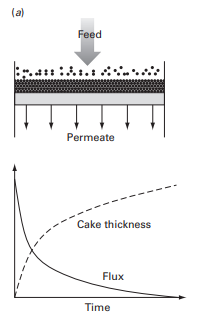
- suitable for large particles
- force is applied perpendicular to the filter surface
- typical filter media includes
- woven and non-woven
- paper, cloth, fiber, screens, strainers
- used for fluid/solid mixtures
- solid in liquid
- solid in gas
- solid in vapor
Conventional filtration is where the flow with the desired product just flows down through the filter
Macrofiltration
- large particles using cloth, and other woven and non-woven media
- Usually cloth, fiber, filter paper, metal screens, and strainers.
Particle size
- coarse particles
- 1-0.1 mm
- fine particles
- 0.1-0.01 mm
Macrofiltration - big filtration
Microfiltration
- Particle size: 10-2 to 10-4 mm
Ultrafiltration/nanofiltration
- 0.001 um - 0.1 um
- filtrations use membranes
- classified on MWCO
- can reject 90% of solute above MWCO
- MWCO
- can range from 1000 Da to 1000000 Da
Membranes filter based on molecular weight cut off
Hyperfiltration
- reverse osmosis
- only water molecules are removed
Filtration from largest particle size to smallest, macrofiltration → microfiltration → ultrafiltration → hyperfiltration
Theory of conventional filtration
Permeate/Retentate
Crossflow
- Permeate is the filtered liquid that passes through the filter
- Retentate is the liquid that passes tangentially to the filters with the solutes in it
Conventional
- Permeate is the filtered liquid that passes through the filter
Overview
- Darcy’s law of flow through porous media
- Batch incompressible particle filtration
- Batch compressible particle filtration
- Continuous rotary drum filtration
- Filtration time
- Cake wash time
- Use of filter aids
- reduce compressibility in compressible biological materials
Crossflow filtration
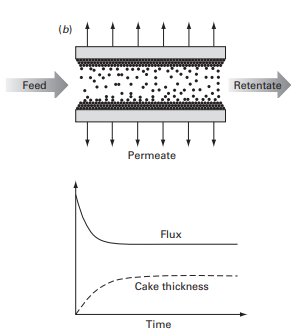
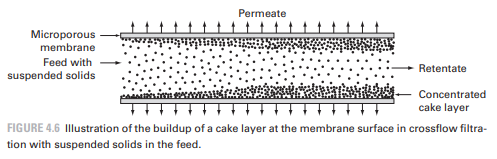
Overview
- Applied force is tangential to surface of filter medium
- Is parallel to filter medium surface
- Separation based on molecular weight cut off (MWCO)
Suitable for
- micro
- macro
- nano-particles
- macromolecules
Medium
- Composed of membrane which do not have specific holes found in woven filters
- made from polymers
- nylon
- polyethylene
- polypropylene
- cellulose acetate
- polysulfide
Crossflow filtration occurs when the flow is tangential to the filter, it helps reduce the buildup of the cake layer which can foul the membrane.
Pretreatment of filtration solutions
Heat treatment
- least expensive
- pasteurizes solution
- improves feed handling characteristics
- may degrade product
- filtering egg solution
Heat treatment can pasteurize solution and improve feed handling
Coagulation and flocculation
- add flocculants to cause coagulation and flocculation
- cationic, anionic, neutral, natural, inorganic flocculants
- see flocculant notes
As previously describe, the flocculates can cause the particles to group together and improve ability to remove them
Adsorption on filter aides
- addition of solid filter aids to broth before filtration
- colloids in broth adsorb onto filter aids → improve filtration
- may reduce compressibility of cake
- may prevent blinding of filter by fragmented mycelium or bacterial cells
- major disadvantage is decrease in clarity of filtrate
Filter aids
- diatomaceous earth and perlite are most common
- these material are silica based and therefore can adsorb protein irreversibly
- ground wood pulp and starch
To improve filtration, you can use filter aids. Filter aids help by absorbing unwanted materials. They can decrease the clarity of the filtrate. A silica based example is perlite and a non silica based is wood pulp.
Equations
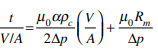
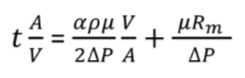
Conventional batch filtration
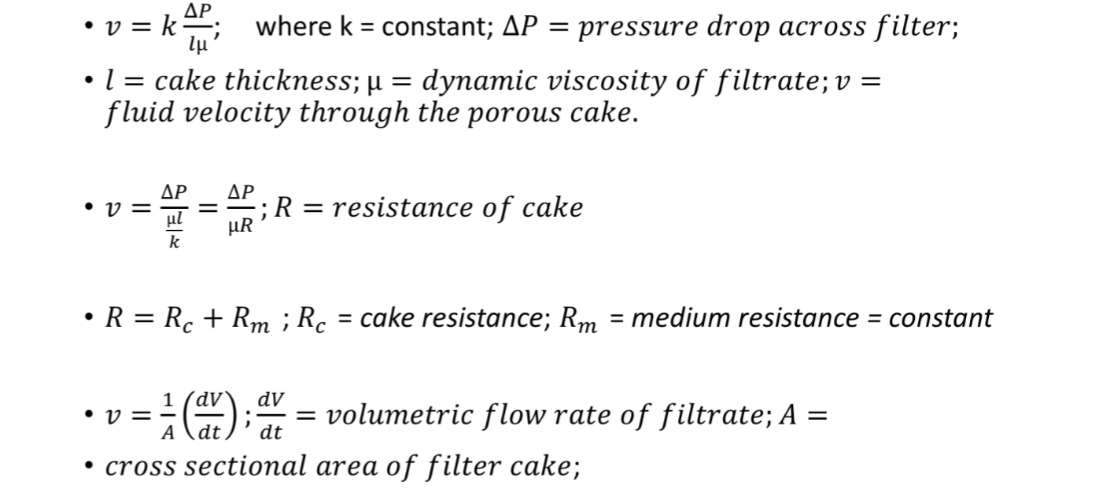

- V = volume of filtrate
- t = time
- A = filtration cross-sectional area (m^2)
- ∆p = pressure drop through the cake and filter medium (Pa)
- assume constant
- µ0 = viscosity of the filtrate (Pa*s)
- R = resistance of the cake and the filter medium (m^-1)

- Rm = resistance of the filter medium (m^-1)
- Rc = resistance of the cake solids (m^-1)
- alpha = specific cake resistance (m/kg)

Incompressible cake (alpha is constant)
- ρc = mass of dry cake solids per volume of filtrate (kg/m^3)
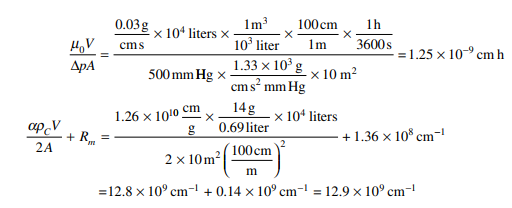
![Before integration]](https://knowt-user-attachments.s3.amazonaws.com/9dcb260112604cc4b8b69dc4c89e0301.jpeg)


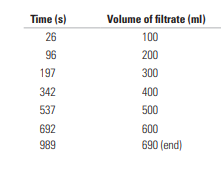
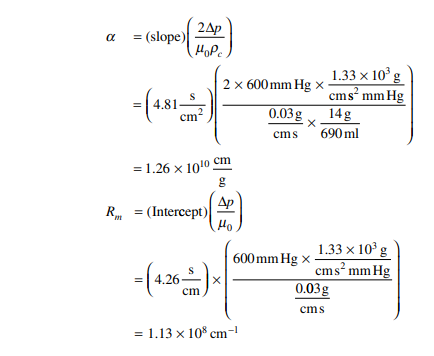
Example
- scatter plot

Compressible cakes (alpha is not a constant)


- to filter compressible cake, add incompressible filter aid
- cellulose, wood pulp, perlite
Continuous filtration
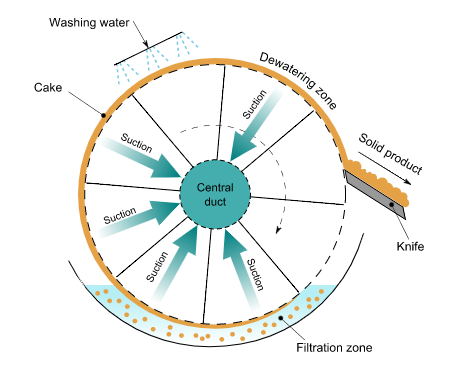
Rotary drum filtration
Stages
- Cake formation
- The product goes to filter via vacuum (suction)
- If cake is compressible
- Filter aids can be used
- Cake washing
- Recover product by washing the cake
- Cake discharge
- Product removed via rope, knife etc.
Equations
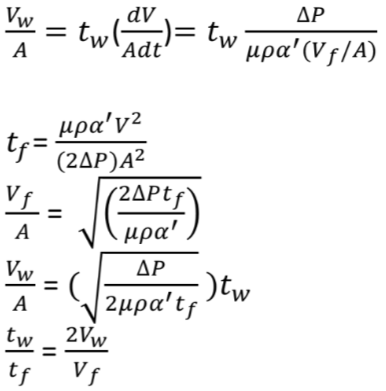
- efficiency

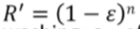
- R′ is the weight fraction of solute remaining in the cake after washing
- basis that R′ = 1.0 prior to washing
- E is the percentage wash efficiency
- n is the volume of wash liquid per volume of liquid in the unwashed cake

- tf/tc = Af/Ac
- tc is time for drum to rotate on cycle
Filter aid
- coat surface with filter aid
- cut cake with knife, leave filter aid intact
Continuous filtration has three steps: Cake formation, cake washing, cake discharge.
Cake formation - The product is sucked into the filter via a vacuum. If the cake is compressible, filter aids can be used.
Cake washing - The product is recovered by washing the cake.
Cake discharge - The product is removed via a rope or a knife that cuts the cake off of the filter.
Tangential filtration - Membrane filtration
Overview
- Force is applied tangential of parallel to filter surface
- Reduces accumulation of filter cake on surface of filter
- Membranes are typically used
- Do not have specific holes
- Made from polymers
- nylon, polyethylene, polypropylene, cellulose acetate, polysulfone
- Separation based on MWCO
- Suitable for micro, macro, and nano-particles, macromolecules
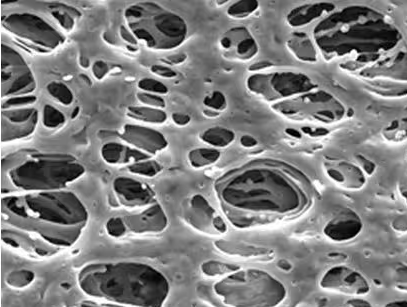
Membranes are made from polymers such as nylon or polyethylene. These membranes have microscopic pores that allow for molecules to pass through based on their molecular weight.
Equation Derivation
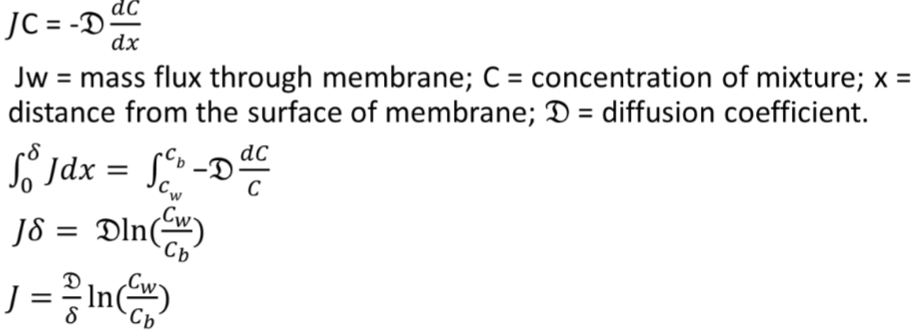
- cw - The elevation of the solute concentration at the membrane surface
- cb - Solute concentration in the bulk solution
- cw/cb - concentration polarization
- polarization modulus - indicates the extent of concentration polarization
- δ - boundary layer thickness
- D /δ - mass transfer coefficient k
- D - diffusion coefficient of the solute
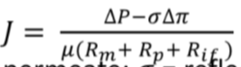
- Rm - membrane resistance
- Rp - resistance due to concentration polarization and a gel layer on the membrane surface
- Rif- resistance caused by irreversible fouling
- sigma - reflection coefficient for the solute
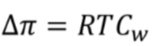
- R - universal gas contant
- T - absolute temp
- Cw - solute concentration on the membrane surface
Membrane types
Homogeneous
- pore size is the same for feed side and permeate size
Asymmetric
- pore size on the feed side is smaller than the permeate side
- feed side is a very thin layer with small pores which is supported on a thicker layer that has larger pores
- serves as structural support for the membrane
Composite
- similar to the asymmetric membrane except:
- feed side membrane and the permeate side are made of different materials
- Don’t back flush composite membranes
- can cause delamination of the thin layer on the feed side membrane
Membrane equipment
Mechanical integrity
- provide necessary physical support
Hydrodynamics integrity
- minimize pressure drop through membrane
- minimize fouling, plugging
- allow for turbulence
Economics
- minimize membrane packing density
- minimize manufacturing cost
- provide sufficient chemical resistance
- easy to scale-up
Filter modules
Hollow fiber
- array of narrow-bore, self-supporting fibers w/asymmetric membrane structure
- liquid flows through the lumen side
- flow is lamina
- Can be back flushed
- if any tube breaks the entire unit must be replaced
- needs pre-filtered to avoid plugging
Tubular
- cast in place within a porous support
- fiber glass, ceramic, plastic or stainless steel
- flow is turbulent
- can be back flushed
- Pumping costs are high
- large tubes do not need prefiltration
- resistant to plugging
Plate and frame
- flat plate systems are in rectangular configuration
- cannot be back flushed
- membrane is supported only on one side
- oil filters
Spiral-wound
Modes of Operation
Batch concentration
- retained stream containing the product suspended particles or dissolved macromolecules is concentrated
- reduced in volume
Diafiltration
- volume of the retained stream is maintained constant by the continuous addition of water or buffer
- results in the removal of low molecular weight solutes into the permeate
- commonly used when salt removal or exchange is desired
Purification
- low molecular weight product passes into the permeate and is thus separated from higher molecular weight impurities; or, the product can be retained and impurities removed in the filtrate
Complete Recycle
- both the retained stream and the permeate are returned to the feed tank
Liquid Sterile Filtration
Overview
- Liquids used for fermentation and other processes that must avoid contamination
- Usually the last step in clean process
- Extensively used in pharmaceutical industries
Factors
- No appreciable filter load
- No cake buildup
- No contribution to resistance from the filtrate
- Does not require filter aid
- 0.2 μm filters can prevent most bacterial and yeast from entering the system
- will not prevent viruses
- membranes can be used for these operations
Major factor to consider
- Sterility required
- Calculated based on probability of a single unit of product containing a single microorganism
- Expected sterility is a maximum of 10-3 for aseptic processes
- One unit dose contaminated with one microorganism per thousand doses manufactured
Air sterile filtration
Overview
- used to clean air for clean rooms, fermentation, etc.
- Used to prevent airborne microbes and particulate matter from settling in or on the surface of \n processed material
- High efficiency particulate air (HEPA) filters
- Vent filters placed on tanks and fermenters
Depth Filtration
Overview
- Multiple layers
- Can tolerate high loads
- sand filter, cotton wool, glass wool
- Good practice to put a depth filter before the sterile filter
- Reduce the load on the sterile filter
- Avoid contamination
Scale-up and design of filtration
- Experimental testing is required in the scale-up and design of conventional filtration system
- True for bioprocess systems
- Each system is unique e.g. raptured cells have different properties depending on the microbe
- yeast, bacteria, algae etc
Common Methods
- Constant pressure filtration
- Buchner funnel
- Rotary vacuum filtration
- Vacuum leaf filter
Membrane filtration
- Based on the filter area derived from the feed or output flow rate
- Scale-up based on the area
Constant values
- Inlet and outlet pressures
- Crossflow or tangential velocity
- Flow channel sizes
- height and width
- Feed stream properties
- test slurry should be representative of the actual process stream
- Membrane type and configuration
- test data from one configuration cannot be used for different geometry