Biology Lab Test #1
Lab Report #1
What do scientists do first when they begin to study a specific topic?
Observation
What is a tentative decision about the outcome of an experiment?
Hypothesis
What do we call the sample that lacks the factor being tested and goes through all the experimental steps?
Negative control
What do scientists call the information they collect while doing experemts or making observations?
Data
Which is made by a scientist following experiments and observations, a theory or a conclusion?
Conclusion
What do you develop after many years of experimentation and a lot of similar individual conclusions?
Scientific theory
Why is a theory more comprehensive than a conclusion?
A theory is tested more
A conclusion is only summarizing the information
Why is it important to have a control substance for an experiment?
It gives you a baseline.
Scientific method steps
Observe
Hypothesis
Testing the hypothesis
Negative control
Data
Conclusion
Lab Report #3
List several types of microscopes
Stereomicroscope, transmission electron, scanning electron
What is the difference between a longitudinal section and a cross section of an object?
Parallel vs. 90 degree angle
What are the differences between a stereomicroscope and a compound light microscope?
Entire objects vs. sections of objects
What does the term compound mean?
More than 1
What is used to improve contrast when viewing clear portions of a cell?
Stains
What kind of microscope would be used to study a whole or opaque object?
Stereomicroscope
What is the name for the lenses located near the eye?
Ocular lenses
Which term describes the minimum distance between two objects required to distinguish them as twin separate objects?
Resolution
If the total magnification of a slide is 400x and the ocular lenses are 10x, what is the magnifying power of the objective being used?
40x
If the amount of light passing through the condenser needs to be decreased, what microscope part should be adjusted?
Diaphragm
What word describes a microscope that remains in focus when the objective lenses are changed?
Parfocal
If a slide is being viewed with the high-power objective, which adjustment knob should be used to sharpen focus/
Fine-adjustment knob
Which objective should be in place when the microscope is put away?
Low-power
If threads are layered from top to bottom, brown, green, red, which layer will come into focus of you are using the microscope properly?
Brown
Microscopes
Stereomicroscope (dissecting microscope)
Used to study entire objects in three dimensions at low magnification
The compound light microscope
Used for examining small or sections of objects under higher magnification
Transmission electron microscope
Ultra-thinly sliced and treated with heavy metal salts to improve contrast
Scanning electron microscope
It gives an image of the surface and dimensions of an object as is apparent from the scanning electron micrograph
Compound light microscope
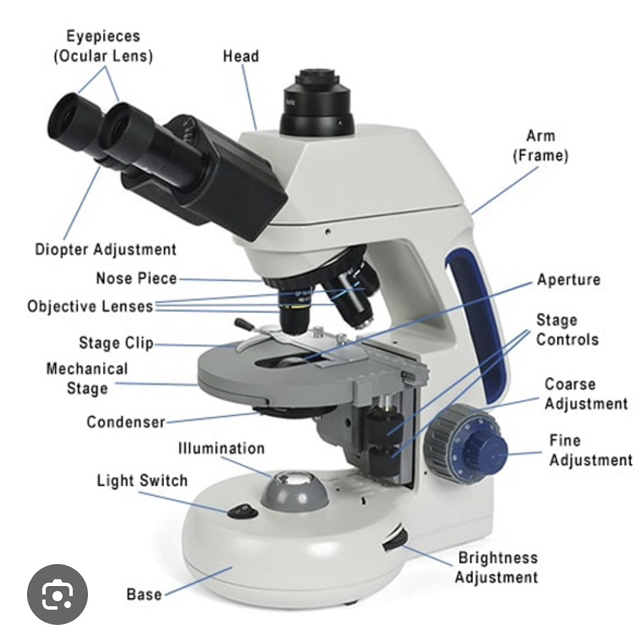
Lab Report #5
What regulates the movement of molecules into and out of the cytoplasm?
Plasma membrane
Identify the features that are used to distinguish a prokaryotic cell
Prokaryotic does not contain a nuclei
What structures associated with prokaryotic and eukaryotic cells carry out protein synthesis?
Ribosomes
Name two things that can be found in the nucleolus of a eukaryotic cell?
DNA, nucleolus
What plant cell organelle carries out photosynthesis?
Chloroplast
What molecule is associated with plant cell walls?
Cellulose
What energy (ATP)-producing organelle is found in animal and plan cells?
Mitochondria
What is the movement of molecules into from an area of higher to lower concentration called
Diffusion
What is the movement of water across the plasma membrane called?
Osmosis
Does water move in or out of cells that are placed in a hypotonic solution>
Into
What king of solution causes crenation to happen to red blood cells: isotonic, hypertonic, or hypotonic?
Hypertonic
What kind of solution causes chloroplasts to be pushed outward against the cell walls: isotonic, hypertonic, or hypotonic?
Hypotonic
If a solution has more hydrogen ions than hydroxide ions, where would the solution be placed on the pH scale?
Acidic side
What is present in human blood that ensures blood pH is maintained at about 7.4?
Buffer
What is the difference between eukaryotic and prokaryotic cells?
Prokaryotic cells do NOT contain a nuclei
Bacteria
Eukaryotic cells DO contain a nuclei
Elodea
Plant vs animal cells
Plant cells
Large central vacuole
Cell wall
Chloroplast
Animal cells Large central
Small vacuoles
Lysosomes
What is the difference between osmosis and diffusion?
Osmoses is the specific diffusion of water molecules across a semi-permeable membrane
Diffusion is the general movement of particles from an area of high concentration to low concentration
What are the different types of solutions in the Tonicity section.
Isotonic
No change
Hypertonic
Shrinks
Hypotonic
Bursts
Lap Report #6
What symbol represents the change that occurs in a chemical reaction?
An arrow
Are the substrates in an enzymatic reaction reactants or products?
Reactants
What is the name of the location on an enzyme where its substrate or substrates bind?
Active site
What cellular organelle contains catalase and is present ion all plant and animal organs?
Peroxisome
What did measuring the bubble column heights in all the experimental procedures indicate?
Enzyme activity
What purpose did the tube containing water and hydrogen peroxide serve in the catalase activity experimental procedure’s?
Negative control
What word describes the loss of an enzymes original shape and ability of its active sight function?
Denaturation
What happens to enzyme activity if the temperature increases slightly?
Increases enzyme activity
What did the negative control tube lack when the effect of enzyme concentration was studied?
Catalase
If cells produce more catalase, will there be more or less water and oxygen produced from the breakdown of hydrogen peroxide by catalase?
More
What word best describes the pH at which the speed of a reaction involving an enzyme occurs best?
Optimum
What does a shift in pH (too high it too low) do to an enzyme that will influence its activity?
Denaturing
What are the differences between an enzyme and a substrate?
Enzymes are organic catalase that speed up metabolic reactions
Substrates are the reactants in an enzymatic chemical reaction
How do they work together?
An enzyme-substrate interaction occurs when a reactant molecule binds to a specific region on an enzyme called an active site
Lab Report #8
List the reactants necessary for photosynthesis.
CO2, H2O, Energy
What organelle, present in eukaryotic photosynthetic organisms, is the location of photosynthesis?
Chloroplast
During photosynthesis, where is water split and oxygen released?
Thylakoids membrane
Where is CO2 reduced during the Calvin cycle reactions?
Stroma
What technique was used to separate the leaf pigments?
Paper chromatography
List the various photosynthetic pigments that are found in leaves.
Chlorophyll a & b
Carotenoids
Carotenes
Xanthophylls
Based on distance traveled up the chromatography paper, which pigment is the most nonpolar pigment?
Carotenes
What color of light is not absorbed by green plants?
Green
What color of light is absorbed by carotenes?
Blue & green
What gas is released during the light reactions of photosynthesis?
O2
What will plants and animals use the gas released from photosynthesis for?
Cellular respiration to make ATP
CO2 is broken apart during photosynthesis. Where will the carbon molecules end up?
Glucose
What process happens in photosynthesis and respiration?
Cycle matter and energy to sustain life
What is the equation for photosynthesis and respiration?
Photosynthesis
6CO2 + 6H2O + SUNLIGHT —> C6H12O6 + 6O2
Cellular respiration
C6H12O6 + 6O2 —> 6CO2 + 6H2O + ATP
Where in the plant cell do the light reactions and Calvin cycle take place?
Light reactions take place in the thylakoids
Calvin cycle takes place in the stroma