crime
Nature of Crime
meaning of crime
an act or omission of duty resulting in harm to society that is punishable by the state
- constantly changing eg. same sex marriage
- aims to protect society. notion that all of society is the victim/a criminal act is an attack upon the whole of society
- covered by Crimes Act 1900 (NSW) and various amendments
elements of crime
Actus Reus (guilty ACT): the physical act of carrying out the crime. Must be voluntary, but can also include omission or failure to act (negligence)
Mens Rea (guilty MENtality): the intent to commit the crime, even with knowledge it was wrong. Multiple levels:
- Intention: a clear, malicious or wilful intention to commit the crime (highest level)
- Recklessness: the accused was aware their action could lead to a crime but chose to continue in that manner eg. reckless driving. Prosecution will prove a reasonable person would have realised the risk
- Criminal negligence: the accused failed to forsee risk at a time when they should have, usually resulting in harm/death of a dependant (lowest level)
}}R v Thomas Sam (2009)}}
strict liability offences
only require the actus reus, generally apply to minor convictions, as standard of proof is lowered eg. speeding. can be appealed that the offence was an ‘honest and reasonable mistake’. Reduce strain on court, are easier to enforce.
causation
the link between the behaviour of the accused and the result of the alleged criminal act ie. actus reus causes the injury/death. Prosecution must prove causation.
}}R v Benjamin Batterham (2016)}}
categories of crime
| Types of offences | Examples |
|---|---|
| offences against the person | homicide (murder,manslaughter, infaticide,dangerous driving causing death) , assault,(common assault, physical assault, sexual assault (R v AEM), indecent assault, aggravated sexual assault in company) |
| offences against the sovereign | treason (attempt to start war/ harm head of state), sedition (R v Sharkey), terrorism (unlawful use of force with political intent) |
| economic offences | property offences (larceny, robbery, burgalry) white-collar crime (embezzlement, tax evasion, insider trading, computer offences, fraud), computer offences |
| drug offences | trafficking, cultivation, possession, use |
| driving offences (see Road Transport (Safety and Traffic Manaf=gement) Act 1999 (NSW)) | speeding, drink-driving, negligent driving |
| public order offences | offensive conduct, obstructing traffic, affray |
| preliminary offences | precede the crime eg conspiracy, attempts |
| regulatory offences | breach of water restrictions, fire restrictions or public transport rules |
summary and indictable offences
| summary | indictable | |
|---|---|---|
| type | less severe/minor | more severe/major |
| which court | local courtappeals to district or supreme | commital hearing in local (to deem prima facie), heard in district or supremeapeeals to court of criminal appeal |
| heard by whom | magistrate | judge &jury |
| judgement | judgement and punishment decided by magistrate | judgement by jury, punishment by judge |
| types of punishment | bond, fine, up to 2 years. up to 5 years if multiple offences | hefty fines, up to 25 years |
| charged by whom | police/government officer | Director of Public Prosecutions on behalf of the state |
| main legislation | Summary Offences Act 1988 (NSW) | Crimes Act 1900 (Cth) 1 |
| mens rea? | no | yes |
| examples | traffic offences, public order offences | sexual assault, murder |
parties to a crime
Principal in the first degree: the person who commits the act. usually receives highest sentence
Principal in the second degree: was present at time of crime, encouraged/assisted principal in first degree. may receive lower sentence depending on circumstance
Accessory before the fact: assisted to set up/plan the crime, but wasn’t present at the time. May receive similiar punishment
Accessory after the fact: helps criminals afterwards but isn’t present during/before the crime
factors affecting criminal behaviour
- psychological: the accused’s state of mind at the time of the crime (eg. mental illness, drug) is accounted for during sentencing
- social factors: relationships and experiences of the accused may condition their opinions of crimes/cause trauma
- econommic: people from disadvantaged backgrounds are more likely to commit crime due to poor education/lack of skills, need, lack of access to legal information
- political: riots. some groups challenge authority of government and the law. Politically motivated crime can lead to terrorism, violent demonstration or assassination
- Genetic theories: no conclusive results, suggest external factors have greatest impact. conditions such as poor impulse control can lead to crime
- self interest: major role. motivation by greed/self-interest/revenge eg. sexual assault, embezzlement
situational/social crime prevention
situational: occurrs at point of crime with aim of making it more difficult/less rewarding. increases risk of crime. however, just moves people to a different area/method.
- making more difficult (car immobilisers, blue fluorescent lights in toilets, firewalls, passwords
- increasing the risk (street lighting, CCTV, alarm systems)
- reducing the rewards (stricter laws for pawn shops, tags that release blue dye on clothes)
social: attempts to address underlying social factors that contribute to criminal behaviour eg. poor home life/parenting, low socieeconomic status, poor education etc
- improving people’s living conditions
- funding for education for ‘at-risk’ students
- improving sense of community eg. youth programs
- dealing with poverty and unemployment
- eg. PCYC’s have capacity to minimise risk factors and enhance protective factors via strengthening young people’s engagement with education and family
Criminal Investigation Process
police powers
crimes are investigated by NSW or federal police. Police powers are outlined under the Law Enforcement (Powers and Responsibilities) Act 2002 (NSW). Some argue law reform has created too many additional powers eg. 2014 amendments allowing police to move on intoxicated individuals (rather than just groups) and issue a fine if they refuse. can be used to target minorities such as young offenders, Aboriginal and Torres Strait Islanders
LEPRA Powers:
- dentain and question
- search property and seize evidence
- use reasonable force
- use technologies to assist
- recommendation of bail
}}case: police officer admits unlawful searching of 19 people at music festival, including minors (2022)}}
Code of Practice for CRIME:
- outlines rights of suspects, aims to prevent discrimination regardless of race, gender, severity of crime etc
- outlines how investigations should occur, improving accountability of police
- Custody, Rights, Investigation, management and evidence
reporting crime
people often hesitate to report crime for a number of reasons:
- inability (language, access etc)
- reluctance to be involved/appear as a witness
- dispute has been settled with the offender
- perceived time/administrative burden
some crimes are more likely to be reported eg. property theft. up to 85% of sexual assault cases are believed to be unreported.
Crime Stoppers: a national community-based program that encourages people to report information and is highly effective.
In 2021 received 288,432 calls via the freecall hotline and 296,553 website contacts. directly led to 4,175 apprehensions and 14,040 charges being laid.
investigating crime
Gathering Evidence:
- role of police to gather evidence to support a charge in court
- must be lawfully obtained under the Evidence Act 1995 which limits ways police can gather evidence/types of evidence. ensures evidence is legitimate and doesn’t conflict individual rights
- this can involve: taking witness statements, searching crime scenes for evidence, photo/videos document in situ
- contaminated/comprimised evidence isn’t admissible in court
Types of Evidence:
- oral testimony (accused, victims, police and witnesses)
- physical evidence (documents, weapons, objects)
- DNA samplings and fingerprints
- Tape recordings, video surveillance and electronic information
Use of Technology:
- surveillance technology (CCTV and phone tapping) and DNA identification
- a person must consent to blood or mouth swabs. police can apply to the magistrate for order to take sample, but this often has a backlog
- current evidence laws struggle to keep up with technology, which is an issue when determining admissable evidence
- }}R v Farah Jama (2008) wrongfully convicted of rape after DNA mix up}}
Search and Seizure:
Part 4 of LEPRA allows police special powers to ‘search people and seize and detain things’ in certain circumstances, even without a warrant
- contains procedures police are required to follow (can request support person, can’t search children)
- police are able to search any person they believe ‘on reasonable grounds’ to be carrying anything stolen or used in commision of an indictable offence or another specified offence (eg. drug, dangerous article). challenges of admissible evidence often surround the question of ‘reasonable grounds’
- }}Darby v Director of Prosecutions (2004) detection of cannabis and methamphetamines by police dog were not on basis of reasobanle suspicion}}
Use of warrants:
a Warrant is a legal document issued by a magistrate or judge and extends the power of a police officer, authorising them to perform a particular act such as an arrest, search or seize property. emergency warrants can be granted and must state reson for search/what is being searched for
LEPRA part 5 outlines circumstances in which a warrant can be used including:
- substantial reasons: evidence must be presented to magistrate/over the phone in the case of an emergency
- usually required to enter/search any premises without consent of the occupier
- if proper procedures aren’t followed, validity of the case may be jepardised
arrest and charge
arrest LEPRA contains conditions under which police can arrest a person:
•Caught during an offence
•Believing on a reasonable grounds that a suspect has/is about to commit an offence
•The suspect has committed a serious indictable offence for which they haven’t been tried
•Possessing a warrant for that persons arrest
Police must state to the person that they are being arrested and why. They are able to use any reasonable force, however they must declare that they have a weapon out and are willing to use it. If force is deemed excessive, the officer can face charges. Complaints can be received via Police Integrity Commission and the NSW Ombudsman.
detention and interrogation
LEPRA and the Criminal Law (Detention and Interrogation) Act 1995 outline lawful conditions for detention and interrogation.
•Police can only detain for 6 hours, excluding rest periods
•Police can apply to magistrates to extend this time up to a further 6 hours
•A caution must be issued to suspects ASAP once detained to inform of: rights, maximum detention period, right to remain silent (Evidence Amendment (Evidence of Silence) Act 2013 means this can allow unfavourable inference) and that anything they say may be used against them in court
•This caution is issued orally and in writing
•Suspects under 18 have the right to an adult present
•Interrogation is recorded on videotape and on two audiotapes; one for police records and one for the defendant
release or charge
At the end of 6 hours, police must charge the suspect with a specific crime or release them unconditionally •Applications can be taken to magistrates for an additional 8 hours
•If charged, police must bring the accused before the magistrate ASAP
•Accused that will be kept in custody must face a bail hearing [Bail Act 2013 (NSW)] The Terrorism (Police Powers) Act 2002 (NSW) was amended -> Terrorism (Police Powers) Amendment (Investigative Detention) Act 2016 No 17 allows police to detain someone as young as 14 for up to 14 days if they suspect them to be involved with a terrorism offence. However, an application must be made to the Supreme Court to request this.
summons
Once charged, the accused will be issued with a summons to appear in court. If a serious matter they will be detained until a bail hearing is set (excluding terrorism).
%%Court Attendance Notice%%: Legal document that clearly states when and where a person must appear in court and the charge to which they must answer. This is delivered personally by a court appointed person. %%Subpoena%%: witness version of court attendance. Required to give evidence at a certain time, failure to do so may result in arrest/criminal charges
bail/remand
temporary release of an accused person awaiting trial, on conditions of a lodgement of a sum of money as a guarantee. conditions of bail are outlined in the Bail Act 2013 (NSW), replaced 1978 act as 30 years of ammendments had made it too complicated . Determined by the NSW police or magistrate/judge of the local, district or supreme court. protects innocent until proven guilty. s18 contains unnacceptable risk test (eg. violent crime, failing to appear in any proceedings, interfere with evidence).
%%Show cause test%%: Place the onus on the defendant to prove why they should be on bail rather than the magistrate to prove why they shouldn’t. example of amendments: 2007 Amendments to the Bail Act 1978 (Defendants can’t make more than one bail application unless new circumstances arise). This limits defendant’s access to the legal system in an effort to increase resource efficiency. Example of show cause: R v Goutounas (2018)- application to CCA for a fresh bail determination for major drug dealer. Bail denied due to the likelihood of conviction, prior offending for similar matters, skepticism that his surety of $1.5 mil would even reduce the risk of him fleeing, lack of evidence that separation would be a burden to his family.
%%Remand%%: held in detention until trial, time is taken off sentence. The Bureau of Crime Statistics and Research (BOCSAR) found between 1993 - 2009 remand population tripled and only 16% of young offenders in remand received custodial sentences. Costs $276/day for adults, $589 for young offenders R v Monis (Sydney siege)- was on bail after allegedly 40 counts of sexual assult and accessory to murder. Despite his strict bail conditions he was still accountable for the deaths of two people.
criminal trial process
court jurisdiction
REVIEW YEAR 11
Essentially local (<$100 000), district ($100 000 -$750 000, can’t deal with murder, treason, piracy), supreme (everything else). Children’s, coroner’s, land and environmental, court of criminal appeal all specialised. High court = very high level appeals and some constitutional original jurisdiction.
The Crimes (Appeal and Review) Act was amended in 2006 to allow people to be out on trial again for serious offences if: There is new or compelling/strong evidence/Something was done in the original trial that “tainted” the verdict
%%Stats%%: From 1 March 2013 until February 2015 there were 783 applications for special leave disposed of by the HIgh Court and, of those, 80 were granted special leave to appeal. That represents a 10.22% overall success rate. The Criminal Procedure Act 1986 (NSW) was amended in 2018 to replace committal hearings with a single senior prosecutor reviewing evidence and confirming which charges will go ahead.
adversary system
A mandatory case conference must then occur between prosecution and defence. Aims to improve productivity/reduce delays the adversary system inherited from England.
Pros: both sides have opportunity to speak, ultimately decision maker is neutral. Cons: lengthy process, still inequality due to lawyer, funding etc
•Prosecution v defendant in search of ‘justice’
•Lawyers in control
•Jury system – passive, democratic, only for indictable offences, only hear certain evidence
•Strict rules of evidence
•Jury deem guilty/not guilty
legal personnel
(magistrate, judge, public prosecutor, Director of Public Prosecution, Public Defenders)
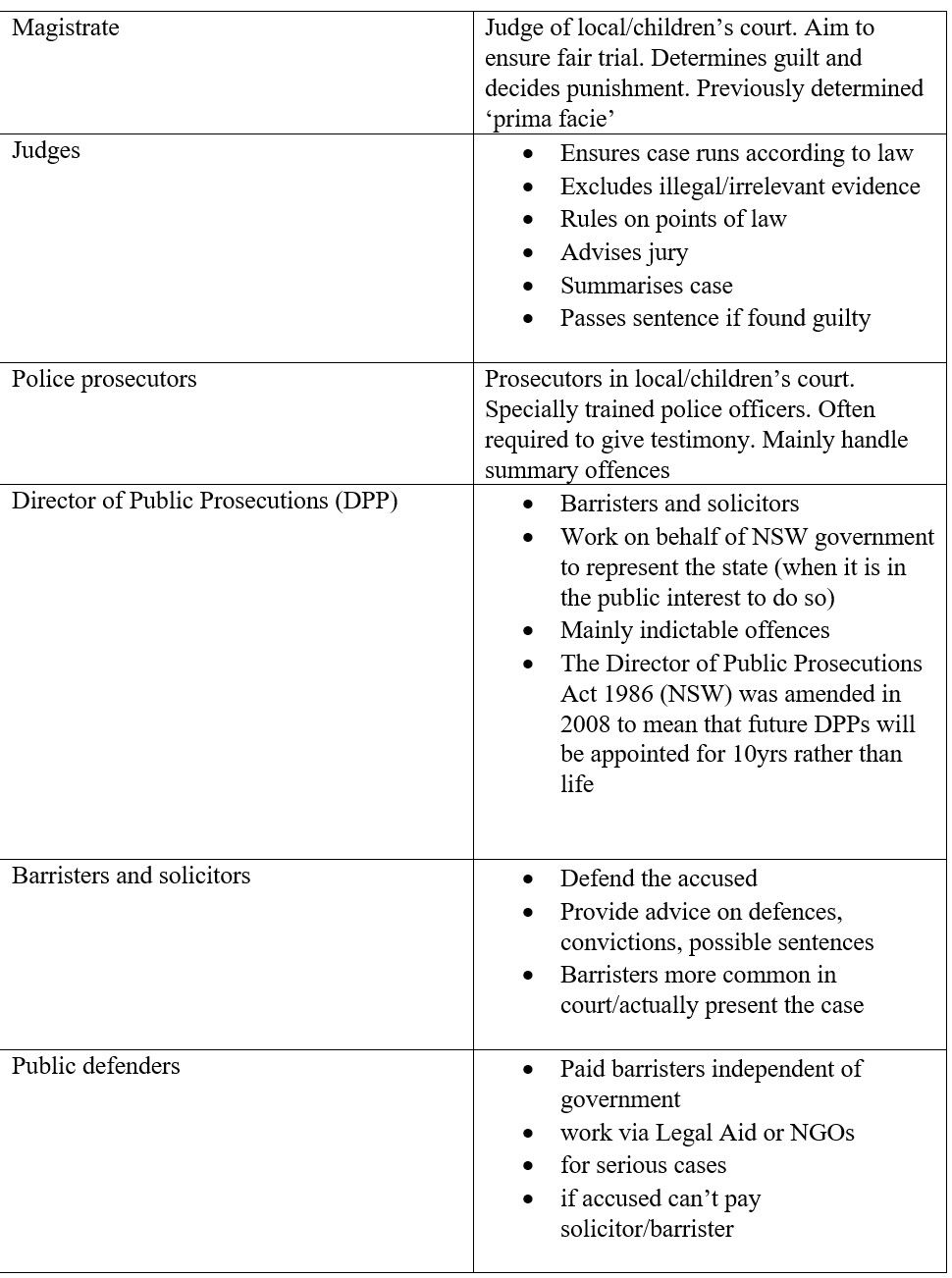
plea
%%Plea%%: a formal statement of guilt or innocence by the accused When charged with an offence must enter into a plea of ‘guilty’ ‘not guilty’ or ‘no plea’ which counts as ‘not guilty’. This trial occurs quickly in front of a magistrate (sends accused higher for sentencing) or judge (sentences on the spot)
charge negotiation
prosecutor agrees to reduce/remove a charge in return for a guilty plea, including discretion. Guilty plea before committal hearing = 25% reduction, after = 12.5% reduction [according to Criminal Case Conferencing Trial Act 2008 (NSW)] often occurs when there are issues with witnesses, an overlap of adequate penalties, multiple offences. is resource efficient (reduces cost $10 000 a day, time, increases convictions) , but may cause insufficient punishment.
encouraged especially when:
- prosecution has a strong case
- likely to be costly trial
- pleas are early and appropriate
- accused accepts responsibility.
- Overlap of adequate penalties
- Witness is unavailable, uncontactable or unpersuasive
- Vulnerable or reluctant witness
Example: Karl Koch and Nanette May (2009)
- Karl Koch assaulted Nannette May. The charge was reduced from attempted murder to maliciuous injury with intent. May was not consulted when the charge was reduced and Koch’s sentence was significantly lighter. Limited effectiveness as the victim does not need to agree to the negotiation, just be aware of it.
legal representation
legal representation, including legal aid no right to legal representation, however recognised unlikely to receive fair trial without it (Dietrich v the Queen 1992). Legal Services Commission established 1979, ‘Legal Aid NSW’ since 2006. Provides services to socially and economically disadvantaged people across NSW. Funded by NSW government. Will provide 15 minutes free legal advice to anyone, more than this required to pass 3 tests:
- Jurisdiction test: What type of case? All are covered but criminal get priority
- Means: Do you make too much money to receive legal aid? Children can always get legal aid
- Merit: Do you have a reasonable chance of winning? Otherwise plead guilty.
burden and standard of proof
the prosecution that has the burden of proof to prove the defendant guilty beyond a reasonable doubt (as this is the standard of proof). ‘innocent until proven guilty’ comes from the International Covenant on Civil and Political Rights.
use of evidence, including witnesses
The Evidence Amendment (Evidence of Silence) Act 2013 slightly changed this burden of proof use of evidence, including witnesses outlined in Evidence Act 1995 (NSW). Only admissible when relevant and legally obtained by police.
Types of evidence:
- Physical – documents, clothing, weapons etc.
- DNA – blood, saliva, hair, semen, fingerprints
- Electronic – video surveillance, computer info
- Expert – testimony from someone with expertise
- Hearsay – evidence that has been overheard and is given by someone who has heard it
- Circumstantial – evidence implying an event has occurred
- Oral – testimony given by witness
- Documentary – in theform of documents, can be affidavit (written statement of facts)
- Real – objects for inspection by the court
- Original – direct evidence given by witness
- Character – shows reliability of the person
- WITNESSES: must swear oath, guilty of perjury if found to be lying. Can give statements of what they have seen, heard or experienced. Rules of Evidence:
- Hearsay – witnesses may only tell court what they saw/heard, not what someone else stated happened
- Opinion – can’t give their opinion in court about another person’s words/actions unless they are an expert
- Relevance – only evidence that relates to the matter under scrutiny can be given
- Character – generally evidence can’t be given about the bad character of the accused
- \
defences to criminal charges
: defences help achieve justice by allowing court to consider circumstances that might justify the accused’s act or reduce their cupidity (denial, justification or excuse for the defence’s actions) complete defences used to justify the accused’s actions. If successfully proven will result in either charges being dropped (or if during trial, an acquittal) defence explanation
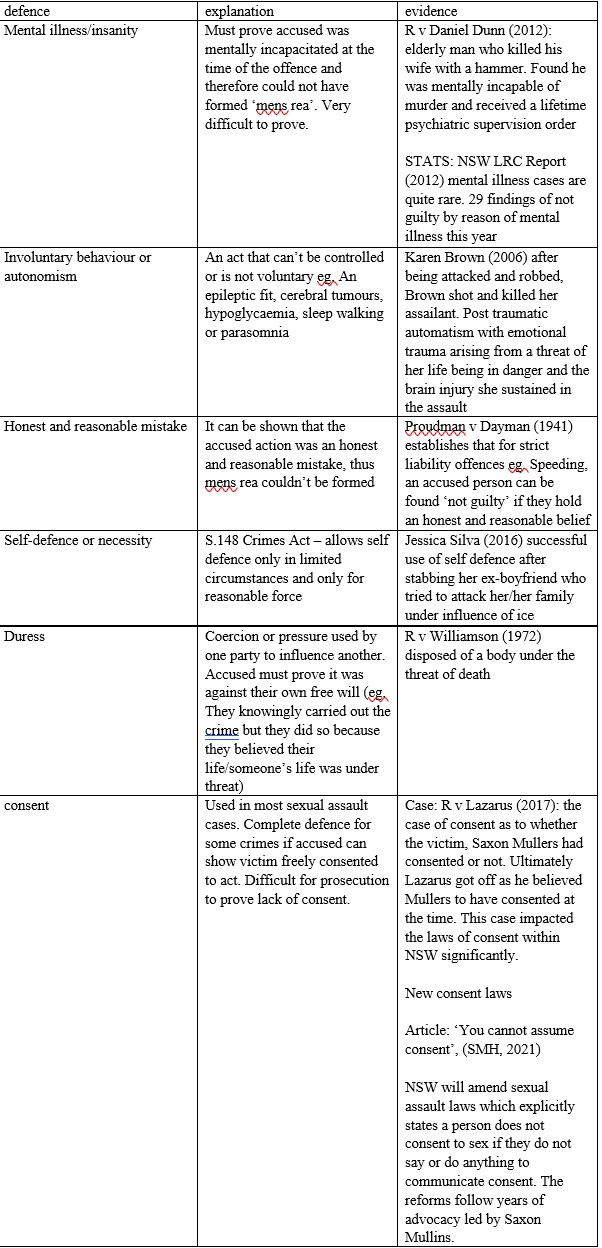
partial defences
may result in the charge or sentence being reduced
| defense | explanation | evidence |
|---|---|---|
| provocation | defendant claims their actions were a direct result of the other person’sactions, which caused them to lose control and commit the offence. Has been abolished in Vic, WA, Tas, can only be used in NSW to reduce murder to manslaughter | R v Singh (2012): Husband slit wife throat after finding out she had been cheating on him. was charged with manslaughter |
| diminished responsibility | can also be used to reduce murder to manslaughter. must proved they suffer from a mental abnormality that caused them to act a certain way eg. low IQ or mental retardation NOT drugs/alcohol | R v Knight (2006)Katherine Knight sentenced to life imprisonment for murdering her husband, despite having borderline personality disorder and suffered amnesia of the incident |
the role of juries, including verdicts
Juries decide ‘questions of fact’ eg. guilty/not guilty. They can only use evidence the judge allows into trial
Issues with jury:
- jurors doing their own investigation, resulting in a mistrial eg. Billal Skaf. Jurors often research because they’re too afraid to ask the judge questions. Article: Jurors playing detective should not be a crime (SMH 2013); currently jurors can be charged with a criminal offence and jail time for simply researching something online in relation to the case.
- Jurors can’t be forced to listen eg. playing sudoku in trial that had cost millions and seen 105 witnesses in 2008
- jurors don’t always understand the judge’s instructions. “if you have any reasonable doubt that the defendant committed this crime, you must find him not guilty”. BOCSAR Report (2008) found that only 67% of jurors said that they understood everything the judge said. NSW Law Reform Commission looked at the issue and recommended that judges should explain things more clearly, use visual aids, use flow charts and encourage questions.
- social media makes jury trials difficult (due to bias)
- Aus Lawyers Alliance made agreement there could be judge only trials. eg. R v Gittany and R v Rayney
Majority Verdicts: The Juries (Amendment) Act 2006 (NSW) brough in ‘majority verdicts’. In a criminal trial, voting can go 11-1 and still counted as a proper verdict. Became more resource efficient/time
From: Majority verdicts NSW Law Reform Commission (2005)
| FOR | AGAINST |
|---|---|
| quicker and easier verdicts | verdicts may be reached prematurely |
| a juror with some doubts has less pressure to conform | against the standard of proof |
| gets rid of the rogue juror effect | only resolves an additional 1.7% of criminal cases |
Sentencing and punishment
sentencing hearing
hearing following a finding of guilt in which a magistrate or judge will determine the sentence to be given to the accused. It involves a judgement about the severity of the offence, the mens rea of the accused and the need for the crime to be punished.
statutory and judicial guidelines
The Crimes (Sentencing Procedure) Act 1999 (NSW)
primary source of sentencing law: purposes for a sentence, types of penalties, when they can be used
- maximum penalty: set by parliament and listed in legislation, max sentence available for an offence
- judicial discretion: power of a judge/magistrate to make a decision within a range of possibilities based on the specifics of a case. can be guided by precedent.
- guideline judgements: judgement issued by the court, on the application of the attorney general, that will set out sentencing guidelines for a particular offence
- mandatory sentencing: removal of judicial discretion by legislation, by setting a minimum or mandatory sentence for a particular offence or type of offender, aim to act as a deterrent . eg. 8 year minimum sentence for one punch offenders and for child sex offenders
purposes of punishment:
deterrence (specific and general), retribution, rehabilitation, incapacitation
| type of punishment | explanation | evidence |
|---|---|---|
| specific deterrence | Passing a higher sentence in the hope that fear of punishment might help prevent future offenders. However there is little evidence that supports this. punishment against an individual aiming to deter them from committing crime in the future | |
| general deterrence | punishment attempting to make an example of an offender in order to send a message to the rest of the community | |
| Retribution | the punishment considered to be morally right or deserved because of the nature of the pnishment. Is the main justification for inflicting punishment and is related to s.3A: ensuring the offender is adequately punished for the offence, making the offender accountable for their actions and denouncing their conduct, recognising the harm to victim and community | R v Dawson (2022)primarily punished for retribution rather incapacitation (personal issue). unfit for rehabilitation due to age. |
| Rehabilitation | One of the most important purpose of punishment aims to discourage reoffending by altering the views of the offender. Aims to prevent recidivism (habitual or repeated acts of criminal behaviour after having undergone treatment or punishment to deter such behaviour). Rarely prime consideration for serious offences. | |
| Incapacitation | Refers to Crimes (Sentencing Procedure) Act 1999 (NSW) 'to protect the community from the offender'. Aims to make offender incapable of committing similar crimes. Eg. Home detention, community work, license cancellation or imprisonment. Restrict freedom, which is a severe punishment. | R v Pender 2021When Pender was arrested and handcuffed he laughed and told the officers he'd have killed them all if he was still armed."The proudest thing a man can do is behead a cop," he said. |
aggravating and mitigating circumstances
The Crimes (Sentencing Procedure) Act 1999 (NSW) section 21A lists out the aggravating and mitigating factors that a judge or magistrate can take into consideration before deilvering their final judgement
section 21A (2) often called on by prosecution to deliver heavier senctence. includes:
- victim was police officer/special worker
- involved/threatened to involve violence, weapons, explosives
- offender caused victim to be affected by a narcotic drug, alcohol or other intoxicating substance
- offender has past convictions
- offence in company of/with someone under 18
- offence in home of victim or any other person
section 21A (3) called on by defence to reduce sentence
- injury/emotional harm/loss/damage caused wasn’t substantial
- not part of planned/organised criminal activity
- offender was provoked by victim
- offender acting under duress
- no significant record of previous convictions
- good character
- unlikely to reoffend
eg. Chris Dawson
| Aggravating | Mitigating |
|---|---|
| Dawson hasn’t admitted guilt/remorseno bodylengthy delay, has been living without responsibilitydenial of responsibility allowed him to remarry JC | No previous convictionsGood characterAge and media have complicated case |
role of the victim in sentencing
victim = those directly harmed and indirectly affected
The Victims Rights Act 1996 (NSW) outlines the rights of victims, including respect for their dignity, compensation, protection from the accused,rights to information and protection of identity. victim impact statement: how the offences have affected life of victim. can only relate to those accused has been found guilty of. voluntary. officer in charge must ensure statement complies with legislation.
impact on victim is relevant consideration when determining penalty. however attitude of family for forgiveness/retribution can’t be taken into affect.
Criminal Procedure Amendment (Domestic Violence Complaints) Act. As of June 2015 allows sexual assault/DV victims to provide evidence through CCTV or video, aiming to make experience less traumatic
Crimes Sentencing Procedure Amendment (Family Member Victim Statement) Act 2014 (NSW) judges now consider a family’s victim impact statement during sentencing, helps balance the rights of individuals
Curtis Cheng (2015)
- Selina Cheng provide victim impact statement when her husband was killed, influencing sentence
appeals
apply to higher court to review one or more decisions made in a lower court
appeal against conviction: appellant argues they guilty of an offence they were found guilty of. usually argue there was some error in handling/prosecution eg. evidence admitted or judge instructing jury. If successful, appellant may be acquitted or retrial may be ordered
sentence appeals: appeals made against the severity of sentence, or by prosecutor against leniency of sentence. can be made alone or in conjunction with appeal against conviction.
evaluation: ensures justice is achieved by providing an avenue of checks and balances, protects accused to ensure accurate outcome, however drws out trial process and decision (cost and time inefficeint)
types of penalties:
no conviction recorded, caution, fine bond, suspended sentence, probation, criminal infringement notice, penalty units, community service order, home detention, periodic detention, forfeiture of assets, imprisonment, diversionary program
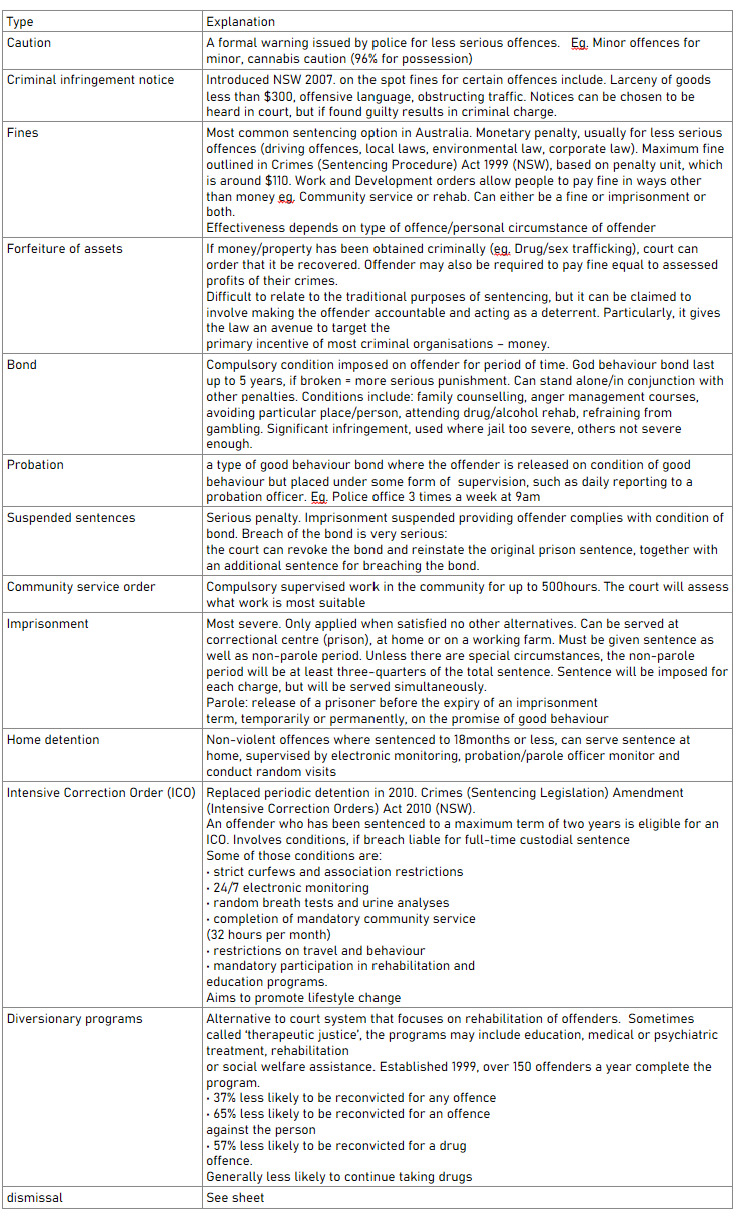
alternative methods of sentencing
circle sentencing,
- involves aboriginal Elders, accussed, victim, families, members of police/prosecution
- discuss penalty other than jail, often community work. punishments tend to fall in middle to heavy end
- only offered to Indigenous members who show high level of commitment to process, not murder or SA
- $4.2 million to expand the circle sentencing program from 12 to 20 high priority Local Court locations - Claire Giotto (ABC News, 2020): "The whole process was very positive one, where at the end of it they felt calm and that there's a way forward" "social benefit would likely outweigh the monetary cost of hosting circles" - Offenders were half as likely to receive a prison sentence, leading to a cost saving to the taxpayer of about $2.8 million a year
restorative justice
- any program where the offender and people affected (victim, families, youth workers) come together to negotiate what should happen
- aim is for offender to show remorse and avoid repeat offending. victims can have a voice in trial, ask questions, have a say in how to repair harm. offenders acknowledge responsibility, hear impact on others
- The Young Offenders Act 1997 (NSW) allows police OR the Children's Court to send send young people to 'Youth Justice Conferencing'
- For 10-17 year olds, the way that Youth Justice Conferencing works in NSW in NO MORE EFFECTIVE THAN THE CHILDREN'S COURT in reducing reoffending - BOSCAR 2012 - Trial of 'Forum sentencing' for 18-24 year olds since 2005 in Liverpool and Tweed
post-sentencing considerations
In NSW the administration of sentencing is governed by the Crimes (administration of Sentences) Act 1999 (NSW) Correctional centres (inmates and prisons) are managed by The Depart. Of Correctional Services NSW (govt. agency).
security classification: prisons are classified due to level of security. offenders are given security ranking due to severity of crime, prospects of rehab, good behaviour. Categories: A (dangerous), C (least serious), E (Escape risks). determines which prison. all prisons must have adequate state of care.
protective custody: some prisoners eg. child sex offenders, police serving prison terms, informants are segregated for protection. segregation does impact ability to work/access educational programs
parole: conditional release of prisoner after completion of minimumterm of sentence. Parole Board will consider: inmates conduct in prison, interests of community, how inmate will reintegrate into society. Aim to incentivise good behaviour/prisoners to access rehab
preventative detention
Part 2A of the Terrorism (police Powers) Act 2002 nsw empowers police to detain a person, without charge for 24 hours. This can be extended via court order for a further 24 hours. These 24 hour period don't include 'dead time' eg. Suspect is sleeping or communicating with lawter. Relying upon the dead time provisions, Dr Haneef was detained and questioned without charge for 12 days in 2007. Subsequently, the prosecution case was collapsed for a lack of evidence, and in 2010 Dr Haneef received a settlement from the Federal Government by way of compensation for his treatment during this investigation, which ultimately resulted in his visa being revoked and his deportation from Australia.
continued detention
The Crimes (Serious Sex Offenders) Act 2006 NSW authorises the Supreme Court, on application by the NSW Attorney General, to order either the continued detention of a serious sex offender or extended supervision of this offender upon release. Requires judicial review, expert evidence suspect is likely to reoffend. However still erodes some fundamentals eg. presumption of innocence, right of offender to only be punished from crimes they been convicted. these must be weighed against recidivism of sex offenders
sexual offenders registraton
serious sex offenders must keep police informed of name, DOB, place of employment, car registration,, travel arrangement. Both state (NSW Child Portection Agency) and Federal (ANCOR) exist. State register is governed by the Child Protection (Offenders Registration) Act 2000 NSW. Offenders are registered with their local police station, minimum 8 years for adults and aims to minimise reoffending. Protection of community outweighs burden of registry.
deportation
rights of non-citizens residing in Australia are governed by the Migration Act 1958 (Cth).
This act provides that if such persons receive a custodial sentence of 12 months or more and they have been resident in Australia for than 10 years, they may be forcibly removed ie. Deported from Australia on the basis that they fail the character test prescribed in the Migration Act.
According to the Department of Home Affairs, 100 visas were cancelled for child sex offences in 2018, 125 for assault, 53 for domestic violence, 34 for rape and other sexual offences, 13 for murder and 56 for armed robbery
Young offenders
age of criminal responsibility
Seen and HEard report 1997
2010 report “Noetic Review” recommended treating young offenders differently due to underdeveloped brains, usually due to abuse and neglect STATS: 11,007 offenders aged 10-17 years in 2019-20, a decline of 6% (or 692 less offenders) from 2021 Australian Bureau of Statistics. International Law: UN Act 37: Children who break the law should not be treated cruelly. They should not be put in prison with adults and should be able to keep in contact with their family Act 40: Children who are accused of breaking the law should receive legal help. Prison sentences for children should only be used for most serious offences. United Nations -> 2019, UN committee on the Rights of the Child recommended 14 years as minimum age for criminal liability.
Doli Incapax: ‘Incapable of Wrong’ A child is unable to form mens rea as they don’t have a sufficient understanding of difference between ‘right’ and ‘wrong’. To rebut this presumption, the prosecution must prove beyond reasonable doubt that the child knew that the act was seriously wrong (not by standards of law, but morally or according to the ordinary principles of reasonable persons) "as distinct from an act of mere naughtiness or childish mischief". Children Under 10: The Children (Criminal Proceeding) Act 1987 (NSW) outlines ‘it shall be conclusively presumed that no child who is under the age of 10 years can be guilty of an offence’
- Doli incapax is a conclusive presumption
- Deems they have exceptionally limited life experience and under-developed
Children 10-13 Under common law doli incapax is a rebuttable presumption, however can be argued
- Prosecution has to prove offender knew what they were doing was seriously wrong and not just ‘naughty’ beyond reasonable doubt
Young People 14-17 years: Presumption of doli incapax no longer applies and can be found criminally liable as they are believed mature enough to understand the consequences and severity of their actions
- Under 16 can’t have a criminal conviction unless indictable
- All cases heard in children’s court
- Governed by The Children (Criminal Proceedings) Act 1987 (NSW) including numerous protections eg. Named publication, all convictions cleared after 3 years
rights of children (when being questioned/arrested)
The Law Enforcement Police (Powers and Responsibilities) Act 2002 (NSW)
- Questioning of Young people: majority of rights are the same for young peoples and adults, certain laws do apply to young people particularly eg. Summary Offences Act (1988) police may stop and require your ID for consuming alcohol in public place
- Questions and Right to Silence: right to silence and laws are the same as for adults to ensure consistency
- Right to Support of a Responsible Adult: Section 13 of the Children (Criminal Proceedings) Act 1987 (NSW) makes any statement a young person gives, inadmissible unless there is a responsible adult there.
- Searches: under LEPRA police may not strip search under 10, support person for 10-18
- Arrest and Interrogation: same as adult
- Support person & Legal Advice: The Law Enforcement Police (Powers and Responsibilities) Regulation 2005 (NSW) describes children as ‘vulnerable’ therefore special provisions: guardian notified if child taken into custody, interview friend to support during interview (must be 14+, consented to), no requirement to have legal representation, however Seen and Heard report suggests should be a requirement
- Caution of Rights: young people have sameright to silence, but must be informed of their rights. Some argue more should be done for age appropriate language etc
- Detention and Interrogation: young offender may be detained for 4 hours, 8 if warrant acquired. support person (less likely duress or coercion) promotes justice, children can’t share cell with adult. Seen and heard report reccommends children aren’t in custody for more than 2 hours
- Forensic Procedures, Photos and Searches: 14+ may take fingerprints and photographs. under 14 equire consent from children’s court to consider the ‘best interests’ of the child. can’t take DNA of under 18 unless they have a court order to do so. if not proven police must destroy evidence on request of guardian
Issues:
In some jurisdictions there is criticism that police are too heavily reliant on powers of arrest to gather evidence particularly in the case of indigenous youth.
- Section 99 of LEPRA outlines when and for what purpose arrest can be made.
- Section 8 of The Children (Criminal Proceeding) Act 1987 (NSW) creates a presumption that children should not be arrested or detained unless the severity of the offence constitutes it.
Children’s Court - procedures and operation
established under Children’s Court Act 1987 (NSW) to deal with children and matters of caring for children. closed court, no jury, specialised magistrate. s6 state: have equal rights to adults, resposible but require guidance and assistance, no interruption to their education, reside in their own home
NSW Commission for Children and Young people - A Picture of NSW Children (2014): 155 or 1% children sentenced to detention. aboriginal children 26x more likely.
penalties for children
purpose must be rehab = children have best chance of rehab and reintegraton, concurs with UN conventions on right of a child. principles: no harsher than adults, assisted reintegration, children should take
Children’s (Criminal Proceedings) Act 1987 (NSW) s.33 lists possible penalties:
- Dismissal: charge dismissed without punishment or conviction. Caution may be issued
- Conviction: conviction recorded, only allowed for those 16+ -
- Adjournment: sentencing can be delayed for up to 12 months to assess prospects or rehabilitation
- Bond: released on good behaviour for a maximum of 2 years with conditions. May be combined with a fine
- Youth Justice Conference: release if the child complies with youth justice conference outcome plan
- Fine: a maximum of 10 penalty units ($1100). Courts must consider age and ability to repay
- Probation: bond with probation order of up to 2 years overseen by NSW juvenile justice officer
- Community service order: severe penalty with 100-hour max for under 16. 250-hour max for 16+
- Suspended control order: court can suspend for up to 2 years subject to good behaviour
- Control order: detainment in a juvenile justice centre for a maximum of 2 years
alternatives to court
Principles of The Young Offenders Act (1997) NSW: impose least restrictive sanction, children informed of right to seek legal advice, criminal proceedings cease where there is an appropriate alternative. Offenders go through 3-tier process:
- warning: on-the-spot notice given for minor first offence, recorded by police with no conditions. offender must be told nature, purpose and effect of warning
- cautions: formal, recorded, signed young offender admits to the offence and consents to a formal police caution. can be considered in children’s court. can be cautioned up to 3 times
- youth justice conferences: can be used when offender admits to offence and agrees to this method. offender accepts responsibility and any harm caused → present at conference are guardian, victim, supporter, mediator, investigating official, second adult, legal representation and a specialist youth officer → promotes rights of offender as it aims to make decisions in respects to them. If offender doesn’t fufill agreements, court proceedings may commence
Generally praised as upholding the ‘welfare model’ and encouraging rehab, although some criticisms act isn’t broad enough
- Costs $150 000 to detain a young person for a year while rehabilitation programs can be more effective and run for a fraction of the cost. For example; Accredited Programs run by Marist Youth and Whitelion have high success rates of integrating young offenders back into society.
- There is still significant room for improvement and for the increase of people going to Youth Justice Conferences.
International crime
categories of international crime
a broad term that can cover any crime with international origin or consequences. Keeping criminal laws defined and contained within national borders is a crucial part of state sovereignty.
crime against the international community
crimes that have been outlined in international treaties or are part of international customary law (binding on all countries regardless of agreement by that country). Heard by ICC, first case 2012, very slow/expensive.
includes: genocide (specific intent to destroy a national, ethnic, racial or religious group), crimes against humanity (serious violations committed as part of a large-scale attack against any civillian population), war crimes (breaches of Geneva conventions), crimes of aggression (person in a position effectively to exercise control over or to direct the political or military action of a State)
eg. Former Ugandan Warlord - Dominic Ongwen (2021)
- Found guilty of crimes against humanity and war crimes at the ICC whose forces attacked camps for the internally displaced against the country in the early 2000s.
transnational crimes
take place initially within one nation but have international law consequences. includes: drug importation, sex slavery, illegal arms trade, international child abuse images, internet crime and international family child abduction
domestic measures - international crime
Signing and ratification of the Rome Statute
- Rome Statute of the International Criminal Court is the treaty that established the International Criminal Court (ICC)
- Australia was one of the first signatories on 9th December 1998
- the federal government: International Criminal Court Act 2002, International Criminal Court (Consequential Amendments) Act 2002
- A new chapter added to the Commonwealth Criminal Code: Chapter 8 - Offences against Humanity and Related Offences. The new chapter made all the crimes listed in the Rome Statute offences in Australia. It did the same for some existing offences eg. many of the war crimes listed under the Geneva Conventions Act 1957
Other Legislation prior to the Rome Statute
- War Crimes Act 1945 and Geneva Conventions Act 1957 - outlawed recognised war crimes in Geneva Convention.
- Australia (signed in 1958) is ‘high contracting party’ to Geneva Convention, meaning it accepts the full scope of obligations under the Geneva Conventions of 1949.Australia is also a party to the 1977 Additional Protocols to the Geneva Convention.
State party to the ICC
- The International Criminal Court Act 2002 establishes mechanisms to facilitate Australia’s compliance with the Rome Statute including the provision of investigaative assisstance and the arrest and surrender of suspects. significant legal gaps remain in relation to crimes committed before 2002. A lack of resourcing to expand the ICCA endagers Australia to war criminals not covered in the act
Compliance with other states
- The Extradition Act 1988 ratifies a number of treaty agreements
domestice measures - transnational crime
Australian Federal Police Force (AFP)
- provides a range of support, security risk management, security vetting and information services to assist the public. interacts with other law enforcement groups (state, territory, commonwealth and international)
- 2020 stats: more than 1500 firearms were recovered and millions of dollars in illicit cash and assets have been restrained by the AFP. 156 people were charged with child-abuse related offences
Australian Border Force
- works with other gov/international agencies to prevent illegal transfer of goods or people across borders. each week: inspect 1.1million mail items, clear 750 000 passengers, clear 700 ships, seize 850 prohibited drug imports, locate 300 unlawful non-citizens, collect 340 milllion in revenue, patrol 2.3 million square nautical miles
Attorney General’s Department
- reports/provides advice on Aus compliance with international obligations, operation of legislation relating to transnational crime, provides information to general public
- Office of International Law within the department provides international law advice to Aus gov. eg. The Passports Legislation Amendment (Overseas Travel by Child Sex Offenders) (2007) tighten laws around sex offenders applying for passports/travelling. Developed in collaboration with AFP, Attorney General and Department of Foreign Affairs/Trade
- World Justice Rule of Law 2016 Australia ranks 12th in effectiveness in dealing with international crime
Australian Criminal Intelligence Commission (ACIC)
- Established by The Australian Crime Commission Act 2002 to combat serious/organised crime
- investigates matters of national cocern, coordinates with other international law enforcement agencies to deliver specialist law enforcement capabilities in investigating crime
- specifically investigates Southeast Asian organised crime (primary source of heroin coming into Aus), money laundering, tax fraud, identity crime and human trafficking
- since 2014 the ACIC has issued 1990 notices to produce and conducted 1010 examinations
Australian High Tech Crime Centre (AHTCC), now part of AFP High Tech Crime Operations
- created in 2022 to coordinate all law enforcement fighting serious types of crime that involve the use of technology. helps assist all Australian jurisdiction in their ability to deal with high-tech crime
international measures
International measures can generally be divided into: cooperation among governments targeting specific types of international crime, courts/tribunals to deal with enforcement of international law, cooperation and intelligence sharing to tackle trans-border crime
Ad Hoc Tribunals/International Criminal Tribunals
Set up after specific events, began in WW2. aim to make individuals accountable for war crimes/crimes against humanity eg. heads of military
International Criminal Tribunal for the Former Yugoslavia (ICTY)
- created 1993 by UN Security Council resolution to try Serbian and Croatian military officials for the killing of minority Muslims in states of the former Yugoslavia. has jurisdiction over breaches of the Geneva Conventions and International Customary Law.
- dissolved in 2017 after 24 years. 161 indictments, 46500 witnesses, 90 sentenced for genocide, crimes against humanity or other crimes
- has been highly effective in prosecution of high-profile individuals, leaving a powerful legacy of war crime justice
International Criminal Tribunal for Rwanda (ICTR)
- created for 1994 genocide in Rwanda. first international court to recognise rape as means of perpetuating genocide. cost over $1.7billion, only 48 convictions
International Criminal Court
- created 1998 in Netherlands in response to signing of Rome Statute
- only got first conviction in 2012 (Thomas Lubanga) also had first acquittal
- raised questions about the ability of prosecutors to get a conviction
limitations: Critics claim that the OTP’s focus on Africa has been inappropriate and unfair. This has led to countries like Kenya withdrawing themselves from the ICC. While the OTP has received information on alleged abuses in other parts of the world, such as Iraq, Venezuela, Palestine, Colombia, and Afghanistan, it has decided not to open investigations into those situations. In addition, some argue that the ICC’s work has interfered with efforts to achieve peace in Africa. This all questions the ICC’s intentions and has given the impression that the ICC is partisan. also extremely slowwww
interpol, UN convention