Unit 6: Customer Value-Driven Marketing Strategy
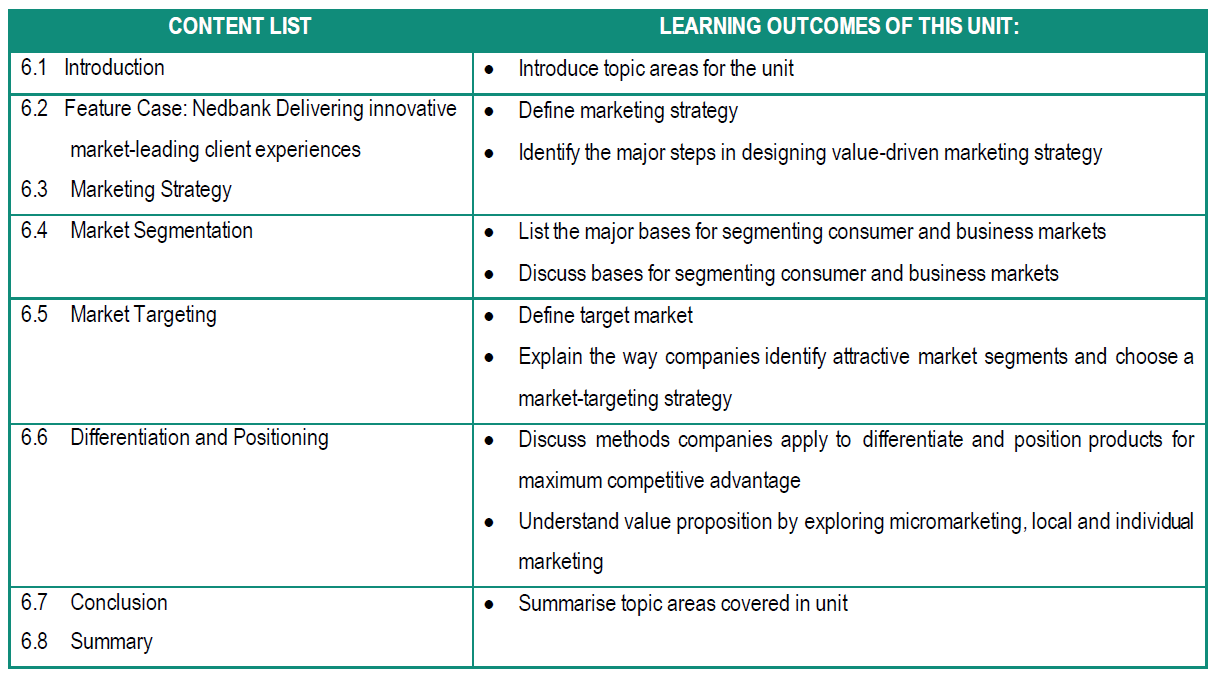
Unit Learning Outcomes
 | Prescribed and Recommended Textbooks/Readings Prescribed Reading(s)
Recommended Reading(s)
|
6.1 Introduction
The previous unit provided discussions on business markets and nonbusiness markets while contrasting them from consumer markets. This unit focuses on the marketing strategies to deliver value to customers. Modern companies are aware of their limitations when appealing to all kinds of buyers that are found in the marketplace. In a marketplace there are widely scattered and varied buyers. This means that buyers’ needs and buying practices are many and different. Since companies are not having the same abilities to serve different market segments, then the marketers make sure that they design customer-driven marketing strategies.
This unit discusses that marketers should work together with customers to create customer driven-value. You should know and understand how customer driven-value marketing strategies sustain the company and help it to attain competitive advantage and profitable customer relationships. By digging deep into marketing strategy, you need to decide on segmentation, targeting, differentiation, and positioning strategy decisions essential in developing a customer value-driven strategy. Below is an excerpt on Nedbank. Nedbank emphasises focus on delivering innovative market-leading client experiences.
6.2 Feature Case: Nedbank Delivering innovative market-leading client experiences
 | CASE STUDY |
 | Think Point 1. Using your experience of a variety segmentation variables, discuss how Nedbank segments and targets the market for the banking sector services. 2. What market targeting strategy do you think Nedbank is using? Support your thinking |
|
6.3 Marketing Strategy
Kotler and Armstrong (2018:212) argue that “marketing boils down to two questions: (1) Which customers will we serve? Companies are here able to: identify market segments, select one or more of them, and develop products and market programs tailored to each.
 | LEARNING OUTCOMES |
In a competitive marketplace, successful companies understand that they cannot serve all buyers in the marketplace. This is shown in Figure 6.1
Figure 6.1: Designing a Customer-Driven Marketing Strategy
Source: Kotler and Armstrong (2018:212)
Figure 6.1 displays key elements in designing a customer driven marketing strategy with the focus to create value for targeted customers as follows:
Market segmentation- Dividing a market into smaller segments with distinct needs, characteristics or behaviour that might require separate marketing strategies or mixes (Kotler and Armstrong, 2018:212)
Market targeting - The process of evaluating each market segment’s attractiveness and selecting one or more segments to enter (Kotler and Armstrong, 2018:212)
Differentiation - Differentiating the market offering to create superior customer value (Kotler and Armstrong, 2018:212)
Positioning- Arranging for a market offering to occupy a clear, distinctive and desirable place relative to competing products in the minds of target consumers (Kotler and Armstrong, 2018:213)
6.4 Market Segmentation
A fundamental marketing question to be answered by the marketer is: What customers will we serve? (Kotler and Armstrong, 2018:213). This section should help you dissect and differentiate segmentation variables for the consumer markets from the business markets. You then need to address the marketer’s question, what customers to serve by creating market segments.
| LEARNING OUTCOMES |
According to Kotler and Armstrong (2018:213) “buyers across the market are different in their buying attitudes, locations, wants, resources, and buying behaviour demanding that companies address them differently to better serve the diverse buyers”. Therefore, marketers and companies divide large and diverse markets into manageable smaller sections of customers to effectively and efficiently serve their varying needs. Three market segmentations are important as presented below:
Figure 6.2 Three Market segmentations
Source: Author
6.4.1 Segmenting consumer market
Marketers succeed in reaching and serving buyers of their products need by finding a strategic method to view the market structure for the company. Thus, Figure 6.3 below is presenting how to segment consumer market.
Figure 6.3: Segmenting consumer market
Source: Study Guide Author
Figure 6.3 shows that consumer market is divided smaller different geographical units, groups of people according to their ages, family and income, social class characteristics, and then consumers’ knowledge, attitude and response to products. Marketers also use Multivariable Segmentation whereby they attain the general view of the buyers from multiple segmentation bases (Kotler and Armstrong, 2018:217). Thus, this is when marketers combine segmentation variables to identify smaller, better-defined target groups in the marketplace (Kotler and Armstrong, 2018:217).
6.4.2 Segmenting Business Markets
Business marketers use similar bases such as those used in the consumer market for segmenting the business markets (Kotler and Armstrong, 2018:219). Companies establish separate units or divisions that will focus on understanding a business unit from a company and construct marketing strategies tailored to specific business needs (Kotler and Armstrong, 2018:219 - 220).
6.4.3 Segmenting International Markets
Companies generally cannot afford the resources to serve all countries of the world, but they navigate national differences in political economies of different world market segments (Kotler and Armstrong, 2018:220).
For example, a contrast can be made between Coca-Cola and MTN. Coca-Cola sell their products in more than 200 countries whereas for MTN the focus is on one smaller market set (Kotler and Armstrong, 2018:220). This implies that international marketers need to be cautious of differences in factors found in national and regional market segments of the world market, and then “group their world markets into segments with distinct buying needs and behaviors” (Kotler and Armstrong, 2018:220).
Figure 6.4 Segmenting international markets.
Source: Study Guide Author
Figure 6.4 shows that international marketers segment their world markets according to factors influencing national political economies. Marketers use the intermarket or cross-market segmentation technique (Kotler and Armstrong, 2018:220).
Intermarket or cross-market segmentation is “forming segments of consumers who have similar needs and buying behaviours even though they are located in different countries” (Kotler and Armstrong, 2018:220). This essentially means that in the segmentation of markets there are several ways that marketers can use to segment consumer markets and segment business markets (Kotler and Armstrong, 2018:220).
6.5 Market Targeting
After dividing the market into segments, marketers must then answer another simple marketing strategy question: Which customers will the company serve? (Kotler and Armstrong, 2018:221). Market targeting involves evaluating the market segments and then selecting market segments to target. In this section you should be able to understand how marketers organize the customers they want to serve. You need to discover and decide on undifferentiated and differentiated markets.
LO3: At the end of the section you should be able to define the concept target market. Also, to explain the way companies identify attractive market segments and choose a market-targeting strategy. |
| LEARNING OUTCOMES |
6.5.1 Evaluating Market Segments
Marketers assess and align three factors, namely, segment size and growth, segment structural attractiveness, and company objectives and resources. They do so to determine if segments are appropriate (Kotler and Armstrong, 2018:222). If the assessment result does not satisfy the marketer and fail to give assurance to the company objectives and resources, then the later does not match the needs of a chosen segment. Segment structural attractiveness is affected by the level of competition, new entrants, threat of substitutes, power of buyers, and suppliers (Kotler and Armstrong, 2018:222).
6.5.2 Selecting Target Market Segments
After evaluating different segments, the company then decides on which and how many segments it will target. Target market refers to “a set of buyers who share common needs or characteristics that a company decides to serve” (Kotler and Armstrong, 2018:222). Market targeting can be carried out from broad targeting through different levels to narrow targeting, as shown in Figure 6.5 below.
Figure 6.5 Market-targeting strategies.
Source: Kotler and Armstrong (2018:222)
Undifferentiated marketing
This occurs when a firm decides to ignore market segment differences and go after the whole market with one offer. Focus is on what is common in consumer needs, rather than what is different (Kotler and Armstrong, 2018:222). For example, agricultural products such as tomatoes may be sold using a mass-market approach because companies selling tomatoes are not able to differentiate market segments.
i) Differentiated marketing
When a firm decides to target several market segments and designs separate offers for each (Kotler and Armstrong, 2018:222). For example – Vaseline offers skin care products for women, families (such as babies) and men.
ii) Concentrated marketing (niche)
When a firm targets one market segment, or a niche. This is especially appealing when resources are limited (Kotler and Armstrong, 2018:223). For example, Nespresso targets the luxury coffee market segment.
iii) Micro marketing
This is the practice of tailoring products and marketing programmes to the needs and wants of specific individuals and local customer groups (Kotler and Armstrong, 2018:224).
STUDENT TIP: Market targeting comprise of segments the marketer decides to serve best after evaluating various segments. |
6.6 Differentiation and Positioning
Now a company moves further to answer this question: How will we serve them (customers) better? (Kotler and Armstrong, 2018:228). In this section you should therefore be able to assess and adopt the techniques for choosing differentiation and positioning strategy. You need to demonstrate the way a company can deliver on brand positioning.
| LEARNING OUTCOMES |
After the company has decided on which segment to target, now it is time to decide on creating value for the customers and satisfying them in four ways:
Product positioning
The way the product is defined by consumers on important attributes – the place the product occupies in consumers’ minds relative to competing products (Kotler and Armstrong, 2018:228).
Competitive advantage
An advantage over competitors gained by offering consumers greater value, either through lower prices or by providing additional benefits that justify higher prices (Kotler and Armstrong, 2018:230).
Value proposition
The full positioning of a brand- the full mix of benefits upon which it is positioned (Kotler and Armstrong, 2018:232).
Positioning statement
A statement that summarises the firm or brand positioning (Kotler and Armstrong, 2018:235)
STUDENT TIP: Positioning when marketers create favourable brand perceptions, impressions, and feelings that consumers can use as a point of reference in their future purchase decision. |
6.7 Conclusion
Marketing strategy is the blueprint that helps marketers to determine how to effectively serve the chosen markets and to enhance customer value. This first step helps the marketers to divide markets into small groups with similar characteristics and behaviour within the consumer market. Just like the consumer markets, the business markets are segmented geographically, demographically, or by benefit sought, user status, usage rate, and loyalty status. International markets are segmented using geographic location, economic factors, political and legal factors, cultural factors, and cross market segments.
6.8 Summary
Due to constant investments in marketing research, companies can develop effective marketing strategies, and can reinforce brand superiority in a competitive market. This unit looked at methods that marketers can use to divide the consumer, business and international markets into manageable groups with similar characteristics and buying behaviour. The emphasis in market segmentation is to evaluate and select the segments that offer greater opportunities and align with company objectives and resources. This helps with an understanding of how marketers evaluate all potential markets and end up deciding on one or a few that it can effectively serve better than competing companies do. Market differentiation looked at how marketers sell their products or brands to distinct markets.
 | REVISION QUESTIONS 1. Define the major steps in designing a customer value–driven marketing strategy: market segmentation, targeting, differentiation, and positioning. Submit Your Answer 2. Explain how companies identify attractive market segments. Submit Your Answer 3. Discuss how companies differentiate and position their products for maximum competitive advantage. Submit Your Answer |