🧪 Unit 1 Review
1.1 Introduction in Physics
What is physics? Physics is a branch of science that studies matter and its behavior through space and time.
SIX STEPS TO THE SCIENTIFIC METHOD
Observation
Question
Hypothesis
Experiment
Conclusion
Result
What are dependent and independent variables? Dependent means it is the variable I can measure, Independent means a variable I can change in the experiment.
AREAS WITHIN PHYSICS:
Mechanics: Studies motion and its causes
Thermodynamics: Studies heat and temperature
Vibrations and Waves: Studies specific type of repetitive motions
Optics: Studies light and mirrors
Electromagnetism: Studies electrcity, magnetism, and light
Quantum Mechanics: Studies behavior of submicroscopic particles
UNITS, STANDARDS, AND THE SI SYSTEM
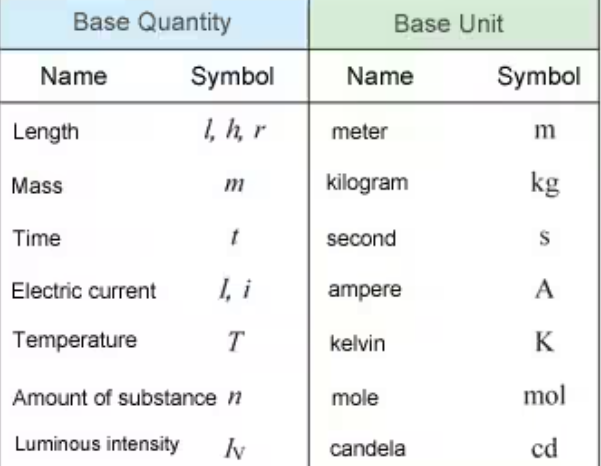
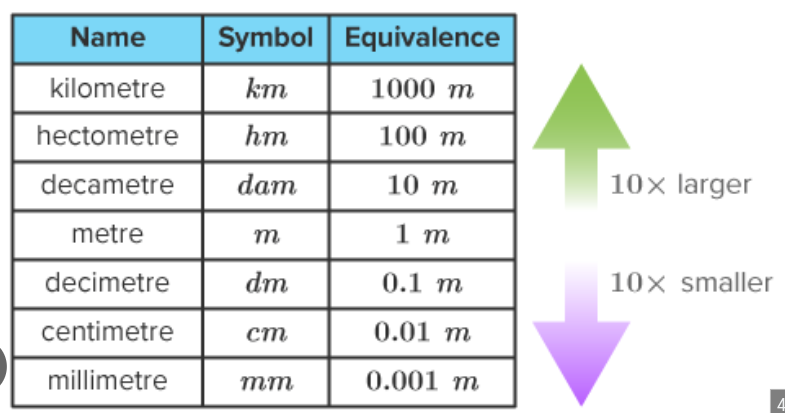
Smallest units in order:
1.2 Physical Quantities
All measurable aspects of motion are called physical quantities. These come in two types:
🔹 Scalar Quantities
Have magnitude only (just a number).
No direction involved.
Examples:
Distance: “I walked 5 km.”
Speed: “The car is going 60 km/h.”
Time: “It took 2 hours.”
Mass: “The box weighs 10 kg.”
🔸 Vector Quantities
Have magnitude and direction.
Direction matters!
Examples:
Displacement: “I moved 5 km north.”
Velocity: “The plane is flying at 800 km/h east.”
Acceleration: “The car is speeding up at 3 m/s² forward.”
Force: “A push of 10 N to the left.”
🧠 Why does this matter? If you walk 5 km in a circle and end up where you started, your distance is 5 km, but your displacement is 0 — because you didn’t change position.
📍 Position
Position is the location of an object relative to a reference point (often called the origin).
Imagine a number line:
If you’re standing at +3 meters, you’re 3 meters to the right of the origin.
If you’re at −2 meters, you’re 2 meters to the left.
Position is a vector — it tells you where and in which direction.
📏 Distance vs. Displacement
Let’s say you walk from your house to the park and back:
Distance is the total path you traveled.
If the park is 2 km away, and you walk there and back, your distance is 4 km.
Scalar — just the number.
Displacement is the change in position.
You started and ended at the same place, so your displacement is 0 km.
Vector — includes direction.
🧭 Displacement can be positive, negative, or zero, depending on the direction of motion.
🚀 Speed vs. Velocity
🔹 Speed
How fast something is moving.
Scalar — no direction.
Formula:
Speed=Distance/Time
🔸 Velocity
Speed with direction.
Vector — direction matters.
Formula:
Velocity=Displacement/Time
1. 3 Acceleration
🚀 What Is Acceleration?
Acceleration is the rate at which an object’s velocity changes over time. It tells us whether something is speeding up, slowing down, or changing direction.
It’s a vector quantity — meaning it has both magnitude and direction.
Positive acceleration: speeding up in the forward direction.
Negative acceleration (also called deceleration): slowing down or accelerating in the opposite direction.
🔺 Acceleration Formula
Acceleration Formula = Change in Velocity/ Time = V(f) — V(i) / T
v_f = final velocity
v_i = initial velocity
t = time taken
1. Average Speed
🔹 Definition:
Average speed is the total distance traveled divided by the total time taken. It tells you how fast something moved overall, regardless of changes in speed during the journey.
🔹 Formula:
Average Speed = Total Distance / Time
⏱ 2. Instantaneous Speed
🔹 Definition:
Instantaneous speed is the speed of an object at a specific moment in time. It’s what you see on a speedometer or radar gun.
🔹 Formula:
There’s no simple formula — it’s often found using calculus or from a graph (slope of distance-time curve at a point).
🔹 Example:
If your speedometer reads 65 km/h right now, that’s your instantaneous speed — even if your average speed for the trip is lower.
🚀 3. Average Acceleration
🔹 Definition:
Average acceleration is the overall change in velocity divided by the time it took for that change. It tells you how quickly an object sped up or slowed down over a period.
🔹 Formula:
Average Acceleration = Vf - Vi / T
⚡ 4. Instantaneous Acceleration
🔹 Definition:
Instantaneous acceleration is the rate of change of velocity at a specific moment. It’s like the “acceleration reading” at a particular instant.
🔹 Formula:
Found using calculus or from a velocity-time graph (slope at a point).
🔹 Example:
If you press the gas pedal suddenly and your velocity jumps sharply, the spike in acceleration at that moment is your instantaneous acceleration.
1.4 Kinematic Equations
🧮 The 4 Kinematic Equations
These equations assume constant acceleration and are used when motion is in a straight line.
Equation | Use When | Formula |
|---|---|---|
#1 Final velocity | You know initial velocity, acceleration, and time | v = V0 + at |
#2 Displacement | You know initial and final velocity, and time | Δx= v + v(a) / 2 × t |
#3 Displacement | You know initial velocity, acceleration, and time | Δx= VoT + 1/2at² |
#4 Final velocity | You know initial velocity, acceleration, and displacement | v²= v²0 + 2aΔx |
🧠 How to Use Each Equation
🔹 Equation 1
Use when you need final velocity.
You must know initial velocity, acceleration, and time.
✅ Example:
A car starts at 10 m/s and accelerates at 2 m/s² for 5 seconds:
v=10+(2)(5)=20 m/s
Equation 2:
Use when you know both velocities and time, but not acceleration.
✅ Example:
A train speeds from 20 m/s to 40 m/s in 10 seconds:
Δx=40+202⋅10=300 m
Equation 3:
Use when you know initial velocity, acceleration, and time, but not final velocity.
✅ Example:
A ball is thrown upward at 15 m/s with acceleration −9.8 m/s² for 2 seconds:
Δx=15(2)+12(−9.8)(2)2=30−19.6=10.4 m
🔹 Equation 4
Use when you know displacement, initial velocity, and acceleration, but not time.
✅ Example:
A car accelerates from 0 m/s over 100 m with 4 m/s²:
v2=0+2(4)(100)=800⇒v=800≈28.3 m/s
1.5 Position Match Graph
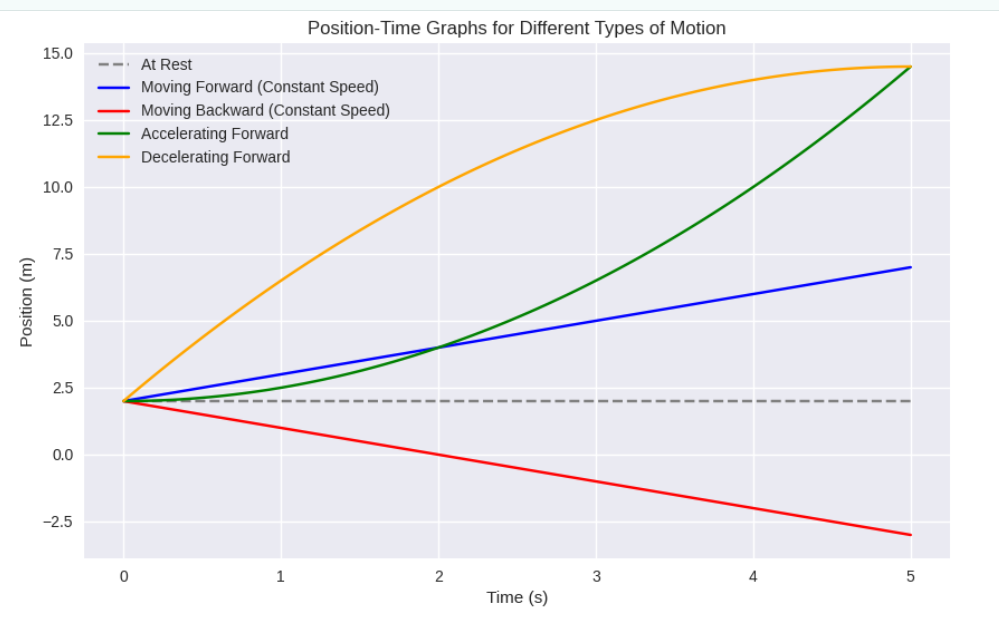
🧭 What Is a Position-Time Graph?
A position-time graph shows how far an object is from a starting point (called the origin) as time passes.
🧠 What Does the Shape of the Graph Tell You?
Let’s break down the different shapes you might see and what they mean:
1. Flat Horizontal Line
What it looks like: A straight line that doesn’t go up or down.
What it means: The object is not moving. It’s staying at the same position.
Example: A parked car.
2. Straight Line Going Up (Positive Slope)
What it looks like: A diagonal line rising from left to right.
What it means: The object is moving forward at a constant speed.
Example: A person walking steadily away from home.
3. Straight Line Going Down (Negative Slope)
What it looks like: A diagonal line falling from left to right.
What it means: The object is moving backward at a constant speed.
Example: A person walking back toward home.
4. Curved Line Getting Steeper
What it looks like: A curve that gets more vertical as it goes.
What it means: The object is speeding up (accelerating).
Example: A ball rolling downhill.