Week 1 Pension
The UK pensions system possesses two tiers:
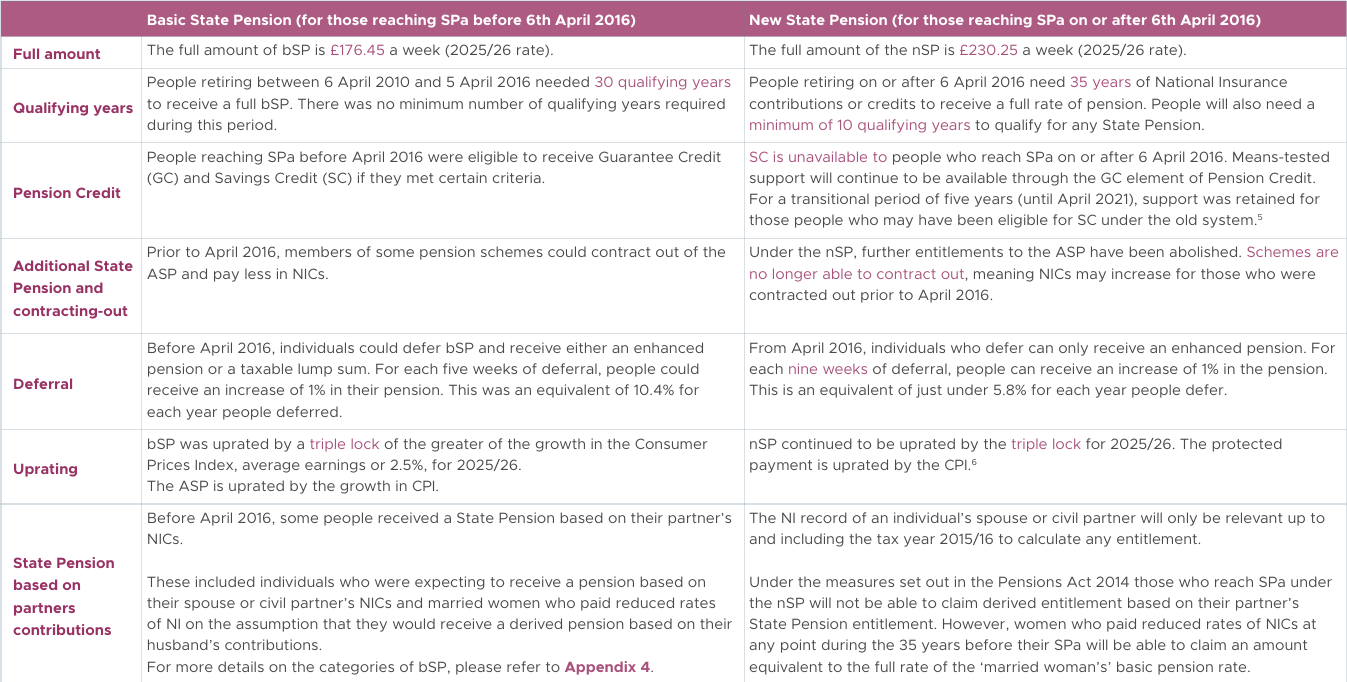
Tier 1 (Public) is provided by the State and consists of a basic level of pension to which almost everyone either contributes or has access, providing a minimum level of retirement income. The State Pension operates on an unfunded ‘pay-as-you-go’ contributory basis, through the National Insurance (NI) system. This consists of the new State Pension (nSP), which people who reach SPa from April 2016 receive, and the basic State Pension (bSP), or old State Pension, which people who reached SPa prior to April 2016 receive.
Tier 2 (Private) is voluntary private pension arrangements that are not directly funded by the State. This includes public and private sector occupational pension schemes, as well as any individual personal pension savings. Private pension contributions from the employer and/or the individual provide designated pensions for the individual. The primary aim of private pensions is to redistribute income across an individual’s lifetime, and not to redistribute income from higher-income to lower-income people.
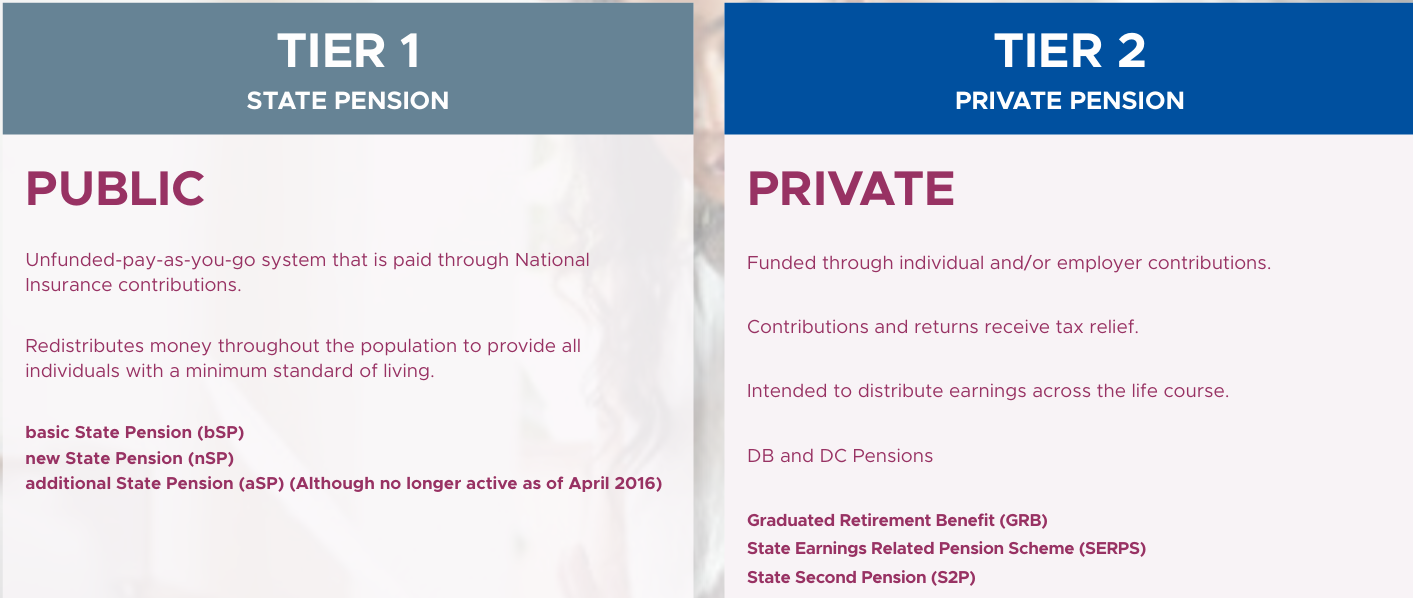
Tier 1 operates on a ‘pay-as-you-go’ basis, through National Insurance (NI) and general taxation. Pension Credit is funded through general taxation
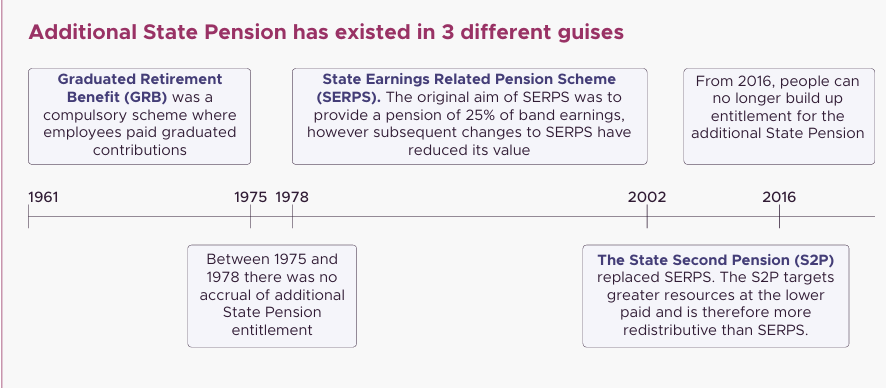
Despite people no longer being able to accrue this entitlement, there are still individuals who continue to receive retirement incomes that include it, so it will remain relevant for years to come.
Included in this section are
The new State Pension (nSP)
The basic State Pension (bSP) and additional State Pension (aSP)
Means-tested benefits.
Pension entitlement is based on an individual’s NI contributions record. Any tax year in which an individual makes, or is credited with making, sufficient NICs is known as a qualifying year. People can gain credits for the State Pension if, for instance, they are entitled to: • Statutory Sick Pay (SSP), • Statutory Maternity (SMP), • Paternity or Adoption Pay, • Child Benefit, • Universal Credit (UC) • or Carer’s Allowance
GC is the main means-tested benefit currently paid to those aged 66 and above. People (or households) become eligible for GC if other sources of income do not reach a certain level. If claimed, GC provides a safety net of a minimum level of income. Its effect is redistributive – the benefit is paid from taxes that are related to income and only paid to those on low income. In 2025/26, GC provides a minimum income of £227.10 a week for single people and £346.60 a week for couples.25 GC entitlement can be higher for disabled people, people with caring responsibilities or people with a mortgage.26
With the introduction of the nSP and the removal of the mechanism for accruing entitlement to ASP, SC is no longer available for people reaching SPa after 6th April 2016. SC was designed to ensure that those who made some private provision for retirement, or had entitlement in excess of the State Pension, including SERPS and S2P, were better off than those who had made no provision.
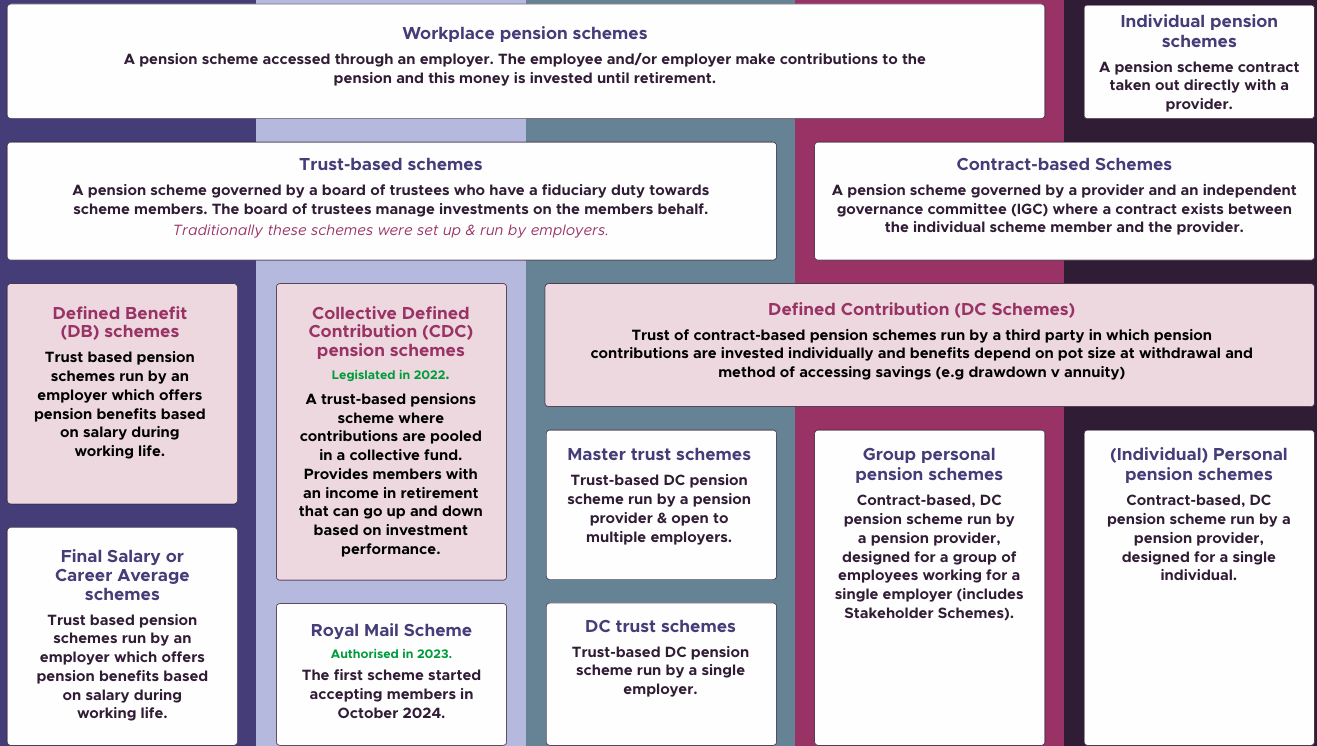
Workplace pension schemes
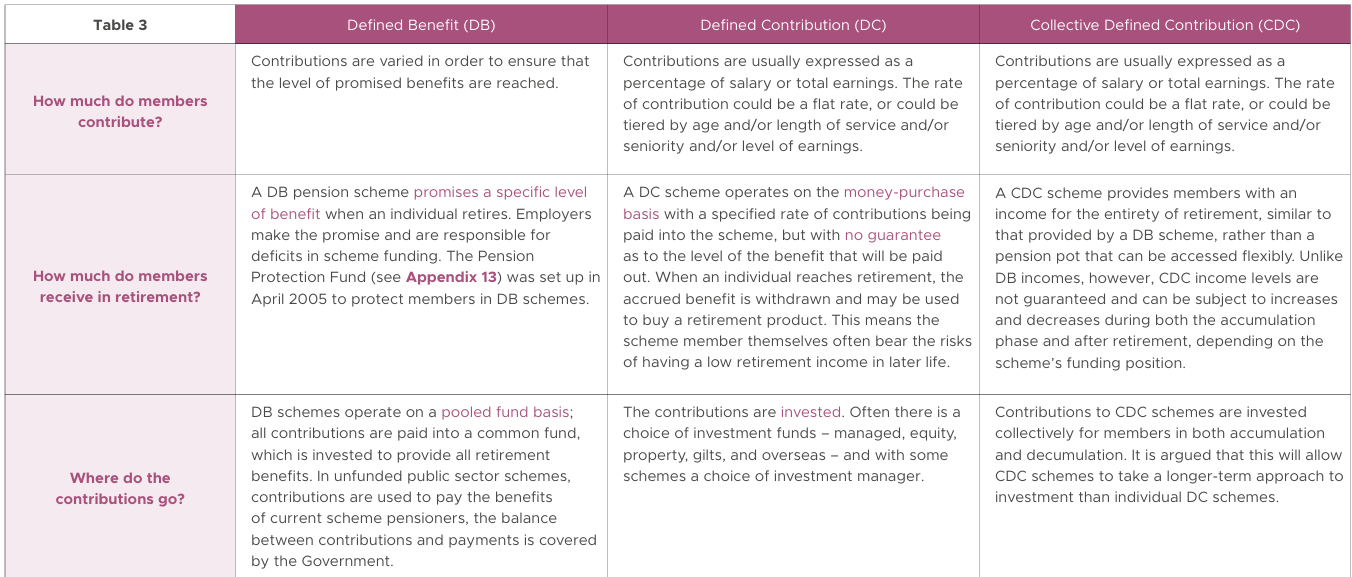
Pensions provided through the employer are called workplace pensions. Workplace pension schemes can be structured as DB, DC, or hybrid/risk-sharing schemes such as CDC. Most private pension arrangements are employer sponsored personal pensions, or multi-employer schemes. The employer usually contributes to these schemes, and, in the case of a scheme used for automatic enrolment requirements, the employer must contribute. More often than not, an employee contribution is also required.
Individual Arrangements Personal pension plans are individual arrangements (not made through an employer) based on a direct contract between the individual and a pension provider, and are contract based (Figure 9). There are several types of these, including stakeholder pensions and a distinct product called a personal pension. These work with the same underlying money-purchase principle as workplace pensions, but individual pensions can have higher charges due to the provider running the scheme for one person rather than a group of employers. Until April 2001, individual personal pensions were only available to individuals while they were self-employed, or were not members of an occupational pension scheme. Legislation introducing stakeholder pensions widened access further and, from April 2006, individual pension arrangements became open to everyone under age 75
Employees have the choice to opt out of being enrolled into a pension scheme. Every three years, employers must repeat the automatic enrolment process so that employees who chose to opt out, or leave subsequent to the opt-out period, can revisit their decision.43 This is known as re-enrolment. The required level of contributions that employers and employees must make into a pension scheme (if employees remain opted in) is 8% minimum total contributions of band earnings.44 This 8% is made up of a minimum 3% from the employer and the remainder from the employee and the Government (through tax relief)45 (Figure 10). If the employer decides to contribute the legal minimum of 3% of band earnings, then employees who do not opt out will have to contribute 4% and the Government will contribute 1% through tax relief.46 However, it will be up to employers to decide whether they want to contribute more. If they contribute more than 3%, that could reduce the amount that employees are required to contribute