Lesson 11: Manage an Offering
Introduction
Welcome to the Manage an Offering lesson. As a Religious Affairs Specialist, you will be tasked with managing an offering. But what does that entail? This lesson will cover the procedures for managing offerings, how to responsibly handle an offering, and how to complete the Detailed Income Record, or DIR.
Lesson Objectives
There are four learning objectives in this lesson. You will learn to identify the procedures for collecting offerings, determine the usage, destination, and management of collected offerings, identify the roles of the five key personnel involved in receiving chapel offerings, and identify the procedures for the completion of the Detailed Income Record, or DIR. At the end of this lesson you will complete the Lesson 11 posttest with a score of 70% or higher.
- Identify procedures for collecting offerings
- Determine the usage, destination, and management of collected offerings
- Identify the roles of the five key personnel involved in receiving chapel offerings
- Identify procedures for completion of the Detailed Income Record (DIR)
Topic 1: How to Responsibly Handle an Offering
- Introduction
In many religions around the world, giving back a portion of one's earnings is a way to show humility, respect, and charity. Tithes and offerings from worshipers are an essential element of religious service. As a Religious Affairs Specialist, one of your duties will be to collect and secure the chapel tithes and offerings. In this topic, you will learn how to manage the Chapel Tithes and Offerings Fund, or CTOF. Any misuse of the fund will result in Uniform Code of Military Justice, or UCMJ, action against you and anyone involved. It is imperative that you take responsibility in order to ensure that all money is properly handled and accounted for.
- What are Offerings and Tithes?
Offerings, or tithes, refer to donations in the form of money given by worshipers as an expression of their faith. For many, an offering is an integral and essential part of their worship. Offerings are an essential element of religious services, or EERS.
Offerings/Tithes:
- Donations
- Money given by worshipers
- Integral and essential part of worship
- Essential Element of Religious Services (EERS)
- Chapel Tithes and Offerings Fund
Every offering is deposited into the Chapel Tithes and Offerings Fund, or CTOF. The CTOF is a non-appropriated fund that provides supplemental support for the religious practices and requirements of Soldiers, authorized Department of Defense, or DoD, personnel, their family members, and other authorized personnel. Every CTOF is legally constituted as an instrumentality of the U.S. Government, meaning that CTOF funds and property belongs to the U.S. Government; in addition, CTOFs have no independent organizational existence apart from their relationship with the mission of the Chaplaincy. However, as fiscal entities, CTOFs maintain custody of and control over their assets. CTOFs are managed by the approved Chaplaincy Financial Accounting System, or CFAS, in accordance with AR 165-1 and the Chief of Chaplain's policy guidance.
Chapel Tithes and Offerings Fund (CTOF)
- Non-appropriated fund
- Supplemental support for religious practices and requirements of:
- Soldiers
- Authorized Department of Defense (DoD) personnel
- Family members
- Other authorized personnel
- Legally constituted as an instrumentality
- Managed by approved Chaplaincy Financial Accounting System (CFAS)
- CTOF Uses
The CTOF is used to enhance worship and provide supplemental funding for the Unit Ministry Team, or UMT, programs. Some examples of acceptable usage for the CTOF include purchasing of fellowship refreshments, supplementing funding for mission or youth trips, and obtaining supplies for special programs or retreats. The CTOF will not be used to cash checks or make change.
- Enhances worship
- Provides supplemental funding for Unit Ministry Team (UMT)
- Examples:
- Purchase of fellowship refreshments
- Supplementing funding for trips
- Obtaining supplies for special programs/retreats
- Not used to cash checks or make change
- Personnel Responsible for Offerings
In order to manage CTOF funds properly, five key personnel are involved in receiving chapel offerings: the Fund Manager, the Fund Clerk, the Counters, the Verifier, and the Officiating Chaplain. Each of these individuals has a responsibility when dealing with offerings.
Five key personnel:
- Fund Manager
- Fund Clerk
- Counters
- Verifier
- Officiating Chaplain
- The Fund Manager and Fund Clerk
The Fund Manager is responsible for ensuring that there are internal control plans, or ICP, in place and is a Chaplain or a Religious Affairs Specialist in the rank of Staff Sergeant or above. The Fund Clerk is responsible for the processing of the fund and must be a graduate of the U.S. Army Chaplain Center and School, or USACHCS, CTOF Fund Clerk Course. According to AR 165-1, the Fund Manager and Fund Clerk are appointed by the Commander. * Fund Manager * Ensures internal control plans (ICP) in place * Chaplain or Religious Affairs Specialist (SSG or above) * Appointed by the Commander * Fund Clerk * Responsible for processing fund * Must be graduate of U.S. Army Chaplain Center and School (USACHCS) CTOF Fund Clerk Course * Appointed by the Commander
- The Counters
Counters are responsible for physically counting the money correctly. Collections and offerings will be received publicly, remain in public view until removed for counting, then counted immediately upon removal from public view and prepared for deposit by at least two counters. Counters must be 18 years of age or older and unrelated by either blood or family ties, and they should not be part of the Chapel Staff.
Counters
- Responsible for counting the money
- Keep money in public view until removed for counting
- Count immediately upon removal
- Two counters prepare money for deposit
- Must be 18 or older, unrelated, and cannot be Chapel Staff
- The Verifier
You, the Religious Affairs Specialist assigned to the service, are the verifier. The verifier is responsible for physically verifying the counters' totals and completing the Detailed Income Record, or DIR, correctly. In addition, you are responsible for selecting and screening the counters. Many congregations will have already designated the ushers, who collect the offerings, as counters, but you must confirm their eligibility from the required criteria. Select or verify your counters prior to the service. This is important to you since you will be counting offerings at your chapel. Ensure you follow your local standing operating procedure, or SOP.
Verifier - Religious Affairs Specialist
- Verify totals and complete Detailed Income Record (DIR)
- Select and screen counters
- Based on required criteria
- Prior to service
- Follow local standing operating procedure (SOP)
- The Officiating Chaplain
The Officiating Chaplain certifies that the appropriate management controls are followed. The Chaplain in charge of the service or the designated representative will verify that the collections and offerings SOPs are followed.
- Certifies that management controls are followed
- Verifies the collections and offerings SOPs are followed
- Summary
In this topic, you learned how to handle an offering and the roles of those who manage the Chapel Tithes and Offerings Fund, or CTOF. By understanding the process and procedures of collecting and securing tithes and offerings, you will begin to understand how to better assist the chaplain.
How to handle an offering \n
Topic 2: Completing Detailed Income Record
- Introduction
In this topic, we will discuss the components of a Detailed Income Record, or DIR, and the procedures for completing one. As the Religious Affairs Specialist, you are responsible for collecting, counting, securing, and depositing an offering. Handling money given by worshipers is a highly sensitive procedure and should be treated with respect; any missing funds could result in administrative or legal action.
- Management Controls
As the Religious Affairs Specialist and Verifier, you must adhere to specific rules when collecting and counting offerings before completing a DIR. For instance, offerings must be received publicly and remain in public view until removed for counting. Next, the money should be accompanied to the counting room, counted immediately, and prepared for deposit by at least two adults. It is important to note that the Chapel Tithes and Offerings Fund, or CTOF, will not be used to cash checks or make change.
- Offerings received publicly, remain in public view
- Money must be counted immediately when removed
- Prepare for deposit by two adults
- Do not use Chapel Tithes and Offerings Fund (CTOF) to cash checks or make change
- Management Controls (Continued)
In order to obtain an accurate total, Counters need to follow specific procedures. First, Counters should separate the offerings by denomination and coin, and then separately count and verify the total using scrap paper and a pen. Then, the Counters should compare totals for a match and recount to ensure accuracy. Finally, as the Verifier, you will count the offerings again to verify the Counters' totals. Using this information, the Verifier fills out the DIR.
Counters:
- Separate offerings by denomination and coins
- Separately count money using scrap paper and pen
- Compare totals and recount
Verifier:
- Count offerings again to verify totals
- Fill out DIR
- Section I of DIR
After completing a thorough count of all offerings, you must complete a DIR. Section I of a DIR is filled out for you by the funds office. The control number indicates that the DIR is a controlled document. The Garrison block is usually the installation where the service is located. Date of Service is the date the service is conducted. Type of Income is broken down into three categories: regular offering, designated offering, and donation. 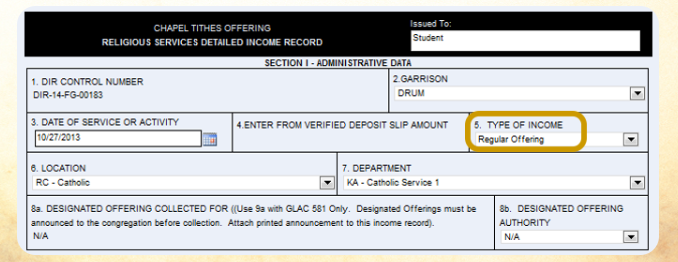
- Section I of DIR (Continued)
The location block identifies the type of service, such as Catholic, Jewish, or another denomination. The department block identifies what service is covered; this is useful when you have more than one service in the same day, such as Catholic service one at 0900 and Catholic service two at 1100. The designated offering collected block and the designated offering authority block are used for designated offering information; if no designated offering exists, these blocks can say "not applicable."
- Section II of DIR
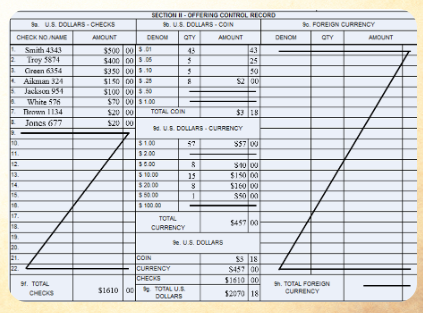
Section two of a DIR contains specific information about the donated offerings. Block 9a contains the check number and the last name of the person who donated money; after the last check, use a large Z to block out any remaining black spaces. Block 9f shows the product of the checks in this section. Block 9b indicates the amount of loose change in the offerings; the denomination column shows the various denominations included, the quantity column shows the number of coins given for each denomination, and the amount column is the product of the first two columns. The total coin section shows the final product based on the amount column. 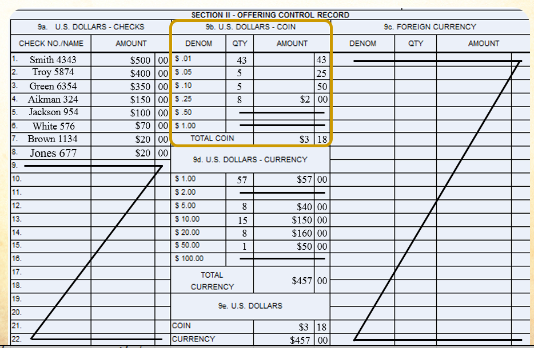
- Section II of DIR (Continued)
Block 9c, foreign currency, and 9d, U.S. dollars, function in the same capacity as Block 9b; however, foreign currency is not used often. Check with the Fund Clerk or the local SOP on the policy for receiving foreign currency before the service begins. Section 9e summarizes the data from the total coin, total currency, and total checks sections, and Section 9g contains the final product.
- Section III of DIR
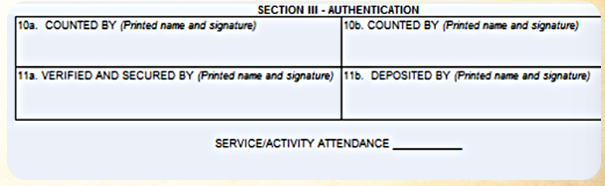
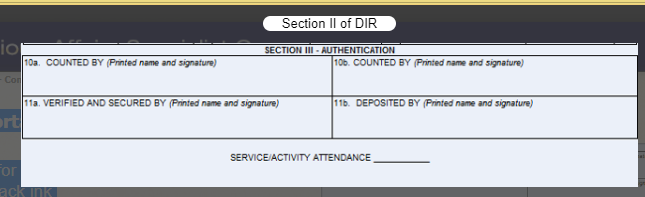
In Section 3, Blocks 10a and 10b should include the printed name and signature of each of the Counters. Make sure that their printed names are legible in case they need to be contacted about the offering. Block 11a should include the printed name and signature of you, the Religious Affairs Specialist and Verifier. Block 11b indicates the printed name and signature of the person who deposits the money. The Service/Activity Attendance line should be used to record the number of worshipers in attendance. This can be used as justification for a larger facility.
- Blocks 10a and 10b: Include both printed and signed names of counters
- Block 11a: printed name and signature of Religious Affairs Specialist/Verifier
- Block 11b: printed name and signature of person who deposits money
- Record attendance in Service/Activity line
- Attendance can be used to justify a larger facility
- Page 2 of DIR
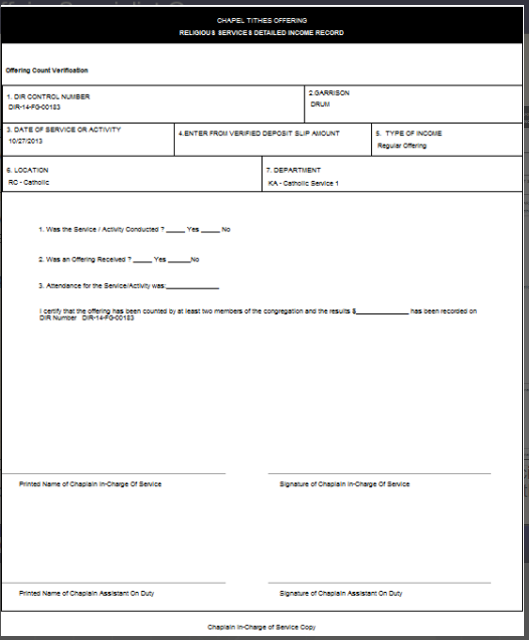
On Page 2 of the DIR, Blocks 1 through 7 are filled out by funds office and auto-populate. As the Religious Affairs Specialist, you will fill out the rest of the information. Indicate whether or not a service activity was conducted and an offering was received, and include the number of people in attendance once again. Then, you will certify that two members of the congregation counted the money and that the amount of money was recorded in the DIR. The Chaplain in charge of the service and the Religious Affairs Specialist will provide their printed names and signatures at the bottom of the page. Page 2 of the DIR stays with the Chaplain in charge of the service.
- Blocks 1-7 autopopulate via funds office
- Indicate service activity, offering, and number of attendants
- Certify two members of congregation counted money
- Certify that total money was recorded in DIR
- Chaplain and Religious Affairs Specialist print and sign
- Page 2 stays with Chaplain
- Page 3 of DIR
Page 3 of the DIR is a duplicate of Page 2. Once filled out, the fund manager should receive page three, unless indicated otherwise by local standing operating procedure, or SOP.
- Deposit Slip
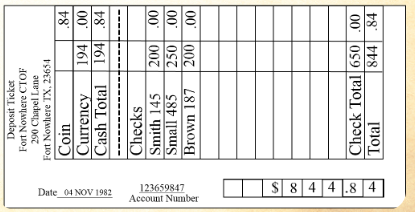
After completing the DIR, you should prepare the money to be deposited. The deposit slip should indicate the date of the deposit, the account number, the total of all cash and coin, the checks listed by name and check number, the check total, and the overall total.
- Date of deposit
- Account number
- Total cash and coin
- Checks listed by name and check number
- Check total
- Overall total
- Receipts for Checks
Every check included in the offering should be stamped for deposit with the local bank number. For all checks over $250, ensure the congregation member receives a receipt; if the congregation member is not available, provide the funds office with a receipt. Fill out the receipt as shown on the screen. For most installations, the "for payment of" line indicates the local CTOF. The Religious Affairs Specialist should sign the receipt.
- Stamp checks for deposit
- Provide receipts for checks over $250
- Religious Affairs Specialist signs receipt
- Acquiring a DIR
In order to acquire a DIR, the Religious Affairs Specialist must plan accordingly. The fund office provides the DIR and the bank deposit bags. Keep in mind that the Religious Affairs Specialist needs to make arrangements to sign for and pick up the DIR and deposit bags before the service; if your duty is on Sunday, most Fund Clerks require the DIR and deposit bag be picked up by 1500 on Friday. You must also plan for holidays and designated duty assignments. Each post and duty assignment is different, so you must contact your Fund Clerk for the local SOP.
- Fund office provides DIR and bank deposit bag
- Religious Affairs Specialist picks up DIR and bag before service
- Pick up by 1500
- Plan for holidays and duty assignments
- Contact Fund Clerk for local SOP
- Other Important Information about DIRs
A DIR is required for each service and must be filled out with black ink. In addition, you must complete the form in front of the designated Counters. The Counters sign the DIR in Blocks 10a and 10b only after the DIR is complete. Leave no blank spaces; this will reduce the risk of anyone trying to alter the DIR.
- DIR required for each service
- Fill out with black ink
- Complete form in front of Counters
- Counters sign only when DIR is complete
- Leave no blank spaces
- Correcting a DIR
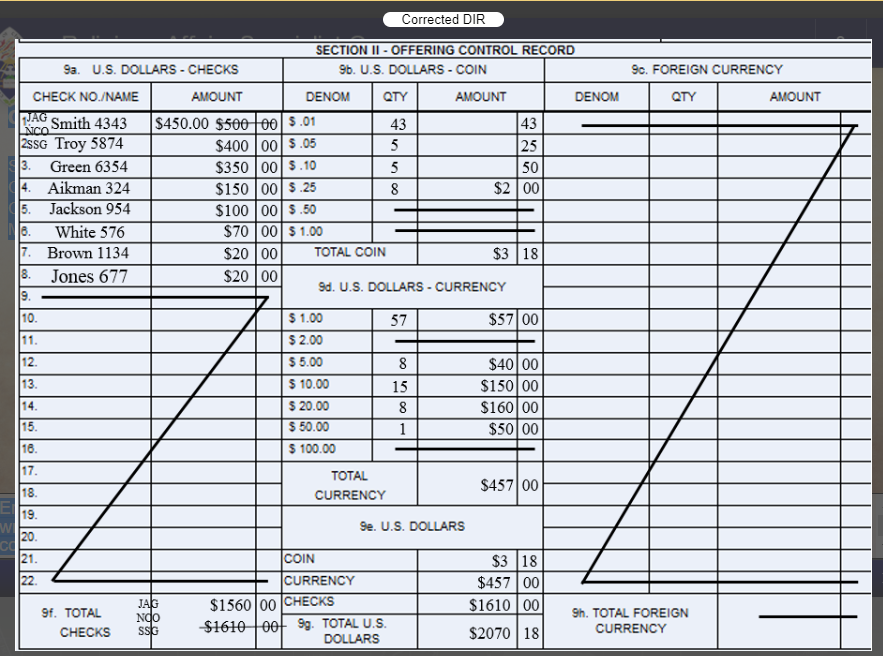
Errors sometimes occur on a DIR. To correct an error, draw a single straight line through the error and clearly write in the correction. Both counters must then initial the correction. All corrections must be made before the counters leave the room.
- Single straight line
- Clearly write correction
- Counters initial correction
- Must make corrections with counters present
- Designated Offerings
If a service includes a designated offering, two DIRs must be filled out. A designated offering is an offering collected to support religious and humanitarian activities or organizations. The date, subject, and intent of the designated offering will be announced prior to the collection of the offering, preferably printed in the worship program or weekly announcements. Designated offerings are voluntary; participants should be given the option of contributing to the designated offering or to the general operating sub-account. A bulletin of the service with the designated offering announcement will be turned in to the Fund Clerk; check your local SOP for these procedures. Block 8a and 8b of the DIR identify the designated offering.
- Two DIRs required
- Supports religious and humanitarian activities or organizations
- Announce date, subject, intent of offering prior to collection
- Voluntary offering
- Turn in bulletin of service to Fund Clerk
- Securing an Offering
Offerings should be stored in an Army-approved combination safe. The offering should be in the physical possession of the Religious Affairs Specialist until it is secured in the safe. Page 1 of the DIR stays with the offering, while the officiating Chaplain receives Page 2 and the Fund Clerk receives Page 3. You may be required to deposit money into the banks night deposit box; you should know in advance which night deposit box you will use. Make sure you have the key to the bank deposit box or the code.
- Use Army-approved safe
- Offering stays with Religious Affairs Specialist until secured
- DIR Page 1 stays with offering, Page 2 goes to Chaplain, Page 3 goes to Fund Clerk
- Know night deposit box in advance; must have key or code
- Summary
In this topic, we discussed the components of the Detailed Income Record, or DIR, and the procedures for completing the DIR. Remember, you have the sole responsibility of ensuring that the offering is collected, counted, secured, and deposited. Attention to detail is highly important because any missing funds could result in administrative or legal action being taken against you.
Components and procedures of a Detailed Income Record, or DIR \n
\n
\n
\n \n
\n