Muscular System
- There are three types of muscles, all animals have some form of muscle most of which are smooth and striated
- Striated (skeletal): Composed of fascicles of several muscle fibers.
- Each fiber is made up of bundles of myofibrils of actin and myosin myofilaments.
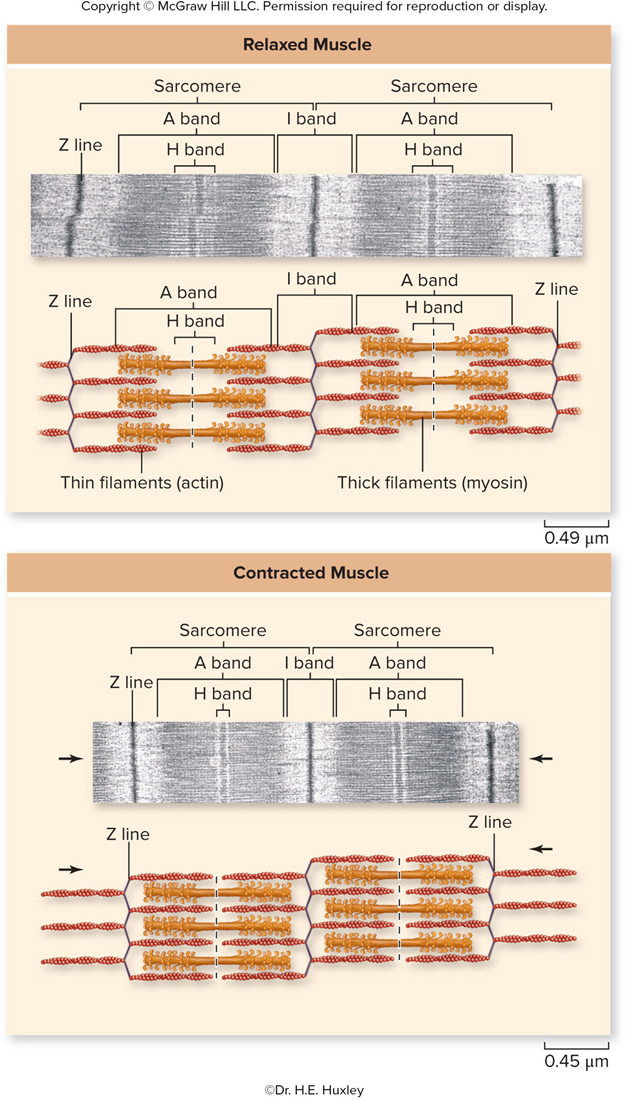
- The actin and myosin of the myofilaments are arranged into contractile units called sarcomeres which is what makes it look striated
- Cells have multiple nuclei
- Smooth
- Cardiac: Found only in the hearts of vertebrates
- Striated with branched cells, adjacent cells are connected with intercalated discs that contain gap junctions which enable the heart to function as a unit
- Cells have one nuclei
- Involuntary action that is partially controlled within the heart
- Cells do not fatigue
- Neuromuscular Junction: Where somatic nerves synapses with muscle fibres
- Acetylcholline leaves nerves and binds to receptors in muscles. This opens sodium ion channels which spread into the cell. T-tubules release calcium ion which binds to troponin exposing myosin binding sites on actin and allows muscles to contract
- Motor Unit: A group of fibres controlled by one nerve. More precise movements requires more motor units, less precise movements requires more fibres per neuron.
- Muscles are antagonistic
- Origin: attachement to bone that is stationary
- Insertion: attachement to bone that moves
- Isotonic: muscle tension doesn’t change, size does, ex. lifting weights
- Isometric: Muscle tension changes, muscle size does not, ex. holding an object at your side
- Striated muscle evolved to enable complex movements requiring greater nervous system control. It can generate faster movements and more force than smooth muscles
- Striated and skeletal muscles are used in locomotion and posture, their action is voluntary and contraction can be fast or slow
- Arthropods only have striated muscles
- Skeletal muscles can be stimulated to contract by electrical impulses
- Twitch: A quick contraction and then relaxes
- When a second impulse is delivered immediately after the first and creates a summation
- Increasing frequency of impulses decreases the relaxion period between twitches and increases the strength of a contraction
- Tetanus: A smooth sustained contraction which is achieved after a particular frequency of stimuli
- Slow-twitch: Lots of capillaries, many mitochondria, numerous respiratory enzymes, lots of myoglobin
- Red fibers: More myoglobin, operates aerobically and can sustain activity for a long time without fatigue
- Fast-twitch: Fewer capillaries and mitochondria, less myoglobin
- White fibres: Less myoglobin, can operate anaerobically and are adapted for rapid generation of power, lack endurance
- A band (dark): is overlapping thick (myosin) and thin (actin) filaments.
- H band: shortens as myosin and actin move along one another also the thick filaments only.
- Z line: is the end of each sarcomere.
- I band (light): is thin (actin) filaments only