Job Design Practices
Job Design
- A job is a set of tasks performed by one person
- Job Design: the process of assigning tasks to a job, including the interdependency of those tasks with other jobs
- Organization’s Goal: to create jobs that can be performed efficiently yet employees are motivated and engaged
Job Specialization
- Dividing work into separate jobs that include a subset of the tasks required to complete the product or service
- Cycle Time: the time required to complete the task before starting over with a new work unit
- Scientific Management
- American industrial engineer ^^Frederick Winslow Taylor^^ strongly advocated job specialization
- Taylor also emphasized person-job matching, training, goal-setting, work incentives
- Evaluating Job Specialization
- Extreme job specialization adversely affect employee attitudes and motivation. Employee turnover and absenteeism tend to be higher in specialized jobs with very short cycle times
- Advantages
- Less time spent in changing activities
- Lower training costs
- Job mastered quickly
- Better person-job matching
- Disadvantages
- Job boredom
- Discontentment pay
- Higher costs
- Lower quality
- Lower motivation
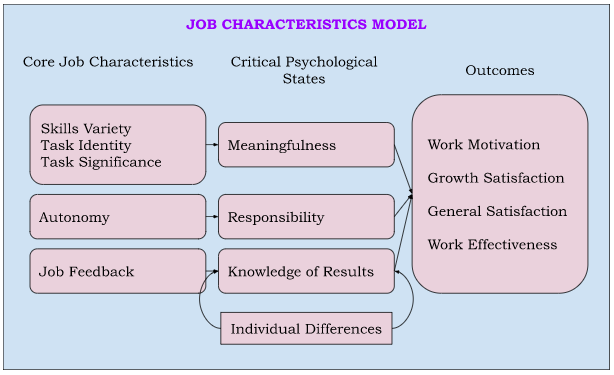
Job Characteristics Model
- Core Job Characteristics
- The Job Characteristics Model, ^^developed by Richard Hackman and Greg Oldham^^, is a model that shows how to make jobs more motivating. The higher a job scores on each core characteristics, the more it is considered to be enriched
- Skill Variety: the degree to which jobs include a variety of different activities and involves the use of a number of different skills and talents
- Task Identity: the degree to which the job requires completion of a “whole” and identifiable piece of work, one that involves doing a job from beginning to end with a visible outcome
- Task Significance: the degree to which the job is important and involves meaningful contribution to the organization or society in general
- Autonomy: the degree to which the job gives the employee substantial freedom, independence, and discretion in scheduling the work and determining the procedures used in carrying it out
- Job Feedback: the degree to which carrying out the work activities provides direct and clear information to the employee regarding how well the job has been done
- Job Design Practices that Motivate
- Job Rotation: the practice of increasing task variety by periodically moving employees from one job to another that involves different tasks
- Movement from one job to another/^^cross-training^^
- Benefits
- Minimizing repetitive strain injury
- Multiskills the workforce
- Potentially reduces job boredom
- Job Enlargement: broadening the types of tasks performed in a job to make jobs less repetitive and more interesting
- Adding tasks to a existing job
- Job Enrichment: the practice of giving employees more responsibility for scheduling, coordinating and planning their own work
- Clustering tasks into natural groups
- Stitching highly interdependent tasks into one job (e.g., video journalist; assembling entire product)
- Establishing client relationships
- Directly responsible for specific clients
- Communicate directly with those clients