Anxiety Disorders Review
Overview of Anxiety and Fear
Anxiety is defined as a future-oriented emotional state. It is primarily characterized by:
Excessive worry
Apprehension
Anticipation of a potential threat
Physiologic arousal
Distinguishing Normal Anxiety vs Anxiety Disorder:
Normal Anxiety: a temporary emotional and psychologic response to stress that helps us prepares us for challenges or danger
Anxiety Disorder: anxiety that is excessive, persistent, out of proportion to the situation and causes functional impairment that significantly interferes with daily activities, relationships, and overall quality of life.

Core cognitive questions associated with anxiety include "What if I fail?", "What if something bad happens?", and "What if this symptom means something serious?"
Distinguishing Fear vs. Anxiety:
Fear: A response to an immediate threat occurring in the present ().
Anxiety: Recurrent anticipation of a future threat ().
Assessing Severity: Persistent worry for months that interferes with sleep and work is a much stronger indicator of an anxiety disorder than brief worry (e.g., after lab results) or situational nervousness (e.g., job interviews or public speaking).
Epidemiology of Anxiety Disorders
Anxiety disorders are very common psychiatric conditions, frequently underdiagnosed and often managed in primary care.
Lifetime Prevalence: Approximately for any type of anxiety disorder.
Gender Distribution: Women are affected more than men at a ratio of approximately .
Specific Prevalence Data:
Specific Phobia: Approximately
Social Anxiety Disorder: Approximately
Generalized Anxiety Disorder (GAD): Approximately
Panic Disorder: Approximately
Etiology: Biological, Psychological, and Environmental Factors
Biological Factors:
Genetics: Increase risk significant; Twin and Family studies suggest moderate heritability.
Family History: Increased risk if there is a family history of anxiety disorders, depression, or substance use disorders.
Neurotransmitters: Dysregulation of neurotransmitters such as serotonin, norepinephrine, and gamma-aminobutyric acid (GABA) may contribute to the development of anxiety disorders.
Neurotransmitter
Role in Anxiety
GABA
Inhibitory neurotransmitter that reduces neuronal excitability; decreased GABA activity is linked to increased anxiety.
Serotonin
Influences mood and anxiety levels; SSRIs boost serotonin levels to alleviate anxiety symptoms.
Norepinephrine
Associated with the body's stress response; high levels can increase anxiety.
Dopamine
Plays a role in reward and motivation; imbalance may contribute to anxiety disorders.
Cortisol
The body's primary stress hormone; elevated levels can exacerbate anxiety symptoms.
Glutamate
Major excitatory neurotransmitter; dysregulation may be involved in anxiety pathophysiology.
Key Brain Regions and Pathophysiology:
Amygdala: The threat detection and fear center.
Prefrontal Cortex: Responsible for emotional regulation.
Hippocampus: Involved in memory and context.
Conceptualization: An overactive alarm system paired with under-regulation.
Psychological Contributors:
Cognitive Distortions: Catastrophizing and overestimating danger.
Behavioral Conditioning: Learned fear responses.
Personality Traits: High neuroticism and perfectionism.
Environmental Risk Factors:
Chronic stress
Adverse Childhood Experiences (ACES)
Trauma and family instability
Chronic illness and substance use
Major life transitions
Clinical Evaluation and Physical Exam
Anxiety is a clinical diagnosis; there are no specific labs or imaging for the disorders themselves.
Physical Exam Findings (In-Office):
Diaphoresis (sweating)
Cool, clammy hands
Restless or agitated state
Tachycardia (elevated heart rate)
Hyperventilation
Emotional: excessive worry, fear, irritability
Cognitive: rumination, poor concentration, racing thoughts
Telehealth Observations:
Avoidant behavior or distractibility
Restlessness or shaking the camera
Smoking on camera
Irritability
Patient Education for Vitals: Teach the patient how to obtain a radial or carotid pulse; utilize digital health devices.
Mental Status Exam (MSE):
Alert and Oriented:
Mood: Normal or depressed
Affect: Normal
Behaviors: Averted gaze, restlessness, fidgeting, skin picking, or bouncing legs.
Cognition: Insight and judgment usually remain intact.
Risk Assessment: Suicidal ideation is possible and must be assessed.
Diagnostic Rule-outs (Labs/Testing):
levels: To rule out hyperthyroidism (The "Biggest One").
levels: To rule out hyperparathyroidism.
Holter monitor or EKG: To rule out cardiac etiologies (e.g., arrhythmias).
Urine drug screen: To rule out substance-induced anxiety.
Generalized Anxiety Disorder (GAD)
DSM-5 Criteria:
A. Excessive anxiety and worry occurring more days than not for at least .
B. Difficulty controlling the worry.
C. Three or more associated symptoms: Restlessness, being easily fatigued, concentration difficulty, irritability, muscle tension, and sleep disturbance.
D. Significant distress or impairment in social/occupational functioning.
E. Not attributable to substances or medical conditions (e.g., hyperthyroidism).
F. Not better explained by another mental disorder.
Screening: The USPSTF recommends annual screening for all adults aged . The standard tool is the GAD-7 scale.
GAD-7 Scoring:
: Mild anxiety
: Moderate anxiety
: Severe anxiety
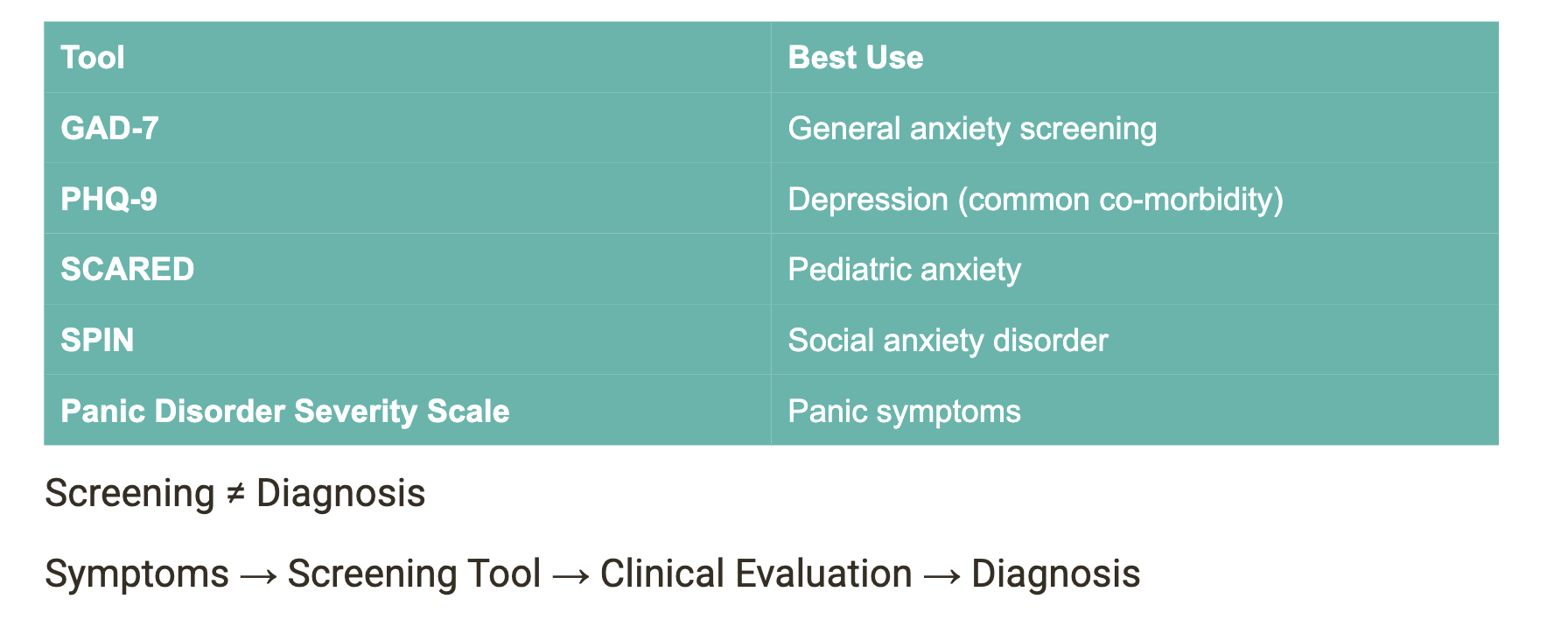
Comorbidities: Anxiety rarely travels alone. Common co-occurring conditions include:
Major Depressive Disorder (Most common)
Substance Use Disorder (Alcohol, cannabis, nicotine, etc.)
Insomnia/Sleep Disorders
ADHD (Overlap in restlessness and inattention)
PTSD and OCD
Chronic Pain (Fibromyalgia, migraines; anxiety amplifies pain)
GI Medical Conditions (IBS, GERD)
Differential Diagnoses: THINC MED

Treatment:
First-line: SSRIs or SNRIs + Psychotherapy (Cognitive Behavioral Therapy - CBT).
Anxiolytics: Buspirone (), Hydroxyzine () PRN, or short-term Benzodiazepines.
Specific Anxiety Disorders and Their Treatment
Social Anxiety Disorder:
Characterized by intense, persistent fear of being watched or judged by others.
Typically lasts for 6 months or more
General Treatment: First-line includes SSRI/SNRI and CBT.
Performance- Only Social Anxiety Disorder (e.g., Test Anxiety): CBT and Beta-blockers ().
Panic Disorder:
Median onset: . Prevalence: of U.S. adults.
High rate of suicide and suicidal ideation.
Diagnosis requires at least one of the attacks has been followed by one month or more of one or both of the following:
Persistent concern or worry about additional attacks or their consequences
Maladaptive change in behavior (e.g., avoidance of certain places)
4 panic attack symptoms include palpitations, sweating, trembling or shaking, and feelings of choking. Additional symptoms may include sensations of shortness of breath, chest pain, nausea, dizziness, or fear of losing control, all of which can significantly impact an individual's daily functioning and overall quality of life.
Treatment: CBT (preferred), SSRI/SNRI, Benzos PRN.
Agoraphobia:
Fear or anxiety about two or more of the following 5 situations:
Public Transportation
Open Spaces
Enclosed Spaces
Standing in Line/Crowds
Being Outside of the House Alone
Fear of situations where escape might be difficult or help might not be available
The fear is out of proportion to the actual danger or threat posed by the situation, often leading to significant distress and avoidance behaviors that can impact daily functioning.
Lasting typically or more.
Treatment: CBT, Exposure and Response Prevention (ERP) Therapy, SSRI/SNRI.
Separation Anxiety Disorder:
Developmentally inappropriate fear of separation from attachment figures. Displays three of the following:
Excessive stress when anticipating or experiencing separation
Persistent worry about losing major attachment figures
Persistent worry about experiencing an event that causes separation
Refusal to go out
Reluctance about being alone
Nightmares involving theme of separation
Physical symptoms when separated from major attachment
Duration: At least in children/adolescents; typically in adults.
Treatment: CBT, Exposure Therapy, SSRI/SNRI.
Specific Phobia:
Fear of specific objects/situations (Animal, Natural environment, Blood-injection-injury, Situational).
Typically lasting for 6 months or more
Treatment: Exposure therapy and CBT are mainstays. Avoid medication unless PRN (Benzos/Hydroxyzine) for occasional triggers like flying.
Selective Mutism:
Failure to speak in specific social situations despite speaking in others.
Duration: at least .
Treatment: CBT.
Pharmacotherapy Details
SSRI/SNRI (First-line):
Usage: "Start low, go slow." Takes for full effect. May initially worsen anxiety.
SSRIs: Escitalopram () [ initial; range], Sertraline () [ initial; range], Fluoxetine () [ initial].
SNRIs: Duloxetine () [ range], Venlafaxine () [ initial]. Venlafaxine can increase BP/HR at high doses.
Buspirone ():
MOA: partial dopamine () and serotonin ( and ) agonist/antagonist.
Benefit: Not addictive; no dependence. Takes for efficacy.
Hydroxyzine ():
MOA: histamine receptor antagonist. Produces sedation and reduced physiological arousal.
Use: Good for history of substance abuse. PRN for episodic/sleep anxiety.
Propranolol ():
MOA: Non-selective beta- and beta- adrenergic receptor antagonist.
Use: Reduces somatic symptoms; performance anxiety ( given prior).
Gabapentinoids:
Gabapentin () and Pregabalin (): Blocks voltage-dependent channels. Pregabalin is a Schedule controlled substance.
Benzodiazepines:
MOA: Allosterically bind to receptors, increasing GABA affinity and chloride entry, leading to hyperpolarization.
Risks: High addiction potential; dependence can start in . Black Box Warning (BBW) for use with opioids due to respiratory distress.
Examples: Alprazolam () [Intermediate], Lorazepam () [Intermediate], Diazepam () [Long-acting].
Typical Treatment Order (Anxiety or Depression)
Start with SSRI (Titrate Dose)
If Failed —> Consider 2nd SSRI or SNRI
If some response then consider adjunct medications (Buspirone (Anxiety) or Bupropion (Depression))
PRN medications for breakthrough anxiety (Hydroxyzine, Propranolol, Benzo)
Therapy (CBT) should ALWAYS be offered
Consider comorbid diagnosis