Polyatomic Ions and Inorganic Compounds Reference Guide
Overview of Polyatomic Ions and Nomenclature
A polyatomic ion is a charged chemical species composed of two or more atoms covalently bonded, or a metal complex that acts as a single unit. The charge of a polyatomic ion is distributed over the entire structure rather than localized on a single atom. Polyatomic ions participate in ionic bonding by pairing with oppositely charged ions to form neutral chemical compounds. Systematically understanding polyatomic ion nomenclature, oxyanion naming rules, oxidation states, and overall ion charges is fundamental to chemical formulation and stoichiometric calculations.
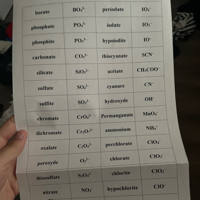
Polyatomic Anions with a -3 Charge
Trivalent anions carry an overall electrical charge of . The primary trivalent oxyanions include borate, phosphate, and phosphite.
The borate ion consists of a central boron atom bonded to three oxygen atoms, carrying the chemical formula . Borate forms the structural foundation of various boron-containing salts and minerals.
The phosphate ion consists of a central phosphorus atom bonded to four oxygen atoms in a tetrahedral geometry, denoted by the formula . Phosphate plays a fundamental biological role in genetic materials such as DNA and RNA, as well as in cellular energy transfer molecules like adenosine triphosphate.
The phosphite ion features a central phosphorus atom bonded to three oxygen atoms, possessing the chemical formula . Compared to phosphate, phosphite contains one fewer oxygen atom while maintaining the same formal charge.
Polyatomic Anions with a -2 Charge
Divalent anions possess an overall charge of . This category contains major carbon, silicon, sulfur, chromium, and oxygen polyatomic species.
The carbonate ion possesses the formula . It contains a central carbon atom sp2-hybridized with three oxygen atoms in a trigonal planar arrangement. Carbonate ions are crucial components of geological limestone and buffer systems in aquatic chemistry.
The silicate ion, denoted as , comprises silicon bonded to oxygen atoms, forming the repeating units of many mineral silicates and glass compositions.
The sulfate ion features a central sulfur atom surrounded by four oxygen atoms, represented by . Sulfate is a common polyatomic ion found in minerals like gypsum and acid precipitation derivatives.
The sulfite ion is written as , having one less oxygen atom than sulfate while retaining the ionic charge. Sulfites are commonly utilized as preservatives and reducing agents in chemical processes.
The chromate ion carries the formula , consisting of chromium in its +6 oxidation state bound to four oxygen atoms in a tetrahedral structure.
The dichromate ion possesses the formula , containing two chromium atoms bridged by an oxygen atom, also featuring chromium in the +6 oxidation state. Dichromate compounds act as powerful oxidizing agents in chemical reactions.
The oxalate ion is a dicarboxylic acid derivative with the formula . It functions as a bidentate ligand capable of chelating transition metal cations.
The peroxide ion has the formula , consisting of two oxygen atoms joined by a single covalent bond with an overall charge, giving each oxygen atom an unusual oxidation state of -1.
The thiosulfate ion is represented by . It is structurally derived from a sulfate ion where one oxygen atom is substituted with a sulfur atom.
Polyatomic Anions with a -1 Charge
Monovalent anions carry an overall charge of . This diverse group includes nitrogen, halogen, manganese, and organic polyatomic ions.
The nitrate ion possesses the formula , featuring a trigonal planar geometry with resonance structures stabilized across the nitrogen-oxygen bonds.
Halogen-based oxyanions exhibit systematic naming patterns based on the oxidation state of the halogen and the number of attached oxygen atoms. For iodine species, the periodate ion is , the iodate ion is , and the hypoiodite ion is .
For chlorine species, the series of oxyanions follows the same structural pattern. The perchlorate ion is , containing four oxygen atoms. The chlorate ion is , featuring three oxygen atoms. The chlorite ion is , containing two oxygen atoms. The hypochlorite ion is , containing a single oxygen atom.
Other single-charged polyatomic anions include thiocyanate , acetate , cyanide , hydroxide , and permanganate . Permanganate is an intense purple ion containing manganese in the +7 oxidation state, widely used as an oxidizing agent in redox titrations.
Polyatomic Cations and Binary Inorganic Compounds
While the majority of common polyatomic ions are anions, positive polyatomic ions also exist. The primary polyatomic cation is ammonium, represented by the chemical formula . Ammonium is formed by the protonation of ammonia and acts as a monovalent cation in ionic salt formations.
In addition to polyatomic ions, simple binary inorganic compounds include potassium hydride and hydrogen fluoride.
Potassium hydride, represented by the chemical formula , is an alkali metal hydride consisting of potassium cations and hydride anions . It functions as a powerful, non-nucleophilic strong base in synthetic organic chemistry.
Hydrogen fluoride, denoted by the formula , is a binary compound of hydrogen and fluorine. In gaseous or anhydrous form, it is hydrogen fluoride, whereas in aqueous solution, it forms hydrofluoric acid, a weak acid capable of etching glass due to its high reactivity with silicates.