Wk 5.3 Membrane Proteins
Learning Goals
Understand transport of integral membrane proteins into the ER membrane.
Understand insertion and classification of integral membrane proteins.
Understand insertion of proteins into the plasma membrane.
Integral Membrane Proteins
Definition: Permanently attached proteins to a membrane.
Some parts translocated across the lipid bilayer, others remain embedded in the membrane.
Insertion process involves:
Signal Recognition Particle (SRP) / SRP receptor pathway (similar to soluble proteins).
Classification based on:
Topology: Number of times a polypeptide chain spans the membrane.
Orientation: Determined by topogenic sequences that guide correct insertion/orientation » form membrane spanning domain into the membrane.
Unique topogenic sequences correspond to transmembrane alpha-helices.
Correct Insertion of Integral Membrane Proteins
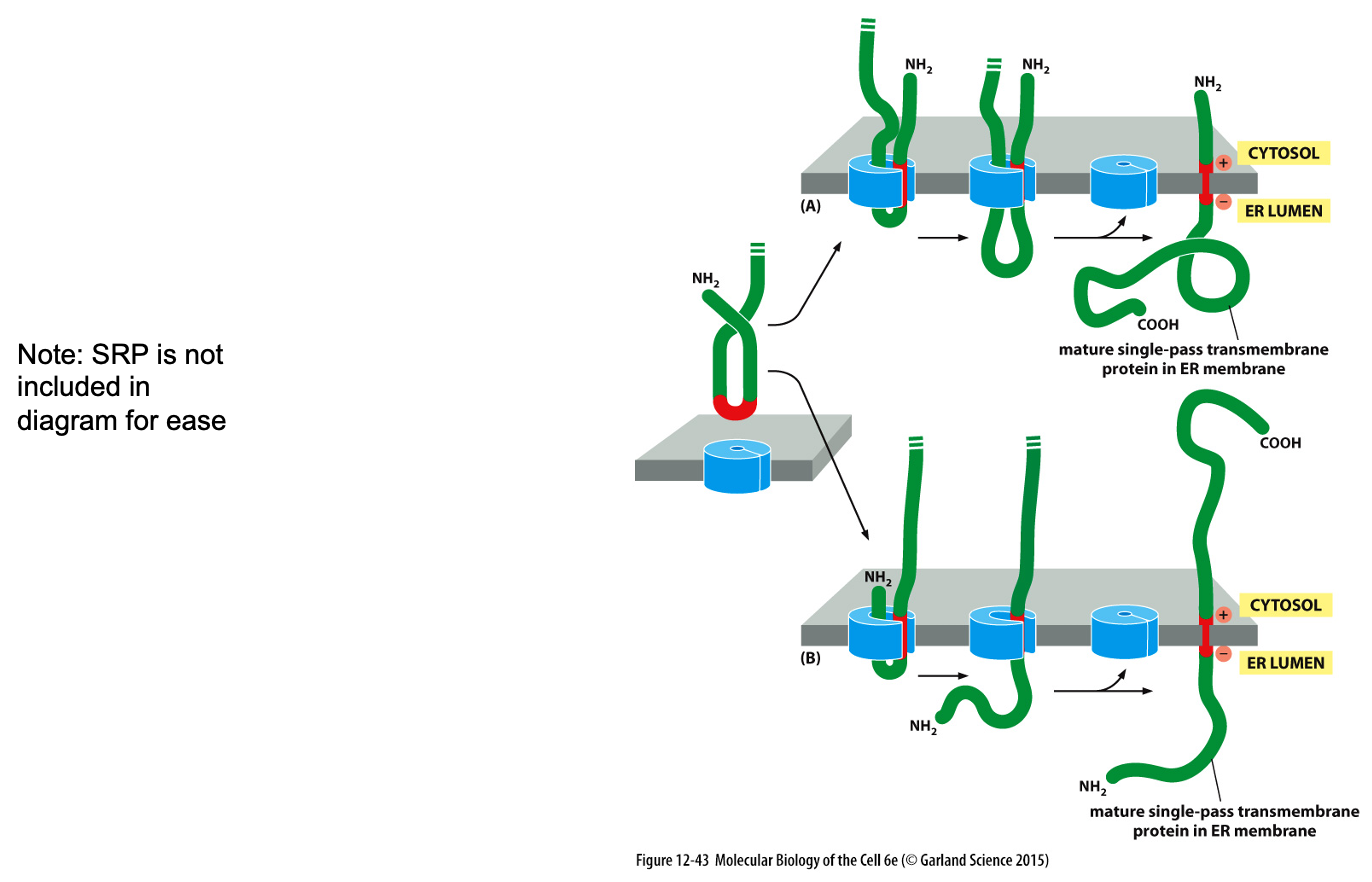
Insertion determined by charge of amino acids surrounding hydrophobic core:
Greater number of positive amino acids at terminal end directs N-terminal into cytoplasm (cytosol).
Classification of ER Integral Membrane Proteins
Two main types:
Single-pass:
Contains cleaved ER signal sequence.
Anchored by stop transfer anchor sequence; N-terminus in ER lumen.
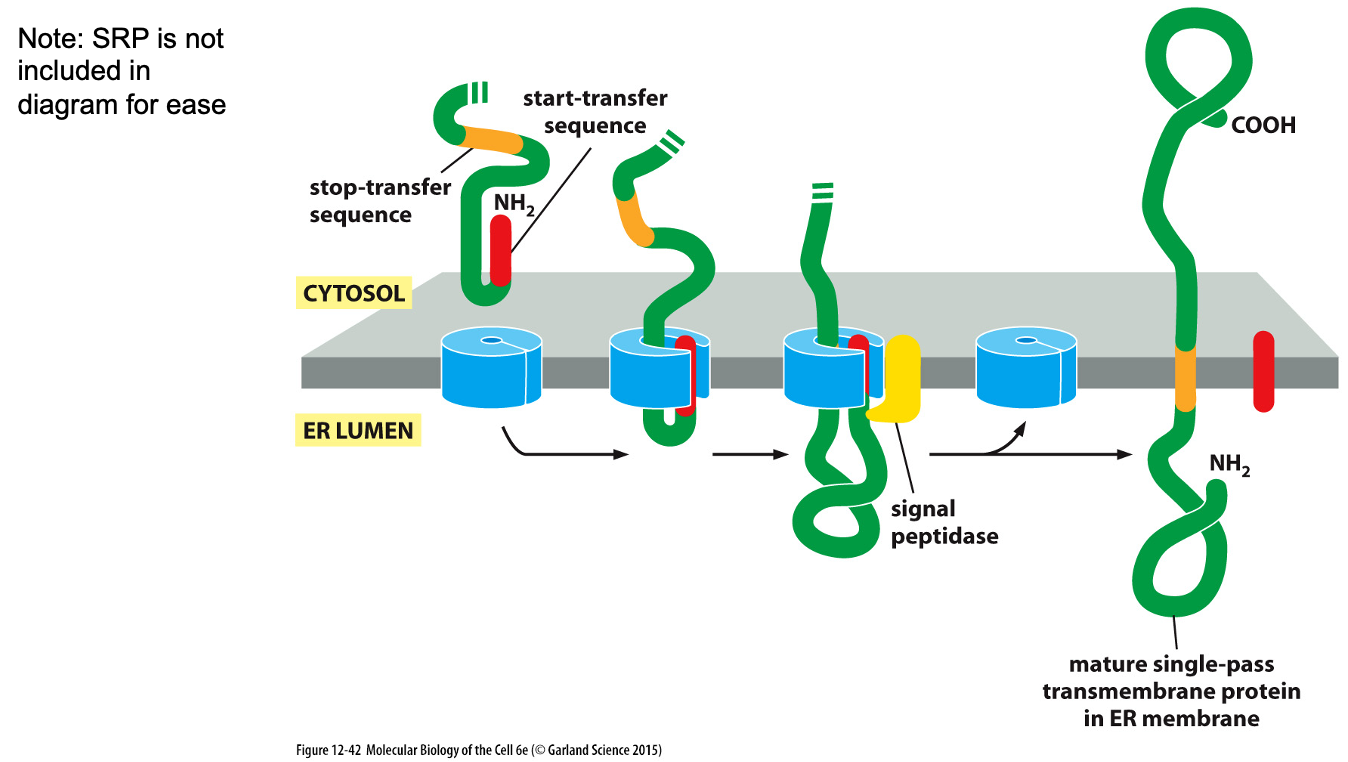
Integration of single-pass transmembrane protein with internal signal sequence
Anchored with signal-anchor sequence
Orientation determined by charge around signal sequence
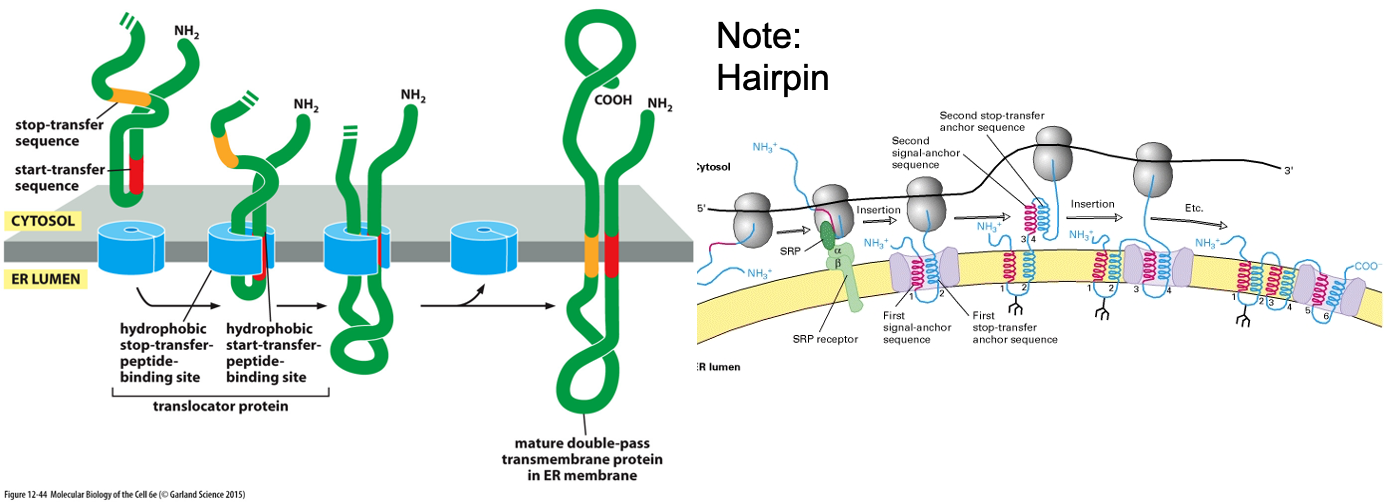
Multi-pass:
Polypeptide chain spans lipid bilayer multiple times, with segments passing both directions.
Insertion Mechanisms
Single-pass insertion with ER signal sequence:
N-terminal cleaved and targets ER lumen.
Multi-pass insertion:
Multiple internal sequences allow the protein to cross the membrane repetitively.
Summary of Membrane Protein Classification
Single-pass proteins:
N-terminal ER signal sequence is cleaved, internal anchor sequence determines orientation.
N-terminus ends in lumen; C-terminus in cytoplasm.
Multi-pass proteins:
Contain several internal anchor sequences and an internal ER signal sequence driving their topology and orientation.
Translocation of Membrane Proteins
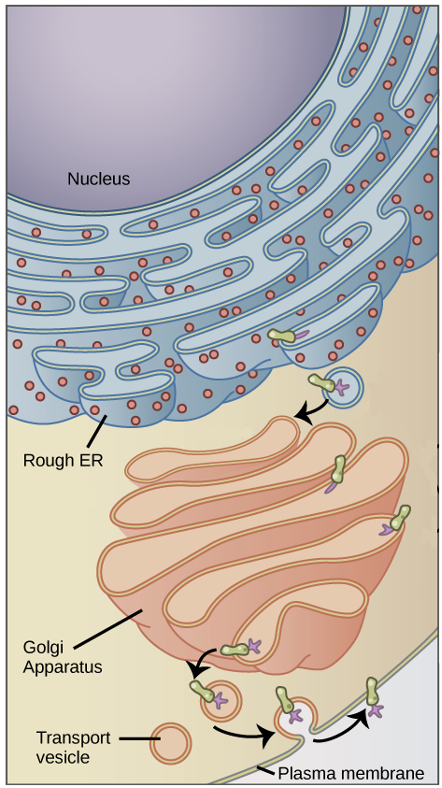
Integral membrane proteins translocated across the ER during synthesis and transported to Golgi.
Sequential transport through the Golgi apparatus:
Cis → Medial → Trans to reach plasma membrane.
Discussion Questions
How are integral membrane proteins classified?
A: Topology
B: Orientation of membrane spanning segments
C: Amino acid sequence
D: Both A and B
How is the insertion direction of an integral membrane protein determined?
A: More positive amino acids at terminal end inserted into the cytoplasm
B: More negative amino acids at terminal end inserted into the cytoplasm
C: C-terminus always in cytoplasm
D: C-terminus always in lumen
Additional Discussion Questions
Predict topology and orientation with given amino acid sequences.
Determine if the signal sequence is cleaved based on amino acid configuration.
Summary of Key Concepts
Integral membrane proteins are classified as single-pass or multi-pass based on their structure and orientation.
Correct localization involves differentiation of their pathway through the secretory system.
Further Reading
Alberts et al., Molecular Biology of the Cell, 6th Edition, Chapter 12
Alberts et al., Essential Cell Biology, 3rd Edition, Chapters 11 and 15