1/21 MWC
White Abalone: At Risk
Haliotis sorenseni
Allee Effect
Mobility
After they were listed on the endangered species act, they still haven’t recovered
Male and females have to be within 10 yards of each other for broadcast spawning to work
Ideal: 1 m apart
Efforts to restore population with info in mind
Challenges: some areas see many abalones, so they eat a lot, while other areas don’t see them so don’t catch them; abalones are clustered in one area which makes it look like there’s a lot when they have a small range
Marine Species: Extinction-Proof Traits
Immense ranges
Huge populations
Millions of eggs
But these traits don’t result in viable individuals at all times.
Risk Factors
Late maturity
sea turtles, sharks
Low reproductive rate
marine mammals
Adaptation to environment with little disturbance
sea birds
Passive dispersal
invertebrates, fish
Bycatch/indiscriminate fishing
catching fish that aren’t your target species, not discriminating
Cumulative Effects
Exposure to multiple factors exacerbates vulnerability
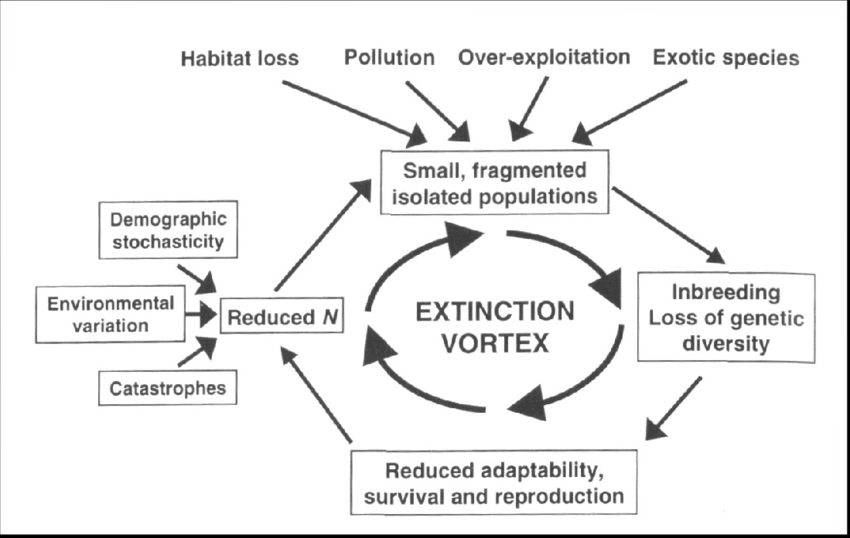
Extinction vortex (sums up how a species becomes extinct)
Frankham et al
environmental variation + demographic stochasticity + catastrophes = reduced Population (N)
habitat loss, pollution, over-exploitation, exotic species = small, fragmented, isolated populations
Inbreeding, loss of diversity
Reduced adaptability, survival, and reproduction

Conservation Challenge: How to Prioritize?
Extinction risk is one of many factors to consider when establishing conservation priorities
Distributional factors, biological factors, societal values, logistical factors, economic factors, other factors also contribute
Conservation challenge: lack of knowledge
We don’t know what we don’t know
What is out there?
Natural history
Taxonomy (wide-ranging species)
local adaptations
opportunistic species
Conservation Challenge: shifting baslines
The incremental lowering of standards, with respect to nature, in which each new generation:
lacks knowledge of how the environment used to be
redefines what is ‘ natural’ according to personal experiences
sets the stage for the next generation’s shifting baseline
Difficult to quantify declines because data have been collected for only the last 20-50 years
these data are used as our ‘historic maxima’
heavy consumption has been underway much longer
Summary
A variety of life history and ecological traits of marine species result in extinction risk and therefore present numerous conservation challenges
When the rate of environmental change out-paces behavioral flexibility, changes in community composition and population dynamics become evident
Understanding of ‘baseline’ behaviors and habitat requirements of species and ecological patterns and processes is therefore useful for conservation to be successful