ANOVA for repeated measures
within and between subject designs
within - e.g. different recording points - they all have it
between - e.g. different treatment - different bet. ppl
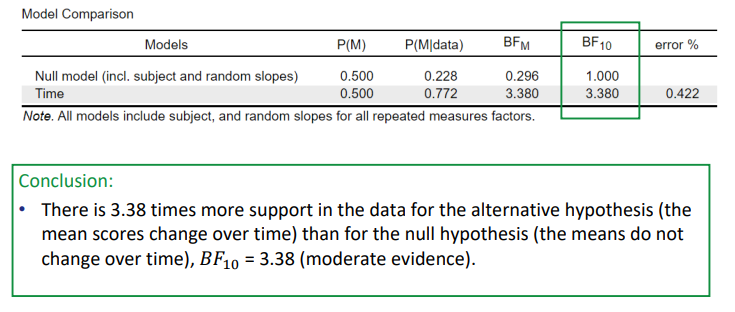
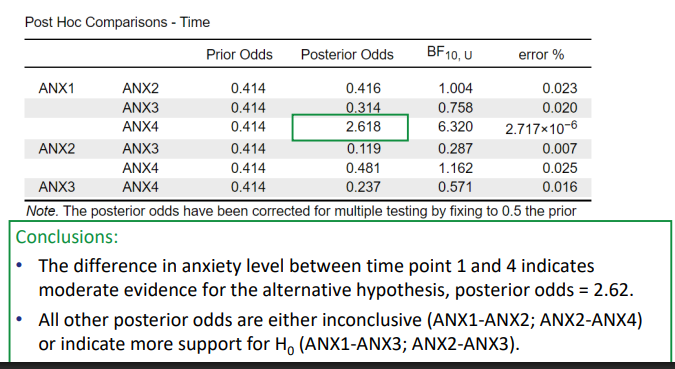
RQ: do anxiety scores change over time?
H0: 𝜇1 = 𝜇2 = 𝜇3 = 𝜇4
Assumptions
Random sample
DV normally distributed
Sphericity - assume equal variances of the difference scores
use Mauchly’s test: if not significant → assume sphericity // if significant, use Greenhouse ε (if that’s smaller than .75, if it’s not, use Huynh-Feldt) - look at adjusted row in further analyses
Report
APA: Significant differences were found between the OCD-scores at the three different measurement times, 𝐹 1.18, 69.69 , 𝑝 < .001, 𝜂2 = .582.
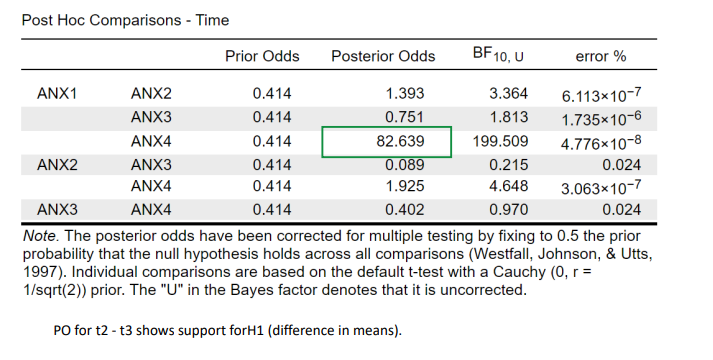
Pairwise comparisons using Bonferroni correction revealed that, on average, participants score 2.43 points higher on the compulsive behavior scale at the first measurement than at the second measurement and this difference is significant (𝑝 < .001). When comparing with the third measurement, participants scored 3.25 points higher at the first measurement and this difference was also significant (𝑝 < .001). Finally, participants scored 0.82 points higher at the second measurement than at the third measurement and this difference was also significant (𝑝 < .007).
Factorial ANOVA
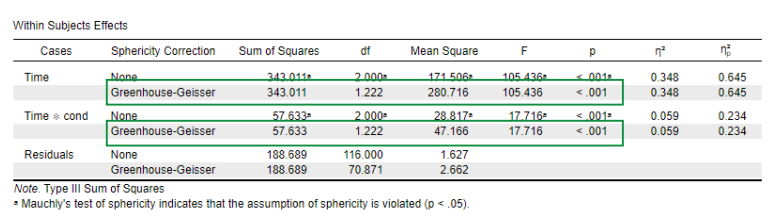
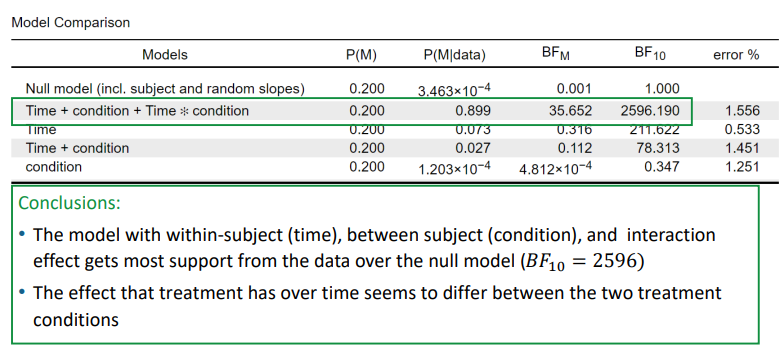
Interaction is significant = the mean changes over time for group A are significantly dif. from mean changes gr. B
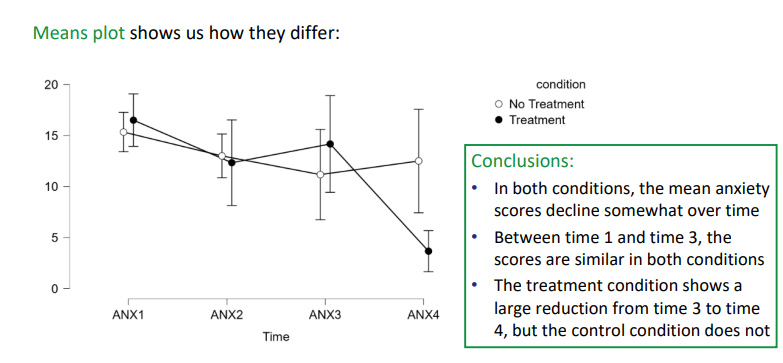
do a means plot
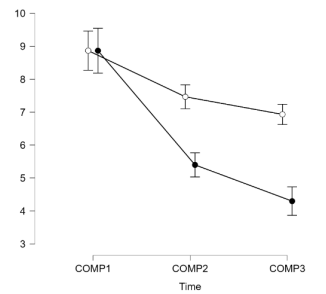
APA: in both conditions, the mean compulsive behav scores decline over time. // In the condition w. gr therapy, the mean scores decline more rapidly.
Report
APA: A Greenhouse-Geisser mixed-design ANOVA revealed a significant decrease in symptoms over time across groups F= 105.436, p < .001, partial eta2 = .645.
OCD symptoms reduce over time in both conditions, but at a significantly higher rate in the counseling & group therapy condition, F= 17,716, p < .001, partial eta2 = .234.
Averaged over the measurement time points, OCD symptoms were lower in the counseling & group therapy group (𝑀 = 6.19) than the control group (𝑀 = 7.76), 𝐹 1, 58 = 22.47, 𝑝 < .001, 𝜂2 = .112.
If accounting for one aspect:
After accounting for OCD levels at time point 1, there are significant differences in the mean compulsive behavior scores at time point 2 between treatment conditions, F(1, 57) = 28.02, p < .001, partial eta2 = .330.
Bayesian