Chemistry - 7 Energy Changes - Required Practical 4: Temperature Changes
Aims:
investigate the variables that affect temperature changes in chemical reactions
Risk Assessment:
acid could be an irritant
acid could damage eyes
Safety:
wear safety goggles
stand cup in beaker to avoid spillage
Equipment:
2 mol/dm³ hydrochloric acid
2 mol/dm³ sodium hydroxide solution
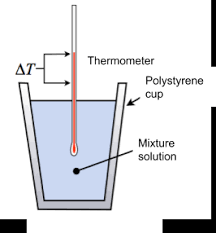
expanded polystyrene cups & lids with thermometer holes
thermometers
measuring cylinder
beaker
Control variables:
volume of hydrochloric acid
concentrations of hydrochloric acid and sodium hydroxide solution
Independent variable:
volume of sodium hydroxide solution
Dependent variable:
maximum temperature reached
Method:
Using a measuring cylinder, measure 30 cm³ hydrochloric acid - read from the bottom of the meniscus
Transfer the acid into a polystyrene cup and stand the cup inside a beaker
Using a thermometer, measure and record the starting temperature of the acid
Using a measuring cylinder, measure out 5 cm³ of sodium hydroxide
Transfer the sodium hydroxide into the polystyrene cup and fit the lid, pushing the bulb of the thermometer through the lid and into the solution
Use the thermometer to gently stir the solution
Observe the rise in temperature on the thermometer. When it stops changing, record the highest temperature reached
Rinse out and dry the polystyrene cup
Repeat steps 1-8, increasing the volume of sodium hydroxide by 5 cm³ until you reach a maximum of 40 cm³
(optional) repeat the whole experiment again for accuracy and find a mean
Calculations/graphing:
plot a graph of maximum temperature reached (y-axis) against volume of sodium hydroxide solution (x-axis)
you will observe that the graph reaches a maximum (where HCl limits the reaction) and descends from then on. Why?
the energy released by the reaction is the same, but it is spread out through the whole solution. Since temperature is average kinetic energy of particles in a substance, the same amount will be spread thinner, so the reading in one area will decrease
Why use polystyrene? it is a good insulator!