Lec 15: Auditory Processing Disorders 2
Historical Context and the Cognition Debate in Auditory Processing
Evolution of the Field: Twenty years ago, the management of Auditory Processing Disorder (APD) was limited. Typical advice included sitting at the front of the class, keeping noise levels low, and "hoping for the best." It has since evolved into a significant and highly debated research area.
The Defining Debate: The central point of contention in APD has historically been the role of cognition. This refers to higher-order processing skills such as memory, learning, attention, and intelligence.
Geographical Divergence of Thought:
The United States: Traditionally focused on the test batteries presented as being purely auditory.
Britain: A strong school of thought argued that APD did not exist as a separate entity and that children labeled with it simply had attention disorders.
Australia: Typically sits in the middle, conducting its own research and viewing the two sides as having merit.
Current Consensus: The debate is no longer whether APD has cognitive components, but to what degree they must be considered during diagnosis and management. The modern view is that auditory processing and cognition are intertwined and inseparable.
Conceptual Models of Auditory Processing
The Bottom-Up Pathway Model (American Approach):
Sound enters the bottom of the auditory pathway and works its way up.
APD is viewed as a perceptual problem occurring as sound is processed.
Remediation focuses on base skill development (e.g., distinguishing where two sounds originate).
The Top-Down Model:
Processing is driven by the central auditory nervous system at the "top."
Memory, prior learning, and language skills are used to make sense of arriving sound.
Remediation focuses on improving attention, memory, and language to improve auditory processing functionality.
Integrated Reality: Most experts now agree these models are not contradictory; they occur simultaneously. Auditory processing in the real world is influenced by both sensory input and cognitive interpretation.
Empirical Evidence and Departmental Research
Study on Interaction between APD and Cognition: A study conducted within the department looked at three groups of children:
Control Group: Children with no reported listening difficulties.
Suspected Group ( children): Children referred for suspected difficulties.
Diagnosed Groups: Out of the suspected, did not have an APD on the test battery, while were found to have a deficit.
Findings on Cognitive Variables:
The control group consistently scored higher in working memory, attention skills, and non-verbal intelligence ().
The children who had listening difficulties but passed the battery still performed worse cognitively than the control group.
Children with APD deficits generally displayed the lowest scores in attention, memory, and non-verbal intelligence.
Literacy Correlations:
Dichotic Digits: Poorer scores in dichotic digits (measuring interhemispheric transfer) correlate significantly with poorer reading and literacy skills in the classroom.
Speech in Noise: Children who perform poorly on speech-in-noise tasks also perform poorly on reading tasks.
NAPLAN Correlation: Research using Sound Scout (a speech-in-noise screening) showed a strong correlation with National Assessment Program – Literacy and Numeracy () literacy scores, though interestingly, not with numeracy scores.
APD Across the Lifespan: Aging and Dementia
Cognitive Decline in Older Adults: There is increasing evidence of a decrease in auditory processing skills in older adults, aligning with age-related cognitive decline.
Subtle central auditory processing tasks can often capture flags of decline before typical dementia symptoms appear.
Spatial Processing Deficits: A study of older adults conducted by Grace (PhD student) found that more than half () had a spatial processing deficit.
Dementia Prevention: Current research investigates whether fitting hearing aids can slow cognitive decline by strengthening auditory pathways and supporting communication.
Comprehensive Diagnostic Test Battery
The Current Standard: The battery must go beyond simple hearing tests to include:
Standard Audiogram: To rule out peripheral hearing loss.
Extended High Frequencies: To identify potential "hidden hearing loss."
Auditory Brainstem Response (): While expensive and time-consuming, it is used to rule out auditory neuropathy (where detection is possible but firing is nonsensical). Historically, early-described APD cases were likely misdiagnosed auditory neuropathy.
Corticals: Used to assess the maturity of the auditory pathway.
Cognitive Screening Tools:
TONY-IV (Test of Nonverbal Intelligence, Fourth Edition): A picture-book based assessment where users identify patterns to fill a blank box. Non-verbal testing is preferred over verbal testing to ensure language deficits do not skew intelligence results.
Digispan (Digit Span): Assesses short-term memory (repeating sequences) and working memory (repeating sequences in reverse). Working memory is more strongly related to listening ability because it requires information manipulation.
IVA QS (Integrated Visual and Auditory Continuous Performance Test): Referred to as "The Number One" or the "boring attention test." It is a task where children click only when they see or hear the number "1." It measures sustained attention, impulsivity, and focus by comparing the child against age-norms (separated by medicated vs. unmedicated status for ADHD).
Auditory Closure: A language screening tool assessing the ability to fill in gaps in sentences (e.g., "A spider [has] eight legs"). This helps determine if a child's listening difficulty is driven by poor language comprehension.
Management Strategy: Direct Skills Remediation
Evidence-Based Auditory Training: Programs should ideally show both improved test scores and real-world impact. Programs mentioned include:
SoundStorm: A iPad-based training targeting Spatial Processing Disorder () using a space-themed game.
Sound Diverse: A newer pilot game designed for generalized listening difficulties in noise, focusing on spatial listening skills but applicable even if a classic SPD pattern is not present.
Acoustic Pioneer - Zoo Caper Skyscraper: An animal-based game building binaural integration (balancing the two ears). It is useful when dichotic digit scores are asymmetrical.
Acoustic Pioneer - Insane Airplane: Targets temporal processing skills.
Acoustic Pioneer - Elephant Memory Training: Developed with psychology support to target auditory memory. Strengthening memory often improves performance across all other auditory processing tasks.
The Engagement Challenge: Clinicians face difficulty competing with high-budget games like Fortnite or Minecraft. Medical training games can be perceived as boring, leading to poor compliance without parental supervision.
Management Strategy: Environmental and Compensatory Support
Environmental Modifications:
Acoustic Treatment: Using carpet, posters, and soft materials to reduce reverberation.
Classroom Setup: Preferencing closed classrooms (one teacher, one class) over open-plan spaces, which are both acoustically and visually noisy.
Reducing Source Noise: Moving children away from air conditioners, heaters, or windows.
Compensatory Strategies for Teachers:
Visual Supports: Writing instructions on the board to complement verbal speech. This is considered the "biggest" and most effective strategy for the entire class.
Active Listening: Ensuring a clear line of sight to the teacher's face.
Linguistic Strategies: Simplified phrasing or asking the child to repeat what they understood (though repeating can be difficult in a large class).
Preferential Seating: While traditionally popular, it is becoming redundant in modern flexible-learning classrooms where teachers roam and students sit in groups.
Technical Interventions: Remote Microphones and Low Gain Aids
Remote Microphones (e.g., Phonak Roger Focus 2):
Function: A teacher wears a mic, and the sound is sent directly to the child's ears (bypassing noise and distance).
Gold Standard: The most researched management tool for APD. It provides immediate support without waiting for skill-building.
Benefits: Improved access to instruction, reduced stress (measured by lower salivary cortisol), maturation of corticals, and improved attention.
Barriers: High cost and teacher resistance (forgetting to mute at the staff room/bathroom; complaints of neck soreness).
Low Gain Hearing Aids:
Advantages: Discreet, no need for a second party (teacher) to manage a mic, practical for teenagers and adults.
Gain Characteristics: Typically provides of gain, resulting in a signal-to-noise ratio () improvement.
Comparison: Less effective than a remote mic but still provides massive real-world benefits.
Questions & Discussion
Diagnosing Toddlers: Can a clinician tell the difference between APD and attention on the phone? No. For kids aged , most appear to have APD because their auditory, language, and memory systems are still developing. Standardized testing is generally reliable starting at age , but is more comfortable at age .
Left-Handedness and Dichotic Digits: Case study of an -year-old left-handed child showed reversed asymmetry (left-ear dominance). This is a reversal of the typical right-ear dominance in the chimera theory of interhemispheric transfer.
Management Barriers: The main barrier to remote microphone uptake is the high cost of Roger systems. There is research into creating cheaper, simplified versions.
Study Abroad Opportunity: Announcement regarding a trip to Hokkaido, Japan, from June 23rdrd to 26thth. This is a self-funded multidisciplinary trip for screening and educational work. Interested students must email Kelly.
LMS Maintenance: Canvas and LMS were reported as offline due to cybersecurity issues, though the system may be intermittently back online. Assignment marks are expected to be released next Monday via the rubric in LMS.
AUDI90061 – Auditory Processing Disorders (Lecture 2)
Detailed notes based strictly on the lecture transcript
Introduction
This lecture builds on the previous lecture about Auditory Processing Disorders (APD).
Previously, APD was often approached as:
Conducting an auditory processing test battery.
Identifying deficits.
Providing limited management recommendations (e.g., sit at the front of the classroom, reduce noise, hope for improvement).
Over the past 20 years, APD has become:
A major research area.
A highly debated area.
An area where substantial evidence has emerged.
The focus of this lecture is:
Before deciding on a final APD test battery and management plan, there are additional important considerations beyond traditional auditory processing testing.
Cognition and Auditory Processing
What is cognition?
Examples discussed include:
Memory
Learning
Attention
Intelligence
Higher-order processing
These are the skills that contribute to how people function and process information.
Historical Debate: Auditory Processing vs Cognition
Historically there were two opposing viewpoints.
Viewpoint 1: APD is a real auditory problem
Predominantly associated with American researchers.
Belief:
Auditory processing deficits exist.
Deficits occur within the auditory system.
Audiologists should assess and manage them.
Viewpoint 2: APD is really an attention problem
Predominantly associated with researchers in Britain.
Belief:
APD does not truly exist.
Children labelled with APD actually have:
Attention problems
Cognitive difficulties
Therefore management should focus on cognition rather than auditory processing.
Australia's Position
Australia largely sat between these two positions.
Research over the last 15 years has helped move the discussion forward.
Current debate is no longer:
"Does cognition influence auditory processing?"
Current debate is:
"How much does cognition influence auditory processing, and how should we consider it clinically?"
Bottom-Up vs Top-Down Models
Bottom-Up Model
Concept
Sound enters the auditory pathway and moves upward.
As sound travels through the auditory system:
Auditory processing skills are performed.
Deficits are considered perceptual deficits.
Implications
If a child cannot determine where sounds are coming from:
The problem is viewed as an auditory processing deficit.
Management should target auditory processing abilities.
Top-Down Model
Concept
Processing is driven primarily by higher-level cognitive systems.
To make sense of incoming sound, individuals use:
Memory
Prior learning
Language skills
Cognitive abilities
Implications
If listening difficulties occur:
The problem is viewed as cognitive.
Management should target:
Attention
Memory
Language
Current Understanding
The two models are not mutually exclusive.
Reality lies between both models.
Auditory processing and cognition:
Occur simultaneously.
Interact continuously.
Together influence listening performance in real-world situations.
Therefore:
Assessment must consider both.
Management must consider both.
Evidence Supporting Cognitive Contributions
Historically, opinions dominated the field.
More recently, evidence-based research has replaced opinion-based arguments.
Research Example: APD and Cognitive Skills
Three groups of children were examined:
Group 1 – Controls
Children with:
No listening concerns
No auditory processing concerns
Group 2 – Referred but APD Not Identified
105 children were referred.
Of these:
73 showed no APD deficit on testing.
Group 3 – APD Identified
32 children demonstrated APD deficits.
Findings
The groups differed significantly in:
Working memory
Attention
Non-verbal intelligence
Pattern observed
Controls had:
Highest cognitive performance
Children with listening concerns but normal APD results:
Intermediate cognitive performance
Children with confirmed APD:
Lowest cognitive performance
Interpretation
There is a strong cognitive influence on listening performance.
However:
The contribution of cognition varies between individuals.
One child may rely more on memory.
Another may rely more on attention.
Different strengths may compensate for weaknesses.
Therefore:
There is no single cognitive profile for APD.
Non-Verbal Intelligence Findings
Children with APD deficits demonstrated:
Lower non-verbal intelligence scores.
Children performing within normal APD limits demonstrated:
Higher non-verbal intelligence scores.
Overall Pattern
Children with auditory processing difficulties tend to have:
Poorer attention
Poorer cognition
Poorer memory
Lower non-verbal intelligence
However:
There is no universal cut-off.
Cognitive skills alone do not explain all listening difficulties.
APD and Literacy
Dichotic Digits and Reading
Poorer performance on Dichotic Digits was associated with:
Poorer reading skills
Literacy difficulties
The deficit is unlikely to be caused simply by difficulty hearing numbers under headphones.
Instead:
Whatever causes poor Dichotic Digits performance also appears related to literacy difficulties.
Speech-in-Noise and Reading
Children who perform poorly on speech-in-noise tasks also tend to:
Perform poorly on reading tasks.
Sound Scouts Screening Research
Recent research demonstrated:
Strong correlation with:
Speech-in-noise scores
NAPLAN literacy scores
No correlation with:
Numeracy scores
Significance
If APD were purely attention/cognition:
Numeracy should also be affected.
Because literacy is specifically associated:
Something beyond general cognition appears involved.
Clinical Implications
Auditory processing cannot be considered independently of cognition.
Particularly important cognitive factors:
Attention
Memory
Different children may have different primary drivers:
Child A
Listening difficulties mainly driven by:
Attention
Child B
Good attention but poor listening
Driven by:
Auditory processing difficulties
Therefore:
Clinicians must evaluate both.
Auditory Processing Across the Lifespan
Older Adults
Evidence shows:
Auditory processing declines with age.
Cognitive abilities decline with age.
These declines often occur together.
Dementia Research
Research is exploring:
Whether hearing aid use can slow cognitive decline.
Future questions include:
Whether improving auditory processing may also influence dementia progression.
Auditory Processing and Non-Organic Hearing Loss
Some individuals previously labelled as having:
Non-organic hearing loss
May actually have:
Auditory processing difficulties
Attention difficulties
Memory difficulties
These may present as listening difficulties.
Older Adult Research Example
Study:
85 older adults
Finding:
Over 60% demonstrated spatial processing deficits.
Those with spatial processing deficits showed:
Poorer executive functioning
compared to those without deficits.
Building an APD Test Battery
Traditional APD tests are only one part of assessment.
Additional domains must also be evaluated.
Hearing Assessment
Must rule out hearing loss.
ABR
The clinic routinely performs ABR.
Purpose:
Not to diagnose APD.
Purpose:
To ensure auditory neuropathy is not missed.
Why Auditory Neuropathy Matters
Auditory neuropathy may present with:
Normal detection of sound
Severe listening difficulties
Historically:
Some early APD cases may actually have been auditory neuropathy cases.
Cortical Measures
Cortical measures help assess:
Auditory pathway maturation
They are considered an important component of assessment.
Non-Verbal Intelligence Assessment
Tool Used
TONI-4
(Test of Non-Verbal Intelligence)
Why Non-Verbal?
Listening difficulties may arise from:
Language problems
Comprehension difficulties
Using a verbal intelligence measure could be confounded by language deficits.
A non-verbal measure avoids this problem.
Alternative Sources
Where available:
Neuropsychology reports
Educational psychology reports
may provide equivalent information.
This avoids unnecessary duplication.
Importance of Screening
Audiologists do not perform full:
Language assessments
Cognitive assessments
Psychological assessments
Instead:
Screening tools are used.
Purpose:
Identify concerns.
Guide referrals.
Auditory Working Memory Assessment
Digit Span
Conducted via Sound Scouts.
Forward Digit Span
Child repeats numbers in same order.
Measures:
Auditory short-term memory
Backward Digit Span
Child repeats numbers in reverse order.
Measures:
Auditory working memory
Clinical Significance
Working memory is considered more closely related to listening ability than simple short-term memory.
Listening requires:
Receiving information
Processing it
Manipulating it
Attention Assessment
Attention screening is underutilised clinically.
Challenges:
Expensive
Time-consuming
IVA-CPT Style Task
Child:
Watches numbers on screen
Hears numbers through headphones
Task:
Respond to "1"
Ignore "2"
Characteristics
Intentionally boring
Lasts approximately 10–20 minutes
Measures sustained attention
Outputs
Measures:
Hits
False alarms
Response patterns
Attention components
Normative Data
Results compared to:
Same-age peers
Same-sex peers
Can also compare:
Medicated vs unmedicated ADHD populations
Auditory Closure
New addition to assessment battery.
Definition
Ability to fill in missing information using context.
Example:
"A spider ___ eight legs."
Expected response:
"has"
Purpose
Screens for language difficulties.
Strong language abilities help listeners:
Fill in missing information
Cope with noisy environments
Poor performance may indicate need for:
Speech pathology referral
The Venn Diagram Concept
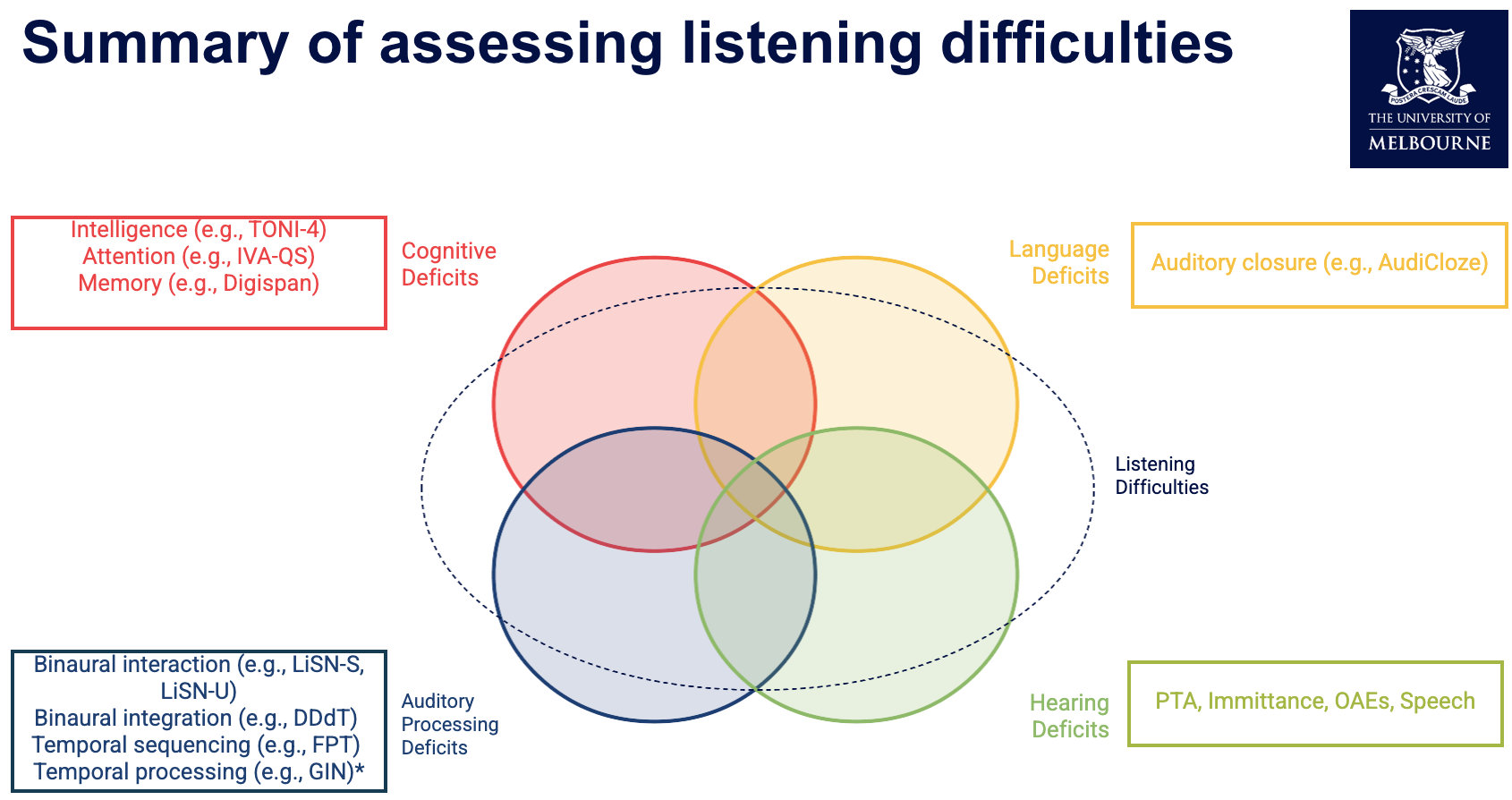
Listening difficulties may involve:
Hearing
Auditory processing
Cognition
Language
Any deficit in one or more domains can create listening problems.
Therefore:
APD should be viewed as a shared interdisciplinary space rather than belonging exclusively to one profession.
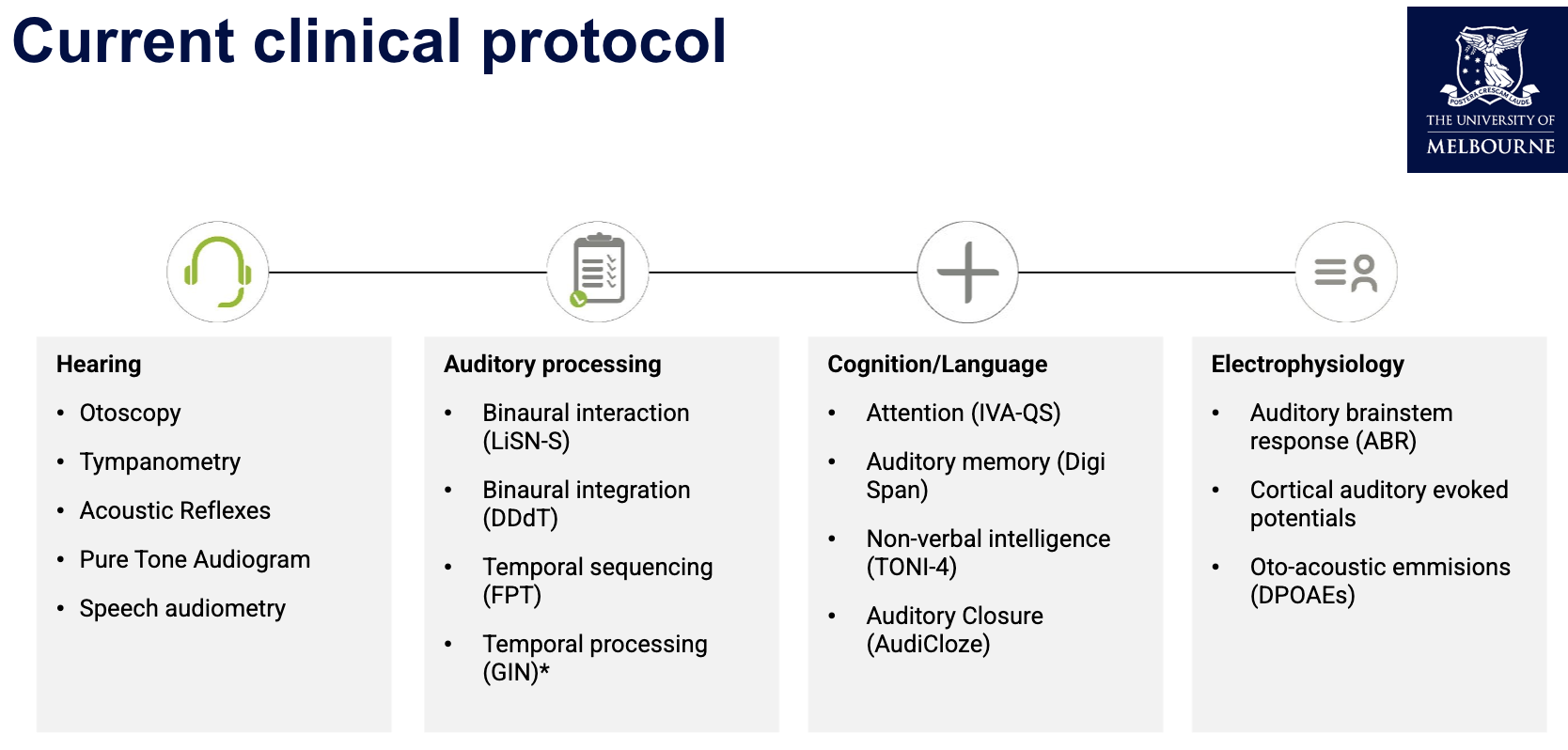
Proposed APD Assessment Framework
Assessment should include:
Hearing
Including:
Extended high-frequency audiometry where possible
Auditory Processing
Assessment of auditory processing domains.
Speech-in-Noise
Assessment of listening in noise.
Language
Language screening.
Cognition
Assessment of:
Attention
Memory
Intelligence
Management of APD
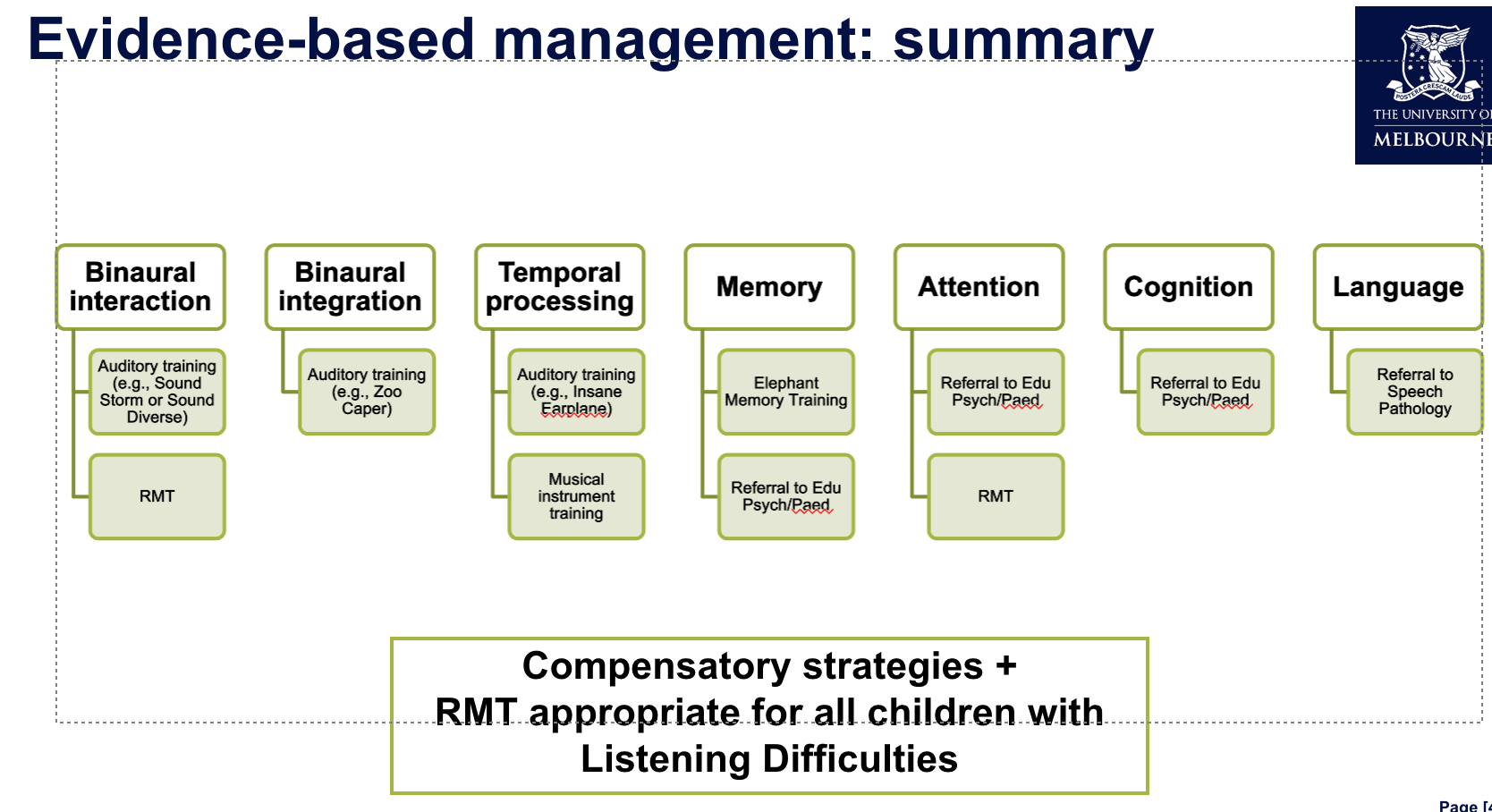
Three broad categories:
Direct skills remediation
Compensatory strategies
Environmental modifications
1. Direct Skills Remediation
Target specific deficits through training.
Goals:
Improve test performance
Improve real-world listening
Real-world improvement is considered most important.
Sound Storm
Targets:
Binaural interaction/Spatial listening skills
Features
12-week programme
iPad/tablet based
Space-themed game
Increasing difficulty
Benefits
Evidence demonstrates:
Improved test performance
Improved real-world listening
Limitation
Compliance.
Children may stop training due to:
Lack of engagement
Busy schedules
Competing interests (e.g., Minecraft, Fortnite)
Soundiverse
Newer programme.
Targets:
Binaural interaction/Spatial listening skills
General listening-in-noise difficulties
Can be used even when classic SPD pattern is absent.
Gamified learning structure (15-30 mins)
Broader applicability than Sound Storm.
Acoustic Pioneer
Zoo Caper
Targets:
Binaural integration/dichotic listening skills
Recommended for:
Dichotic Digits deficits
Ear asymmetry
Uses:
Simultaneous animal sounds
Insane Earplane
Targets:
Temporal processing skills
Evidence-based but less popular with children.
Elephant Memory
Targets:
Visual and auditory memory skills
Observed Effects
Improvement often seen in:
Memory measures
Auditory processing measures
Suggesting memory deficits can negatively affect multiple APD tests.
Example Case: 11-Year-Old Child
Presenting concerns:
Attention difficulties
Listening difficulties
Findings:
Poor binaural integration
Poor attention
Management:
Zoo Caper Skyscraper
Remote microphone technology
Outcome:
Improved Dichotic Digits performance
Improved listening
Improved real-world functioning
2. Compensatory Strategies
Aim:
Help listeners manage difficulties
Support teachers and families
Examples
Visual Supports
Strong recommendation:
Teachers should:
Write instructions on board
Use visual supports
Benefits entire class.
Active Listening Strategies
Encourage:
Better engagement
Better understanding
3. Environmental Modifications
Preferential Seating
Traditionally:
Sit at front of classroom
However modern classrooms often use:
Group seating
Flexible layouts
making this less useful.
Classroom Acoustics
Strategies include:
Carpets
Posters
Soft furnishings
Purpose:
Reduce reverberation.
Closed Classrooms
Advantages:
Less noise
Less visual distraction
Compared with open-plan learning spaces.
Additional Considerations
Avoid:
Noisy air conditioners
Heaters
Other environmental noise sources
Remote Microphones (Roger Focus)
Described as the strongest evidence-based intervention.
How They Work
Instead of amplification:
Teacher microphone transmits speech directly to child.
Overcomes:
Noise
Reverberation
Distance
Advantages
Portable.
Works across:
Different classrooms
Different teachers
Different environments
Evidence
Most APD management research focuses on Roger systems.
Benefits
Improved:
Access to teacher instructions
Understanding of speech
Reduced:
Listening-related stress
(measured via salivary cortisol)
Improved:
Cortical maturation
Attention
Academic outcomes
Quality of life
Low-Gain Hearing Aids
Emerging management option.
Potentially useful for children unwilling to use remote microphones.
Still an evolving area.
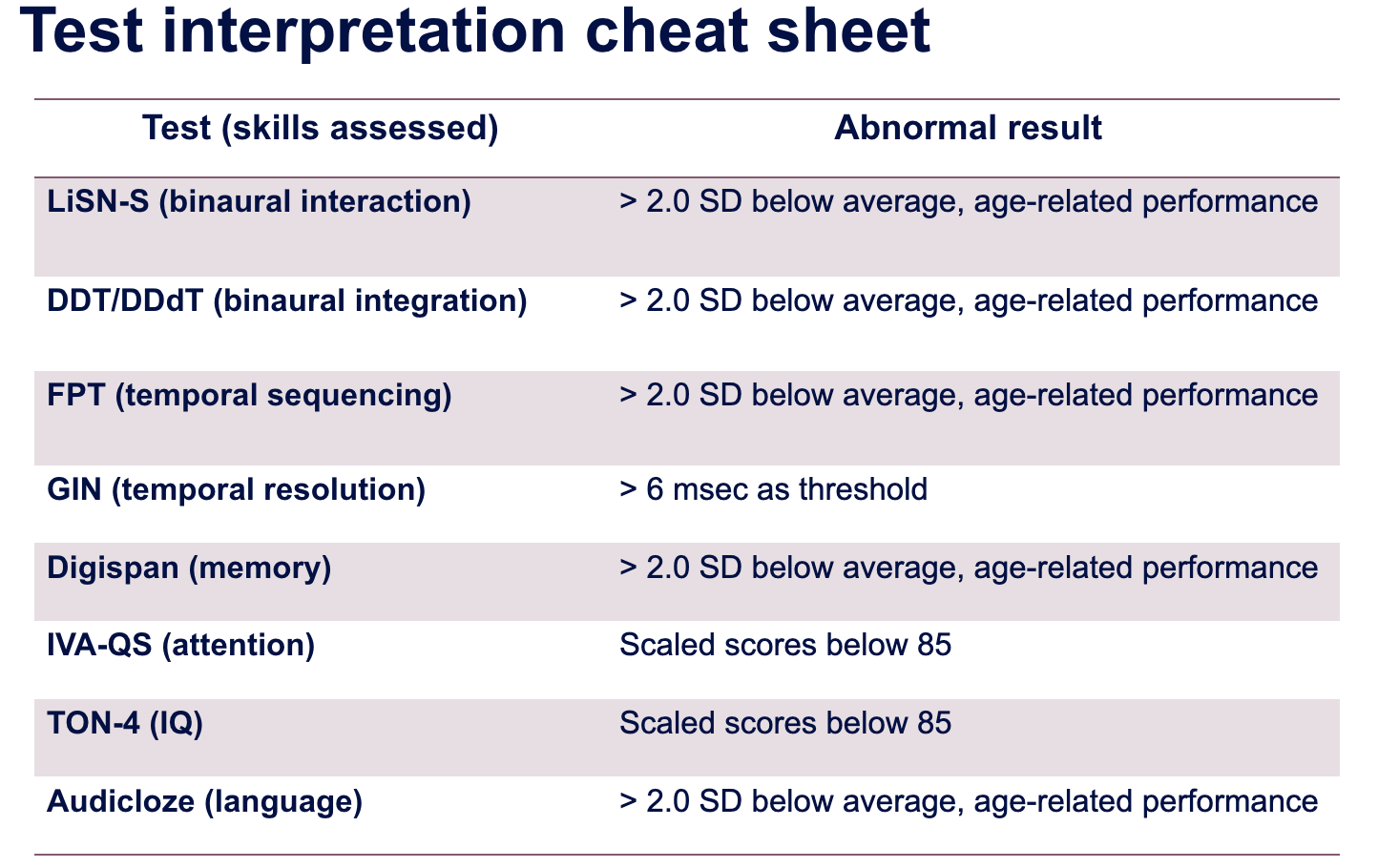
Case Study: Cassie (7.5 years)
Presenting concern:
Listening difficulties in groups
No literacy concerns.
Findings
Lisn-S Results
Poor overall.
Strongest deficit:
Spatial listening
Dichotic Digits
Abnormal.
Classic right-ear dominance pattern.
Diotic Condition
Normal.
Suggesting:
Attention and memory not major contributors.
Frequency Pattern
Normal.
Gaps in Noise
Normal.
Cognition
Normal:
Memory
Language
Intelligence
Attention
Interpretation
Primarily:
Spatial processing deficit
Binaural integration deficit
Management
Remote microphone
Sound Storm or similar auditory training
Case Study: Tom
Findings included:
Attention difficulties
Memory difficulties
Auditory processing difficulties
Attention testing:
Extremely poor
Child became bored and testing ended
Interpretation
Multiple contributing factors:
Attention
Memory
Auditory processing
Management
Referral
Back to:
Psychologist
Paediatrician
for attention/ADHD support review.
Additional Supports
Remote microphone
Auditory training
Communication strategies
Key Take-Home Message
Auditory processing difficulties should not be viewed solely as an auditory problem.
Effective assessment must consider:
Hearing
Auditory processing
Attention
Memory
Language
Cognition
The modern APD approach is:
Comprehensive, interdisciplinary, and individualised.
No two children will necessarily have the same combination of contributing factors, and management should be tailored accordingly.