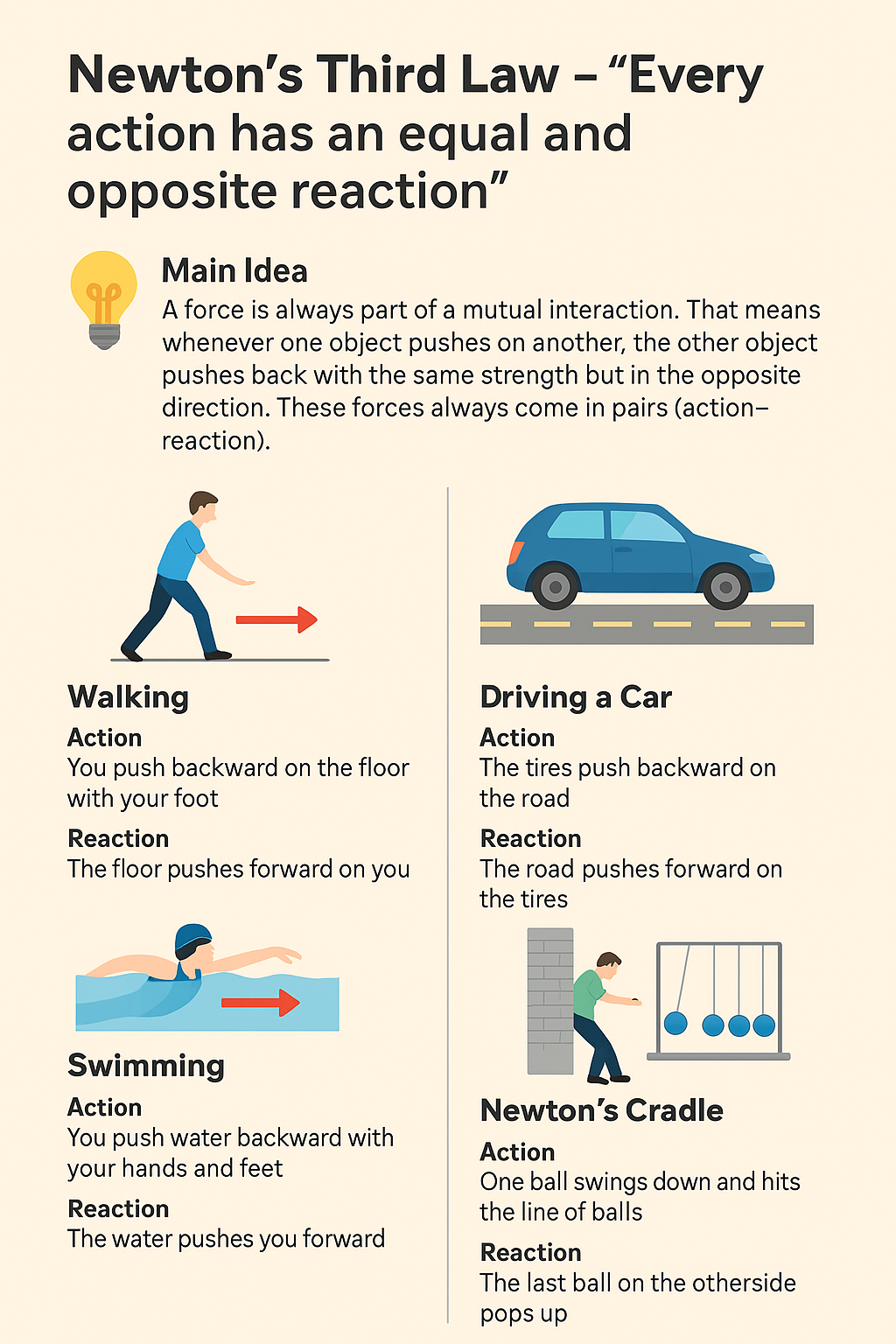
Newton’s Third Law: Action and Reaction
Newton’s Third Law says: For every action, there is an equal and opposite reaction.
That means forces always come in pairs. If one object pushes on another, the second object pushes back just as hard, but in the opposite direction.
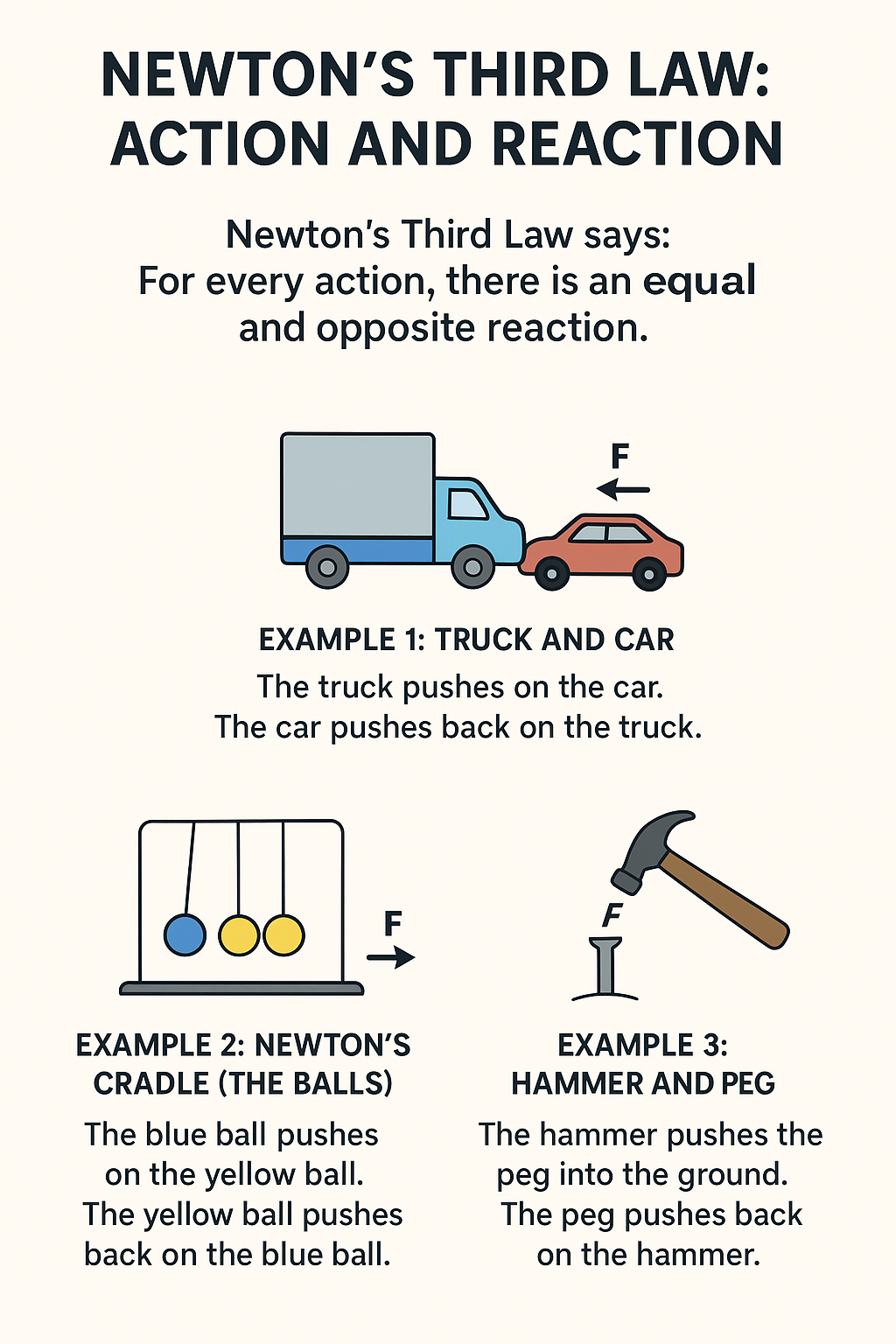
Example 1: Truck and Car
If a truck crashes into a car, the truck pushes on the car. At the same time, the car pushes back on the truck with the same amount of force, but in the opposite direction.
Example 2: Newton’s Cradle (the balls)
Think of Newton’s Cradle, the desk toy with swinging balls. When the blue ball hits the yellow ball, the blue ball slows down and the yellow ball moves away. Why? Because the blue ball pushes on the yellow ball, and the yellow ball pushes back on the blue ball with equal force.
Example 3: Hammer and Peg
When you hit a peg with a hammer, the hammer pushes the peg into the ground. At the same time, the peg pushes back on the hammer. That’s why the hammer doesn’t just go straight through the peg and into the earth — the peg resists and pushes back.
The Big Idea
No matter what the situation is — cars, balls, hammers — forces always happen in pairs.
If object A pushes on object B,
then object B pushes back on object A, equally and oppositely.
That’s Newton’s Third Law: action and reaction are always equal and opposite.