Psyc100 Class Notes
Chapter 4: Sensing and Perceiving Our World
Sensation: physical process; the experience of having your sense organs stimulated
Perception: psychological process; interpreting the sensations that are experienced, to recognize meaningful objects and events
Ambiguous images: images with multiple interpretations
Filling in (pattern completion) phenomena: perception that goes beyond sensation
Basic sensory processes
Sensory adaptation: diminishing sensitivity to an unchanging stimulus
Transduction: converting physical into neural information
Principles of perception
Psychophysics: study of relationship between physical characteristics of stimuli and our psychological experiences of them
absolute threshold: minimum stimulation needed to detect particular stimulus 50% of the time
Signal detection theory: we have four possible combinations when presented with stimuli (hit, miss, false alarm, correct rejection)
Factors affecting absolute threshold
signal and intensity
experience , expectation, motivation, fatigue
Difference threshold (just noticeable difference): minimum difference a person can detect between 2 stimuli half the time
Weber’s law: finding that the size of a jnd is a constant fraction of the intensity of the stimulus
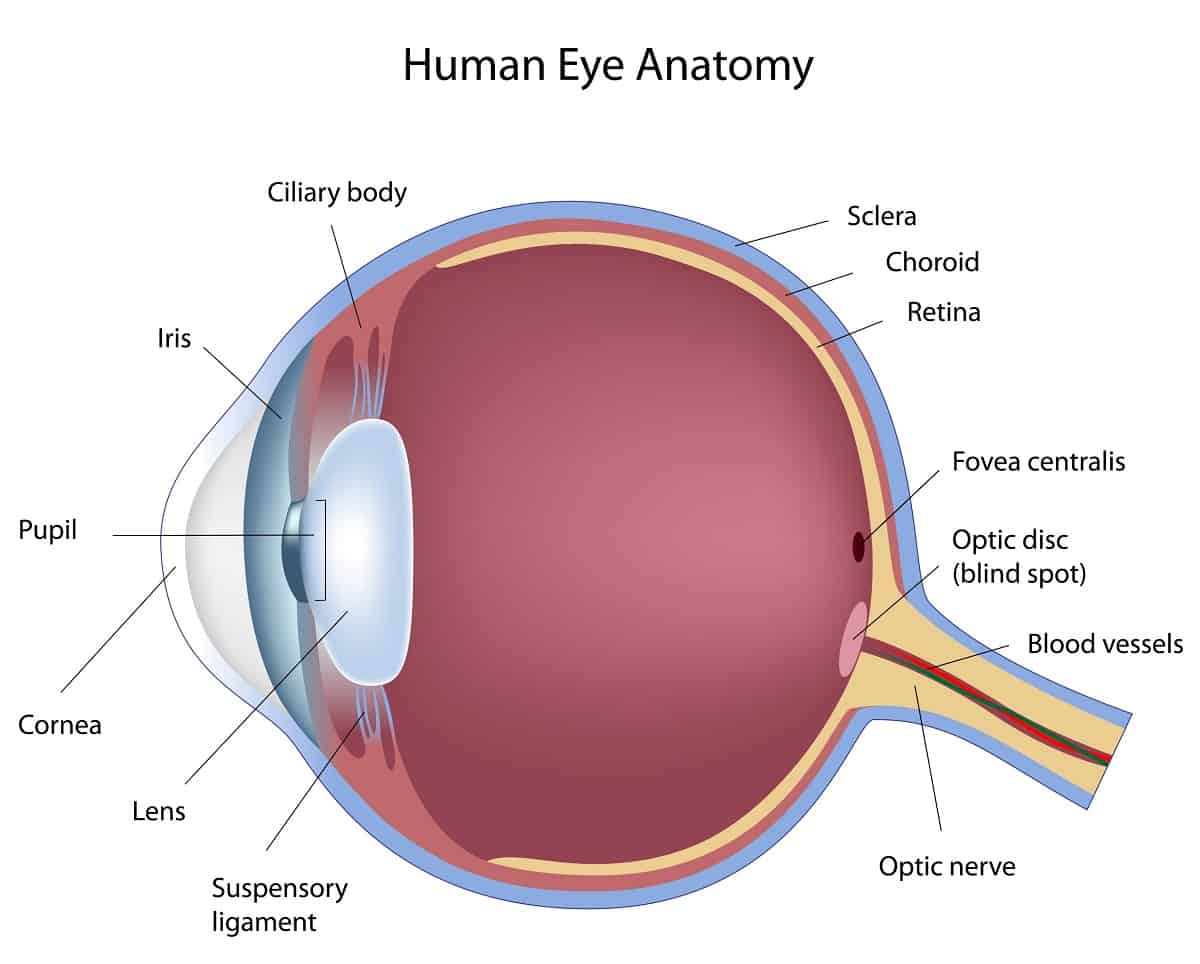
Cornea: protective area, low level focusing of light
Retina: membrane at the back of the eye that houses the photoreceptors
Photoreceptors pick up on light
Fovea: section of the retina
Photoreceptors
Rods: does the opposite of cones; used for seeing black and white (shading) and shapes
Cones: for seeing color and clarity; light is needed for them to work correctly
Optic nerve is made of axons from ganglion cells
Sensing visual stimuli
Vision and specific neurons
Feature detectors: neurons in visual cortex that analyze the retinal image and respond to specific aspects of shapes
Simple cell: bar of light oriented at particular angle
Perceiving color
Two theories of color vision
Trichromatic color theory: theory that all color that we experience results from mixing three colors of light (red, green, and blue)
Afterimages
Does not explain how someone can be red and green color blind but can see yellow
Explains color processing of cones in retina
Opponent process theory: color vision results from cones linked together in three pairs of opposing colors, so activation of one member of the pair inhibits activity of the other
red-green
Yellow-blue
White black
Explains LGN and visual cortex process color information
Deficiencies of color vision
Color blindness: weakness or deficiency in perception of certain colors
Perceiving depth
Binocular cues: depth cues that result from the use of both eyes
Retinal disparity: compare image from retinas of both eyes; greater disparity means object is closer
Binocular convergence: information about how much eyes must rotate inward to look at an object. More rotation means object is closer
Monocular cues: depth cues that are available to each eye separately
Linear perspective: parallel lines appear to converge as they get further away
Texture gradient: you can see more texture or detail on objects that are closer
Atmospheric perspective: things that are further away will appear hazier and bluer in color
Interposition: partially occluded (blocked) it appears to be further away
Size illusions
Perceiving size and shape
Perceptual constancy: perceiving objects as unchanging even as the image on the retina changes
Size constancy
Shape constancy: a shape has a constant shape but the shape falling on your retina changes
perceptual constancy
Lightness constancy: objects seem to have the constant lightness even when illumination varies
Relative luminance: amount of light in an object reflects relative to its surroundings
Color constancy: perceiving familiar objects as having constant color even when changing illumination alters reflected wavelengths
Perceiving patterns and wholes
Gestalt: an organized whole
Law of continuity: opt for the simplest solution
Law of proximity: grouping objects together because they are close together
Principle of closure: we fill in boundaries/boards when there is none physically there
Figure ground: organization of visual field into its objects (figures) and surroundings (ground)
Chapter 8: Learning
Learning: enduring changes in behavior that occur with experience
Vs. innate
Association: processes by which two pieces of information in environment are linked, so we connect them in our minds
Lightning, dog, chair, white,
Contiguity: nearness in time and space
Frequency: how often something occurs
Similarity: how alike things are
Behaviorism: psychology should:
Be an objective science
Study behavior without reference to mental processes
Conditioning: 2 types of associative learning
Conditioning: form of associative learning in which behaviors are triggered by associations with events in the environment
classical conditioning
Operant conditioning: rewards and punishments to increase or decrease behaviors
Classical conditioning (pavlovian conditioning): neutral stimulus becomes associated with stimulus which has automatic, inborn response
Neutral stimulus: stimulus that does not lead to any predictable response
Unconditioned stimulus: stimulus with a biologically innate response
Unconditioned response: biologically hardwired innate response
Conditioned stimulus: stimulus resulting in a conditioned response
Conditioned response: response that is learned over time with association
Acquisition: initial learning of the stimulus; response relationship
Forward conditioning: CS comes before US; most effective
Backward conditioning: US comes before CS
Higher-order conditioning: a new neutral stimulus can become a new CS
Extinction: diminished responding when the CS is no longer paired with the US
Spontaneous recovery: occurs after conditioned response is established, there is a pause in the experiment and response is the same when used again
Generalization: tendency to respond with the Cr to stimuli similar to the CS
Discrimination: learned ability to distinguish between a conditioned stimulus and other irrelevant stimuli
John Waston’s Little Albert study: one of the least ethical studies; when Albert would attempt to touch a white mouse, Waston would make a loud noise. This resulted in Albert having a fear sensation anytime he saw something white and fluffy.
Operant conditioning: process of changing behavior by manipulating consequences of that behavior
Action is strengthened if followed by a reinforcer
Action is diminished if followed by a punisher
E.L. Thorndike
Learning curve
Law of effect: consequences of a behavior increase or decrease likelihood the behavior will be repeated
Reinforcers
Person and context specific
Reinforcement: make the behavior more likely to occur
Positive reinforcement (adding a stimulus): strengthen response by following it with a pleasing stimulus
Negative reinforcement (removing a stimulus): strengthen response by removing something undesirable
Primary and secondary (conditioned) reinforcers
Primary reinforcers: unlearned and innately satisfying
Related to satisfaction of biological needs
Secondary reinforcers: are associated with primary reinforcers to achieve result
Shaping: using reinforcers to gradually guide an animals actions towards a desired behavior
Successive approximations
Continuous reinforcement: reinforce behavior every time it occurs
partial/intermittent reinforcement: reinforce behavior, but not every time it occurs
partial/intermittent reinforcement schedules:
Fixed ratio: reinforce behavior after certain number of responses
Variable ratio: reinforce behavior after unpredictable number of responses
Both are based on how many times the behavior occurs
Fixed interval: reinforce first response after fixed amount of time
Variable interval: reinforce first response after varying time interval
Based on a time interval
Punishment: make the behavior less likely to occur
Positive punishment (adding a stimulus): diminish response by following it with unpleasant stimulus
Negative punishment (removing a stimulus): diminish response by removing a desired stimulus
Conditioned taste aversions: learned avoidance of particular taste or food
Instinctive drift: learned behavior that shifts toward instinctive unlearned behavior tendencies
Biological constraint model: view on learning which proposes that some behaviors are inherently more likely to be learned than others
Latent learning: learning that occurs in absence of reinforcement and is not demonstrated until later when reinforcement occurs
Chapter 7: Memory
Memory: ability to take in, solidify, store and use information; the store of what has been learned and remembered
Four steps in forming memories
Encoding: brain attends to, takes in, and integrates new information from senses
Driven by attention
automatic processing (encoding that happens without intention) vs. effortful processing (encoding that is intentional and takes work)
Mnemonic device: method used to help us remember information
Consolidation: establishing, stabilizing, or solidifying memory
Protein synthesis
Occurs during REM sleep
Storage: retention of memory over time
Hierarchies: organize information from most common to most specific
Schemas: mental frameworks; from experiences with people, objects, or events
Associative networks: chain of associations between related concepts
Retrieval: recovery of information stored in memory
Ease of retrieval influenced by how well we encoded, consolidated, and stored the information
Aids to memory formation and retrieval
Attention
Sleep
Protects memories from being forgotten; makes memories more accessible to recall
Falling asleep soon after learning information leads to greater retention- less interference
Emotion
Generally better at remembering emotional memories (especially negative ones) than factual ones
Switch on genes that build proteins
Strengthen synaptic connections
Form new synapses
Form new neurons
Connections between hippocampus and amygdala
Flashbulb memories: detailed snapshot for what we were doing when we first heard about a major, public, and emotionally charged event
Highly emotional
Longer duration
Highly vivid
Inaccuracies in the flashbulb persist over time but inaccuracies of the event get corrected
Consequently: how consequential is the even for you
Depth of processing
The more deeply people encode information, the better they will recall it
structural/visual encoding- shallow
Phonemic: intermediate
Semantic: deep
Retrieval cues: prompt that helps access information in memory
Spreading activation: activation goes to all nodes that are attached to a node that is turned on
Encoding specificity: how the physical environment can act as a retrieval cue
Impediments to memory formation
distraction/multitasking
Emotion
Narrows attention
Rosy retrospection: tendency to remember events as more positive than they were
Emotional memories less accurate than everyday memories
Three major types of memory
Three stage model: classification of memories based on duration as sensory, short term, long term
Short term memory: 5-9 units of information
Digit span: a list of numbers are given, when they disappear you have to recall the numbers
Chucking: breaking list of items to be remembered into smaller
Serial position effect: curve that says that memory is best at the beginning and end of the list
Highly superior autobiographical memory: when people can recall in great detail personal events from almost any day of their adolescent or adult life
Selective and divided attention
False memory: memories for events that never happened but were suggested by someone or something
Imagination inflation vs being told about event
Recovered memories: memory from a real event that was encoded, stored, but not retrieved for a long period of time until some later event brings it to consciousness
Traumatic events may make memories overall more general
Suggestibility and misinformation
Suggestibility: memories are implanted in our minds based on leading questions, comments, or suggestions by someone else or some other source
Misinformation effect: information learned after an original event is wrong or misleading but gets incorporated into the memory as true
Forgetting: weakening or loss of memories over time
Interference: disruption of memory because other information competes with what we are trying to recall
Proactive: old information makes it difficult to learn new information
Retroactive: new information makes it difficult to recall old information
Decay: gradual fading of physical memory trace
Forgetting curve
Encoding failure (due to absent mindedness): results from inattention
Normal age related declines starting in 60s/70
Aerobic exercise, higher education level, conscientiousness buffer against encoding failure
Neuroticism associated with higher rates of encoding failure
Retrieval failure (blocking): inability to retrieve information that was once stored
Tip of the tongue phenomenon
Repression: basic defense mechanism that banishes anxiety arousing thoughts, feelings, and memories from consciousness
Memory loss caused by brain injury and disease
Amnesia
Retrograde: lose memory for things that happened prior to injury
Anterograde: unable to form new memories
Chapter 9: Language and Thought
Language vs communication
Body language and actions are forms of communication; communication is broad and language is only one form
The nature of language
Human language: communication system specific to homo sapiens
Open: new words are being added
Symbolic: has meaning
Grammar: rules of language
Allows users to express abstract and distant ideas