Intro to Metabolism (copy)
Metabolism → all chemical reactions that take place throughout the body
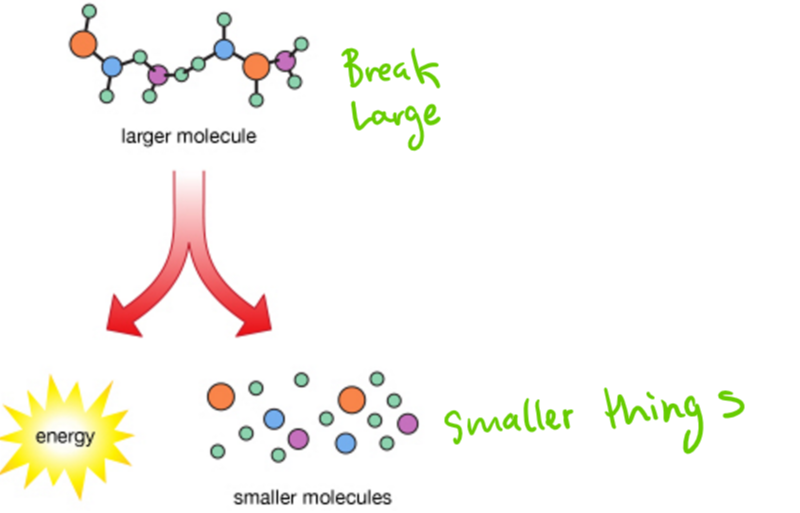
Catabolism → breaking large things into smaller things and releasing energy
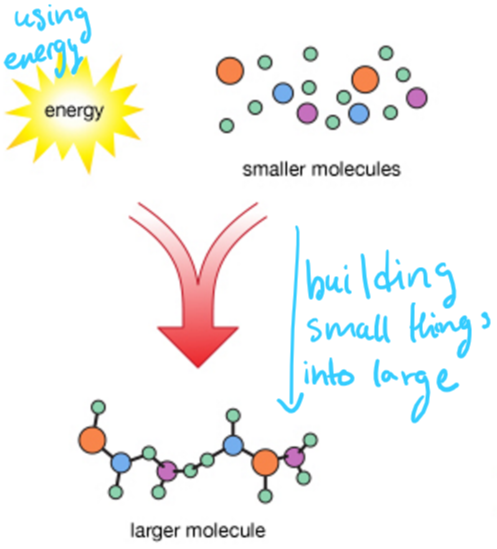
Anabolism → building small things into large things by using energy
ADP → uncharged/ drained energy carrier: adenosine diphosphate
ATP → charged energy carrier: adenosine triphosphate
NAD+ → an energy carrier with ADP + Nicotinic Acid (B3)
NADH → an energy carrier with ADP +Nicotinic Acid (B3) + 1 H
FAD → an energy carrier with ADP + B2
FADH2 → an energy carrier with ADP + B2 + 2 H
First Law of Thermodynamics → energy can be transferred between objects or converted between types
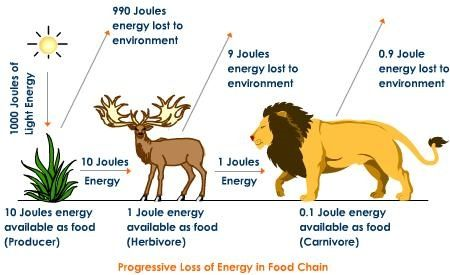
Second Law of Thermodynamics → the conversion and storage of energy is never 100% efficient
I can compare and contrast catabolism/ anabolism
Catabolism | Anabolism |
|---|---|
- breaking large things into smaller things | - building small things into large things |
- releases energy | - using energy |
used by heterotrophs | used by autotrophs |
|
|
I can explain how the laws of thermodynamics relate to biology
Some energy is lost in the form of heat in various steps of conversion, some lost in body processes of species
A process must have enough energy to proceed, but any extra energy is lost
I can describe the "recharging" of energy carriers
ATP to ADP (Adenosine Triphosphate to Adenosine Diphosphate):
ATP is like a charged battery in cells, carrying energy for various cellular processes.
When a cell needs energy, it breaks down ATP into ADP, releasing energy that powers cellular activities.
This process is akin to using up a fully charged battery until it becomes partially discharged.
NAD+ to NADH (Nicotinamide Adenine Dinucleotide to Nicotinamide Adenine Dinucleotide + Hydrogen):
NAD+ acts as an electron carrier in cellular respiration, shuttling electrons during the breakdown of glucose to produce energy.
As glucose is broken down, NAD+ picks up electrons and a hydrogen ion to form NADH.
This conversion represents storing energy in the form of high-energy electrons, similar to charging a battery by storing electrons.
FAD to FADH2 (Flavin Adenine Dinucleotide to Flavin Adenine Dinucleotide + 2 Hydrogen):
FAD is another electron carrier involved in cellular respiration.
It accepts electrons and hydrogen ions from metabolic reactions to become FADH2.
This transformation is akin to storing energy by capturing high-energy electrons, much like charging a battery to store electrical energy.