Meiosis and Mitosis
Meiosis
Meiosis is the process of cell division that produces gametes (sex cells like sperm and eggs) in sexually reproducing organisms.
It reduces the chromosome number by half, from diploid (2n) to haploid (n).
This ensures that when two gametes unite during fertilization, the resulting organism will have the correct number of chromosomes.
It creates four gametes, each of which is genetically different from one another and from the parent cell.
Key Characteristics:
Diploid to haploid: Starts with a diploid cell (two sets of chromosomes) and results in haploid cells (one set of chromosomes).
Two divisions: Meiosis involves two rounds of division, called Meiosis I and Meiosis II.
Genetic diversity: Crossing over and independent assortment during meiosis lead to genetically unique offspring.
Stages of Meiosis:
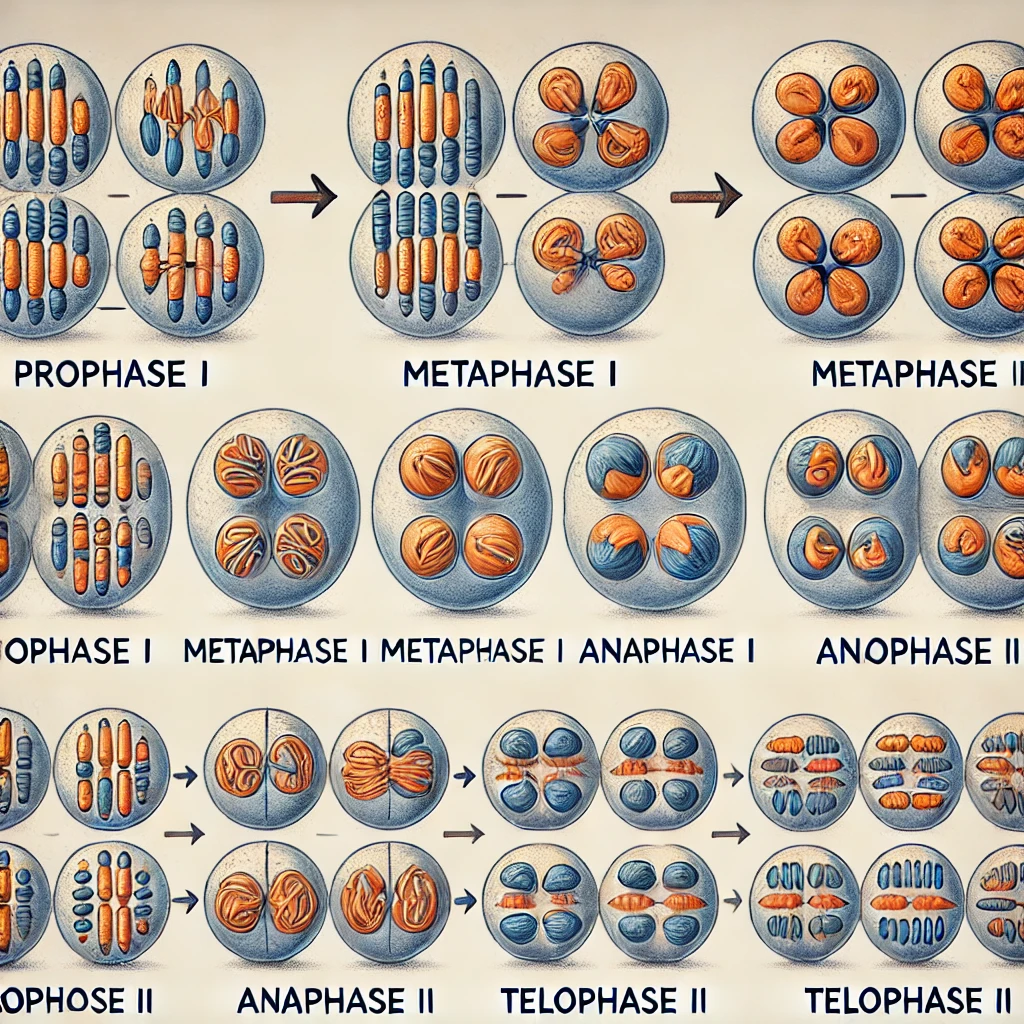
Meiosis I: The Reduction Division
1. Prophase I:
Chromosomes condense, and homologous chromosomes (one from each parent) pair up.
Crossing over occurs, where homologous chromosomes exchange segments, increasing genetic diversity.
The nuclear membrane dissolves, and spindle fibers begin to form.
2. Metaphase I:
Homologous chromosome pairs line up at the metaphase plate (the middle of the cell).
The arrangement of these pairs is random, leading to independent assortment, which increases genetic variation.
3. Anaphase I:
The spindle fibers pull the homologous chromosomes apart, moving them to opposite poles of the cell.
Unlike in mitosis, sister chromatids remain attached at this stage.
4. Telophase I & Cytokinesis:
The cell divides into two haploid cells, each with half the original number of chromosomes.
The nuclear membrane may reform, and the cell prepares for the second division.
Meiosis II: The Division of Sister Chromatids
This division is similar to mitosis, but it starts with haploid cells.
1. Prophase II:
Chromosomes condense again in each of the two new cells, and the spindle fibers form.
2. Metaphase II:
Chromosomes (each made up of two sister chromatids) align at the metaphase plate.
3. Anaphase II:
The spindle fibers pull the sister chromatids apart, moving them to opposite poles of the cell.
4. Telophase II & Cytokinesis:
The cells divide again, resulting in four genetically distinct haploid gametes.
Mitosis
Purpose:
Mitosis is the process of cell division used for growth, repair, and asexual reproduction in somatic (body) cells.
It produces two identical daughter cells from one parent cell, both having the same number of chromosomes as the parent (diploid).
Key Characteristics:
Diploid to diploid: Both the parent cell and the daughter cells have the same number of chromosomes (diploid).
One division: Unlike meiosis, mitosis involves only one round of division.
No genetic variation: The daughter cells are genetically identical to the parent cell and to each other.
Stages of Mitosis:
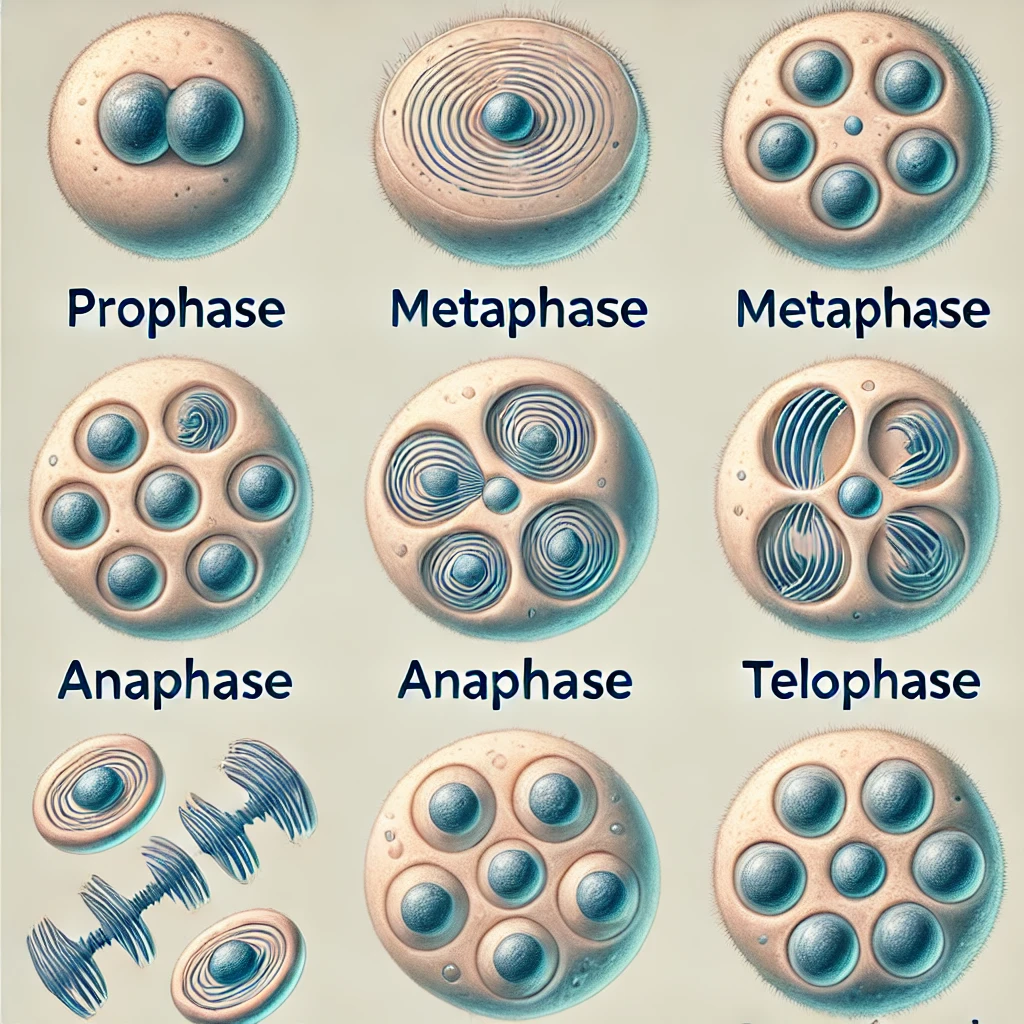
1. Prophase:
Chromosomes condense and become visible under a microscope.
The nuclear membrane starts to break down, and spindle fibers form, connecting to the chromosomes at the centromere.
2. Metaphase:
Chromosomes line up in the middle of the cell along the metaphase plate.
The spindle fibers are fully formed, ensuring that each sister chromatid will be pulled apart.
3. Anaphase:
The sister chromatids are pulled apart to opposite poles of the cell.
Each chromatid is now considered an individual chromosome.
4. Telophase:
Chromosomes arrive at the poles, and the nuclear membrane reforms around each set of chromosomes.
The chromosomes begin to de-condense, returning to their stringy form.
5. Cytokinesis:
The cytoplasm divides, producing two separate daughter cells.
Each daughter cell has the same number of chromosomes as the parent cell (diploid).
Comparison Between Meiosis and Mitosis:
Feature | Meiosis | Mitosis |
Type of cells | Gametes( sex cells) | Somatic cells( body cells) |
Number of Divisions | Two | One |
Number of daughter cells | Four | Two |
Chromosome number | Half (Haploid, n) | Same as parent (Diploid 2n) |
Genetic Variation | Yes (Crossing over) | No (Identical) |
Purpose | Sexual Reproduction | (Growth, Repair, Asexual Reproduction) |
Simplified Summary:
Meiosis: Creates sex cells (sperm and eggs), reduces chromosome number by half, generates genetic diversity, and involves two divisions to produce four unique gametes.
Mitosis: Produces two identical cells for growth and repair, maintains chromosome number, and involves one division.