2.3.6: Equilibrium
Equilibrium:
It occurs when the price where the quantity sellers are willing and able to produce is equal to the quantity consumers are willing and able to buy.
Visually, it is where the demand and supply curves intersect on a graph, indicating the market price at which the quantity demanded equals the quantity supplied.
Markets tend to move and stay toward equilibrium.
Excess demand can shift equilibrium by demanding more than is available to produce, which leads to upward pressure on prices until a new equilibrium is established (this occurs when price is below the equilibrium price).
Conversely, excess supply occurs when the quantity supplied exceeds the quantity demanded, resulting in downward pressure on prices until the market reaches a new equilibrium point (this happens when price is above the equilibrium price).
Change in Demand
Some factors: Income, tastes, price of related goods, number of consumers in market, and future expectations.
When demand increases, the demand curve shifts to the right.
Thus the equilibrium price tends to rise, leading to a new intersection point with the supply curve that reflects the higher quantity demanded at that price.
Change in Supply
Anything that changes the cost of producing a good or service.
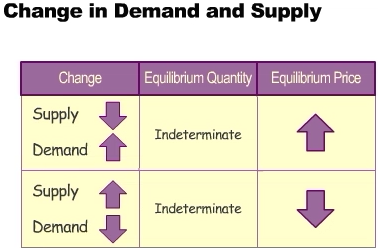
If something causes the cost of producing a good to increase, supply will decrease, which would be a leftward shift of the supply curve, resulting in a higher equilibrium price and a lower quantity sold in the market.
Conversely, if production costs decrease, supply may increase, resulting in a rightward shift of the supply curve, which would lead to a lower equilibrium price and a higher quantity sold in the market.
Change in Supply and Demand
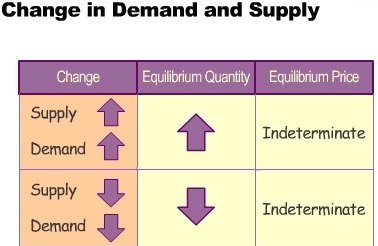
If both increase, then the overall effect on equilibrium price and quantity will depend on the magnitude of the shifts. If the increase in demand is greater than the increase in supply, we can expect a higher equilibrium price and quantity. However, if the increase in supply outpaces the increase in demand, the equilibrium price may decrease while the quantity sold increases.
Remember, increase in supply can lead to a reduction in equilibrium prices and increase quantity
Increase in demand = higher equilibrium prices and quantity sold.
Price Ceilings and Floors
Government may need to intervene in markets because legislators are not content with the unregulated market.
Example: Many feel that an unregulated rental market is too high, so a rent control ordinance is established to limit the amount landlords can charge.
This results from excess demand, and is an example of a price ceiling where prices cannot exceed.
An example of a price floor is a minimum wage law, which sets the lowest legal pay that employers can offer their workers, aiming to ensure that income remains above a certain level for all employees.
It enforces a wage above the market equilibrium and produces excess supply.
In a surplus (when the price is above the equilibrium level -price floor), the quantity supplied exceeds the quantity demanded. This can lead to unemployment as businesses may reduce their workforce in response to the higher wage costs, resulting in an imbalance in the labor market.
Value of the surplus is quantity supplied - quantity demanded.
A shortage occurs when the price is below the equilibrium level -.price ceiling.
In this situation, the quantity demanded surpasses the quantity supplied, which can create long waiting lists for products and services. This imbalance can also lead to increased prices as consumers compete for the limited resources available.
the quantity demanded exceeds the quantity supplied
Shortage = quantity demanded - quantity supplied