US History Note
==Beginnings of WW1==
%%M.A.N.I.A: Causes of WW1%%
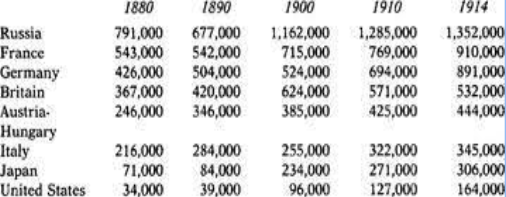
^^M: Militarism: Building up armies and giving the military more power.^^
- Ex: Personnel, Equipment, Plans
^^A: Alliances: A complicated system of partnerships designed to build up each others nations security^^
^^N: Nationalism: Pride in your country or ethnic heritage.^^
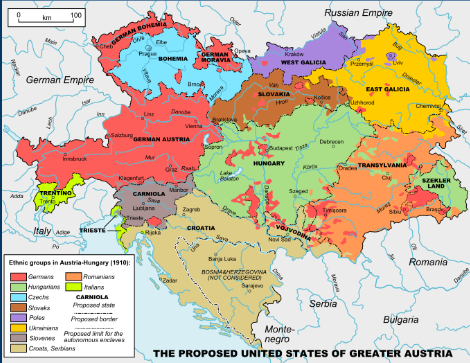
- The longing of an ethnic minority for independence and self-government
- Creates conflict when the great powers act only in their own nation’s interest and attempt to make colonies
^^I: Imperialism: When stronger nations take over weaker ones in order to create an empire^^
- Competition for colonial lands around the world led to conflict
- Most lands were already claimed by major powers
^^A: Assassination: Archduke Francis Ferdinand, heir to the throne of Austria-Hungary, and his wife Sophie went to Sarajevo, the capital city of the Austro-Hungarian province of Bosnia^^
- Both Serbia (independent and nationally similar to Bosnia) and Austria-Hungary (wanted empire) felt Bosnia belonged to them.
- Many Serbians despised Franz and his government
- The Black Hand- Serbian Terrorists
%%Steps%%
- Assassination of Archduke Ferdinand
- Austria-Hungary gives an ultimatum to the Serbians
- Take responsibility for the assassination
- Allow Austria-Hungary annexation of Serbia
- Austria-Hungary Declares war on Serbia
- July 28, 1914
- Russia Mobilizes Army
- Done to protect Serbia
- Would take six weeks
1. Russia had the largest army at the time. 6 weeks was more of a warning to Austria-Hungary
- ^^Mobilization: the readying of troops for war^^
- Germany Declares war on Russia
- Ally of Austria-Hungary
- First demanded that Russia stop mobilization but they did not.
- Declared war on August 1, 1914
- France Declares war on Germany
- France Allied with Russia
- Germany now has a problem because they are at war with both France and Russia (Being attacked by both sides of their country)
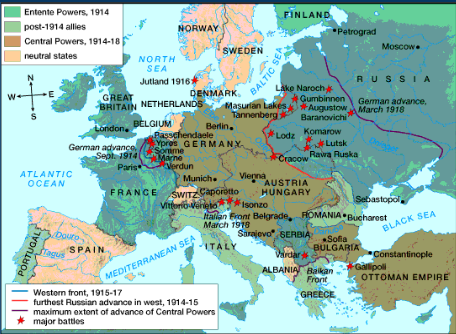
1. ^^The Schlieffen Plan: The Germans attempt to Avoid a two-front war by making a quick sweep through France to knock the French out of the war, then sending all the troops off to the east to fight Russia^^
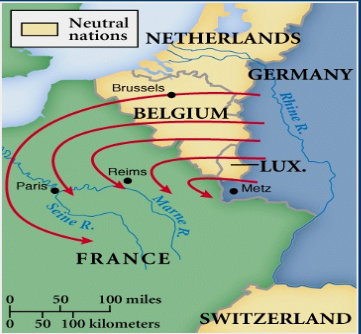
- Germany Invades Belgium
- Belgium is a Neautral country
- Shortest way to get to France
- Britain declares war on Germany
- Ally of Belgium
- Declares war on Germany on Aug. 4
- British colonies were brought into war.
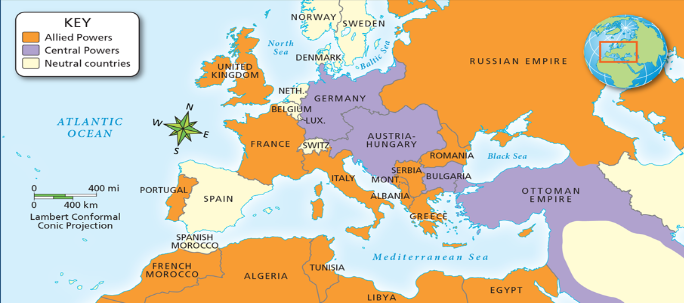
| Allied Powers | Central Powers: |
|---|---|
| - Great Britain- France- Russia- Italy | - Germany- Ottoman Empire- Austria Hungary |
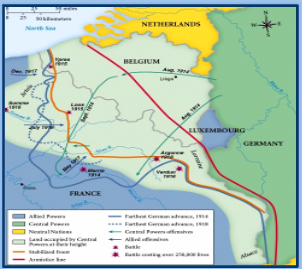
Schlieffen Plan Fails:
Germany advances to within 30 miles of Paris and is finally stopped by the French and British. Both side sides start digging trenches. Trench warfare begins.
- Effects of Schlieffen Plan failure.
- British joined the war on the side of the allies
- British/French are an equal match for the Germans, so neither side can gain an advantage
- Germans had to fight a two-front war which is what they were trying to avoid
- The battle lines remained unchanged from 1914-1916
==Weapons of WW1==
%%Technological Improvements%%
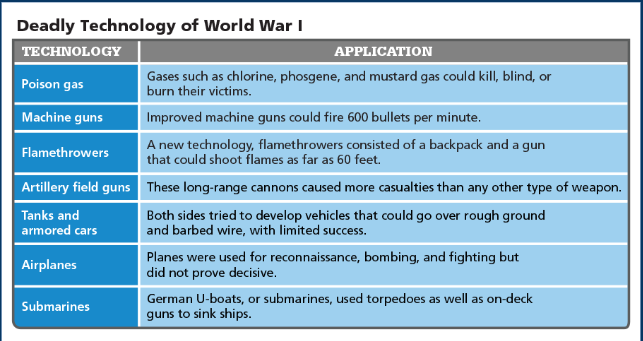
- Prior to WW1, battles were fought with rifles, bayonets, cannons, and “simple” weapons
- Because of the industrial rev., weapons could now be produced faster and more powerful and had the ability to cause mass ^^casualties: Soldiers killed, wounded, or missing^^
- One million French soldiers killed in the first 3 months
- Battle of Verdun and Battle of the Somme- 2 million casualties between Britain, France, and German
^^Trenches: A system of interconnected protections dug into the ground that attempted to provide some form of protection^^
- Interconnected with each other and stretched for hundreds of miles
- Trench Warfare Terminology:
- “Over the Top”: leaving the trenches to attack the enemy
- “No Man’s Land”: the area between the trenches