Lecture #9 | Transcription & Translation
Nucleic Acids Large biomolecules that are fundamental for information storage and exchange. These include DNA and RNA
Central Dogma The flow of genetic info which begins with DNA replication, transcription, and translation
Transcription The reading of a DNA template to make an RNA copy
Core RNA Polymerase Contains αI, αII, β, β′ subunits required to elongate an RNA chain
Sigma Factor Needed only for initiation of RNA synthesis, not for its elongation
How do sigma factors work? They recognize promoters (specific DNA sequence that marks the beginning of a gene) and guide the core enzyme to initiate transcription
Where do the sigma factors bind to? The -10 (Pribnow Box) and -35 regions of genes
Holoenzyme The combination of both the core enzyme and the Sigma factor
How many sigma factors are there in one cell? There are multiple factors in one cell to turn on the transcription of different sets of genes responding to different conditions
𝜎70 sigma factor The housekeeping sigma factor, it recognizes most promoters and has a consensus sequence found at -35 and -10 regions
𝜎32 sigma factor Heat-shocked-induced genes with promoter recognition at -35 and -10
𝜎28 sigma factor Recognizes promoters in genes for motility and chemotaxis at -35 and -10 regions
𝜎38 sigma factor Recognizes promoters on stationary phase and stress response genes at the -35 and -10 regions
𝜎54 sigma factor Recognizes promoters on genes for nitrogen metabolism at -24 and -12 regions
How is transcription initiated? Sigma factor binds to DNA, which recruits the core RNA polymerase enzyme, This holoenzyme scans the promoter region, Holoenzyme unwinds DNA at the promoter, creating the open concept, Sigma factor is released
How is transcription elongated? With the sigma factor released, the core RNA polymerase synthesizes an RNA strand 5→3, This is done by adding complimentary bases of the DNA template strand to create a non-template strand, where U is replaced from T
Rho-dependent Termination To terminate transcription, rho protein binds to the mRNA and pulls itself to the RNA polymerase, ending transcription
Rho-independent termination Occurs in the absence of rho, requires a GC-rich region that forms a stem loop that contacts RNA polymerase, bringing it to a halt. U residues downstream are even more unstable, causing mRNA to break off of DNA and release the polymerase
mRNA Messenger RNA
rRNA Ribosomal RNA
tRNA Transfer RNA which is used to carry info from DNA to protein
sRNA Small RNA that regulate stability or translation of specific mRNAs into proteins
Codons Triplets of nucleotides, 61 codons code for 20 amino acids
Stop Codons UAA, UAG, UGA
tRNA Structure Cloverleaf structure that binds individual amino acids as it has a 3-base anticodon which pairs to mRNA codons
Translation The decoding of RNA into a protein
Ribosome structure Very large rRNA protein complexes with 2 subunits (A 30s subunit and a 50s subunit), can bind one mRNA and 3 tRNA as complementary sequence in 16s rRNA and 30s subunit
30s subunit Contains 16s rRNA
50s subunit 5s and 23 s RNA
How is translation initiated? Ribosome binding site (called Shine-Dalgarno sequence, which is complementary to the 3’ end of the 16s RNA) on mRNA allows binding to 30s subunit, IF3 brings 30s and mRNA together, IF 1 blocks the A site, IF2 escorts the Formylmethionine tRNA to the start codone AUG, which then binds directly to the P site (this just begins initiation, does not have an amino acid, Then the 50s subunit docks to the 30s subunit
How is translation elongated? Aminoacyl-tRNA binds to the A site, A peptide bond is formed between the new aa and the growing peptide chain in the p site, Ribosome shifts down the mRNA one codon
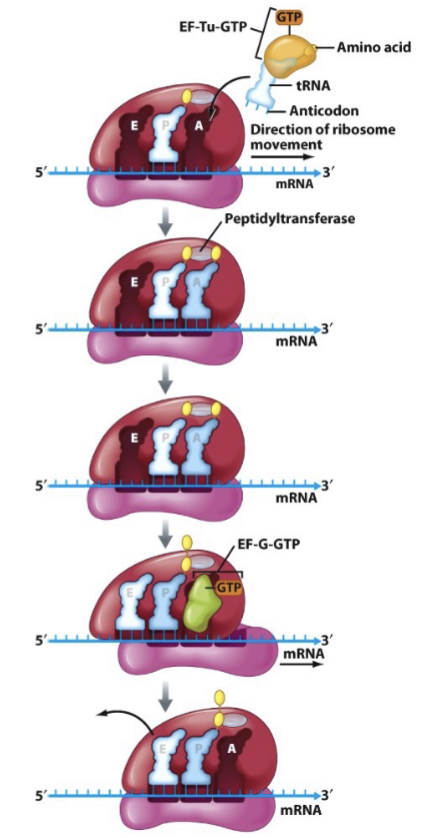
How is translation terminated? Stop codon with no tRNA enters the A site, Protein releasing factor enters the A site, Peptidyltransferase is activated and releases complete protein, Ribosome recycling factor and EF_G enter the A site and 50s undocks from 30s
Describe transcription and translation in prokaryotes A coupled process as ribosome bind to mRNA while mRNA is still being synthesized and multiple ribosomes bind to each mRNA to make proteins rapidly
Open Reading Frame
The protein-coding region contained within mRNA and located between translation start codon (AUG) and stop codon