Chapter 2.2 & 2.3
Water
The hydrogen and oxygen atoms within water molecules form polar covalent bonds
Electrons spend more time with oxygen atoms than hydrogen atoms
No overall charge to a water molecule- but there is a slight positive charge to hydrogen and slight negative to oxygen
Each water molecule attracts other polar molecules (sugars) which form hydrogen bonds
When a substance readily forms hydrogen bonds with water, it can dissolve in water and is referred to as hydrophilic (“water-loving”)
Water Stabilizes Temperature
Hydrogen bonds in water allow it to absorb and release heat energy more slowly than many other substances
Temperature is a measure of the motion (kinetic energy) of molecules
As motion increases, energy is higher and temperature is higher
Water absorbs energy because temperature rises- increased energy disrupts the hydrogen bonds between water molecules
These bonds can be created and disrupted rapidly, water absorbs an increase in energy and temperature changes only minimally
This means that water moderates temperature changes within organisms and in their environments
As energy input continues, the balance between hydrogen-bond formation and destruction swings toward the destruction side
More bonds are broken than formed
This process results in the release of individual water molecules at the surface of the liquid (such as a body of water, the leaves of a plant, or the skin of an organism) in a process called evaporation
Evaporation of sweat which is 90% water allows for cooling of an organism
Breaking hydrogen bonds requires an input of energy and takes away heat from body
As molecular motion decreases and temperature drops- less energy is present to break hydrogen bonds between water molecules
These bonds remain intact and begin to form a rigid, lattice-like structure (a)
When frozen, ice is less dense than liquid water (the molecules are farther apart). This means that ice floats on the surface of a body of water (b)
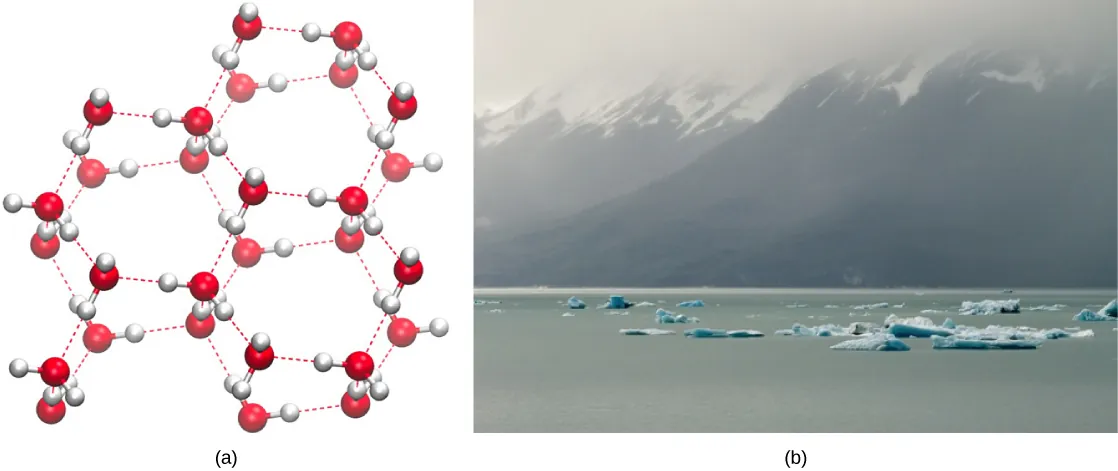
Ice will from on the surface creating an insulating barrier to protect the animal and plant- if not, they could not move freely
Water is a Solvent
Water is polar with slight positive and negative charges, ionic compounds and polar molecules can readily dissolve in it
This makes it a solvent- a substance capable of dissolving another substance
The charged particles will form hydrogen bonds with a surrounding layer of water molecules
Referred to as a sphere of hydration and serves to keep the particles separated or dispersed in the water
In the case of table salt (NaCl) mixed in water, the sodium and chloride ions separate, or dissociate, in the water, and spheres of hydration are formed around the ions
A positively charged sodium ion is surrounded by the partially negative charges of oxygen atoms in water molecules. A negatively charged chloride ion is surrounded by the partially positive charges of hydrogen atoms in water molecules
These spheres of hydration are also referred to as hydration shells
Polarity of the water molecule makes it an effective solvent and is important in its many roles in living systems
Cohesive
Water can stay above the glass because of the property of cohesion
The dome-like shape above a glass of water
Water molecules are attracted to each other (because of hydrogen bonding), keeping the molecules together at the liquid-air (gas) interface, although there is no more room in the glass
Cohesion gives rise to surface tension, the capacity of a substance to withstand rupture when placed under tension or stress
Surface tension that is created by the water molecules
When you drop a small scrap of paper onto a droplet of water, the paper floats on top of the water droplet, although the object is denser (heavier) than the water
Cohesion and surface tension keep the water molecules intact and the item floating on the top.
Adhesion
The attraction between water molecules and other molecules
Observed when water “climbs” up a straw in a glass of water
Water appears to be higher on the sides of the straw than the middle
Cohesive and adhesive forces are important for sustaining life.
Ex. Because of these forces, water can flow up from the roots to the tops of plants to feed the plant
pH
pH of a solution is a measure of its acidity or bascicity
Litmus paper is used as a pH indicator for how much acid or base (basicity) exists in a solution
This pH test measures the amount of hydrogen ions that exist in a given solution
High concentrations of hydrogen ions yield a low pH, whereas low levels of hydrogen ions result in a high pH
The overall concentration of hydrogen ions is inversely related to its pH and can be measured on the pH scale
The more hydrogen ions present, the lower the pH; conversely, the fewer hydrogen ions, the higher the pH
The pH scale ranges from 0 to 14
Acids/Bases
Acids are substances that provide hydrogen ions (H+) and lower pH
Bases provide hydroxide ions (OH–) and raise pH
The stronger the acid, the more readily it donates H+
Bases are substances that readily donate OH–
The OH– ions combine with H+ to produce water, which raises a substance’s pH
Most cells in our bodies operate within a very narrow window of the pH scale, typically ranging only from 7.2 to 7.6
The respiratory system malfunctions if outside this range
Proteins break down
Deviation outside of the pH range can induce coma or even cause death
Buffers
Buffers readily absorb excess H+ or OH–
Carbon dioxide is part of a prominent buffer system in the human body; it keeps the pH within the proper range
This buffer system involves carbonic acid (H2CO3) and bicarbonate (HCO3–) anion
If too much H+ enters the body, bicarbonate will combine with the H+ to create carbonic acid and limit the decrease in pH
If too much OH– is introduced into the system, carbonic acid will rapidly dissociate into bicarbonate and H+ ions
The H+ ions can combine with the OH– ions, limiting the increase in pH
Without this buffer system, the pH in our bodies would fluctuate too much and we would fail to survive
Carbon
Life is “carbon-based”
Carbon atoms form the fundamental components of most molecules of living things
The “foundation” element for molecules in living things
The bonding properties of carbon atoms responsible for important role
Carbon Bonding
Carbon contains four electrons in its outer shell
Form four covalent bonds with other atoms or molecules
Simplest organic carbon molecule is methane (CH4)
four hydrogen atoms bind to a carbon atom
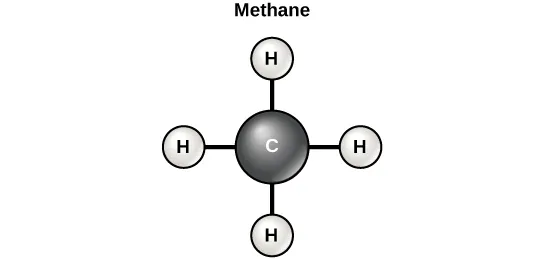
Any of the hydrogen atoms can be replaced with another carbon atom covalently bonded to the first carbon atom
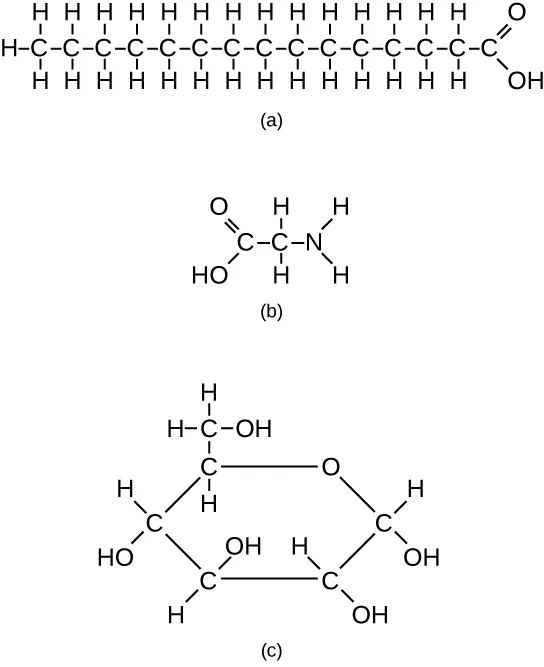
Long and branching chains of carbon compounds can be made (a)
Carbon atoms may bond with atoms of other elements, such as nitrogen, oxygen, and phosphorus (b)
The molecules may also form rings, which themselves can link with other rings
Carbohydrates
Macromolecules
Essential for our diet- provide energy through glucose and simple sugars
Represented by the formula (CH2O)n
n is the number of carbon atoms
ratio of carbon to hydrogen to oxygen is 1:2:1 in carbohydrate molecules
Classified into three subtypes: monosaccharides, disaccharides, and polysaccharides
Monosaccharides
Simple sugars
Mono- = “one”; sacchar- = “sweet”
Most common is glucose
Number of carbon atoms present ranges from 3-6
Most monosaccharide names end with the suffix -ose
Depending on the number of carbon atoms in the sugar, they may be known as trioses (three carbon atoms), pentoses (five carbon atoms), and hexoses (six carbon atoms)
Exist as linear chain or ring shaped molecules; in aqueous solutions they are in ring from
Chemical formula for glucose is C6H12O6
Glucose is important source of energy
During cellular respiration, energy is released from glucose, and that energy is used to help make adenosine triphosphate (ATP)
Plants synthesize glucose using carbon dioxide and water by the process of photosynthesis
Glucose is used for the energy requirements of the plant
Excess synthesized glucose is stored as starch that is broken down by other organisms that feed on plants
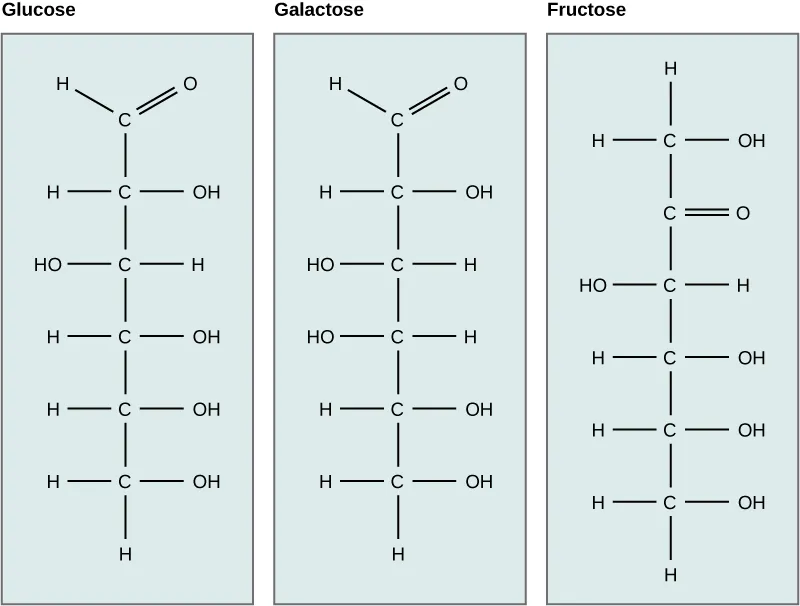
Galactose (part of lactose, or milk sugar) and fructose (found in fruit) are other common monosaccharides
Differ structurally and chemically (and are known as isomers) because of differing arrangements of atoms in the carbon chain
Disaccharides
Two monosaccharides undergo a dehydration reaction (a reaction in which the removal of a water molecule occurs)
di= “two”
Hydroxyl group (–OH) of one monosaccharide combines with a hydrogen atom of another monosaccharide, releasing a molecule of water (H2O) and forming a covalent bond between atoms in the two sugar molecules
Common disaccharides are lactose, maltose, and sucrose
Lactose is a disaccharide consisting of the monomers glucose and galactose (found naturally in milk)
Maltose/ malt sugar is disaccharide formed from a dehydration reaction between two glucose molecules
Sucrose/ table salt is the most common disaccharide composed of monomers glucose and fructose
A polysaccharide is a long chain of monosaccharides linked by covalent bonds
Poly= “many”
Chain may be branched or unbranched- can contain different types of monosaccharides
Polysaccharides may be very large molecules
Ex. starch, glycogen, cellulose, and chitin
Starch
Starch is the stored form of sugars in plants made up of amylose and amylopectin (polymers of glucose)
Plants synthesize glucose and extra is stored as starch in different plant parts like roots and seed
Starch consumed by animals is broken down into smaller animals like glucose - then the cells absorb glucose
Glycogen
Glycogen is the storage form of glucose in humans and other vertebrates (monomers of glucose)
Glycogen is the animal equivalent of starch
A highly branched molecule stored typically in the liver and muscle cells
As glucose levels decrease- glycogen is broken down to release glucose
Cellulose
One of the most abundant natural biopolymers
Cell plant walls mostly made of cellulose- provides structure to support cell
Wood and paper are mostly cellulosic in nature
Made up of glucose monomers that are linked by bonds between particular carbon atoms in glucose molecule
Every other glucose monomer in cellulose is flipped over and packed tightly as extended long chains
Gives cellulose its rigidity and high tensile strength- important for plant cells
Cellulose passing through digestive system is dietary fiber
Glucose-glucose bonds in cellulose cannot be broken down by human digestive enzymes
Herbivores like cows, horses, and buffalos are able to digest grass that is rich in cellulose and used as food source