Temperature, Heat, and Expansion
15.1 Temperature
Temperature is a quantity related to the random motion of particles in a substance
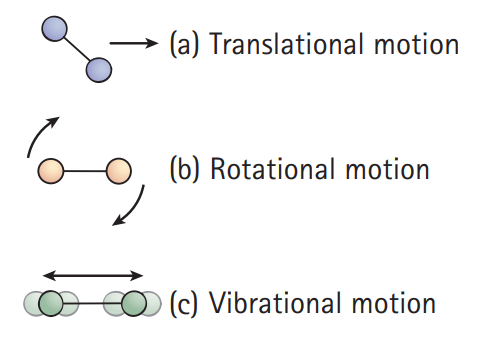
Temperature is proportional to the ==average translational KE== of random molecular motion. Molecules may also rotate or vibrate with KE, but those motions aren’t translational; they don’t define temperature
- Celsius - calibrated according to water
- 0 C: water freezes
- 100 C: water boils (at sea level atmospheric pressure)
- F = (9/5)C + 32
- Kelvin - calibrated according to energy (favored by scientists)
- 0 K: absolute zero, substance has no kinetic energy
- K = C + 273.15
15.2 Heat
When a hot object (A) touches a cold object (B), energy begins to transfer from A to B, making object A cooler and object B warmer.
Heat is the flow energy due to temperature difference
- Matter cannot contain heat
- Heat is ==energy in motion==
- once the transfer is complete and the energy is stationary, the stationary energy is called internal energy
Internal Energy is the total of all the energies inside a substance
- translational KE + rotational KE + vibrational KE + potential energy
- When a substance absorbs heat, the internal energy increases.
When 2 items are in contact: heat moves from higher temperature to lower temperature
Units of Heat
Typically, energy is measured in Joules
- %%Joules = Nm = (kg*m^2)/(s^2)%%
- * = a multiplication sign
Calories are more commonly used in the US
| calorie | Calorie (kilocalorie) |
|---|---|
| the amount of heat needed to increase the temp of 1 gram of water by 1 degree Celsius | the amount of heat needed to increase the temp of 1 kg of water by 1 degree Celsius |
| 1 calorie = 4.19 joules | This is what we use when we label food |
15.3 Specific Heat Capacity
Imagine heating a bowl of soup and toasting a piece of bread. After a while, the bread is cold while the soup is still warm. Why?
They have different capacities for storing internal energy.
- different materials require different amounts of heat to raise the temperature
specific heat capacity (J/(g K)) is the quantity of heat required to change the temperature of 1g of a substance by 1-celsius degree
Q = cmΔT
the quantity of heat Q (J) transferred when a mass m (g) of a substance undergoes a change in temperature ΔT (K) is specific heat capacity x mass x temperature change.
15.4 High Specific Capacity of Water
water has a much higher specific heat capacity than most materials
- small amounts of water can absorb a lot of heat with only a small rise in temperature
- water takes a long time to cool and warm
Water’s ability to @@resist temperature change@@ improves the climate in many locations
15.5 Thermal Expansion
| Temp Increases | Temp Decreases |
|---|---|
| particles move faster and move farther apart | particles slow down and become more compact |
| the substance expands | the substance contracts |
- Liquids expand more than solids
Expansion of water