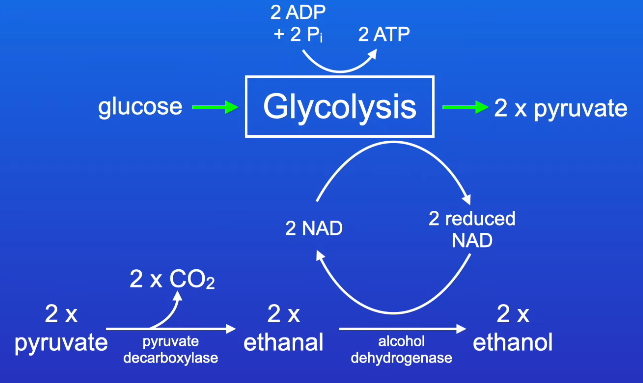
ATP and hydrogen carriers
when a hydrogen is released its added to a molecule called a hydrogen carrier for example NAD + H+ → reduced NAD
glycolysis
substrate-level phosphorylation:
molecule A is converted to molecule B and the energy released during this reaction is used to make a molecule of ATP
a hydrogen ion can be removed from a molecule = dehydrogenation/ oxidation , the hydrogen is transferred to a carrier
glycolysis takes place in the cytoplasm and does not require oxygen
in the first stage glucose reacts with two molecules of ATP
each ATP molecules transfers one phosphate onto the glucose molecule = phosphorylation
this activates the glucose and makes it more reactive = hexose bisphosphate
hexose bisphosphate splits into two molecules of triose phosphate - a lysis reaction (splitting)
inorganic phosphate ions from the cytoplasm reacts with each molecule of triose phosphate → triose bisphosphate
each triose bisphosphate is converted into a molecule of pyruvate, reducing NAD and forming ATP
yield of glycolysis:
2x ATP
2x reduced NAD
2x pyruvate
the link reaction
in the case of aerobic respiration this takes place in the mitochondria
pyruvate is transported into the mitochondrial matrix
pyruvate + coenzyme A → acetyl coenzyme A + carbon dioxide
NAD is reduced during this reaction to NADH - oxidation reaction
yield:
acetyl coenzyme A
carbon dioxide
NADH
the link reaction takes place twice for each molecule of glucose entering respiration
when carbon dioxide is removed from a molecule its called decarboxylation reaction
since there is a decarboxylation reaction and an oxidation reaction this is called oxidative decarboxylation
the krebs cycle
in the first stage:
acetyl coenzyme a reacts with a 4 carbon molecule called oxaloacetate
2 carbons from acetyl coenzyme a move onto oxaloacetate forming a 6 carbon molecule called citrate
at the same time coenzyme A is released and goes back to take part in the link reaction
second part:
decarboxylation reaction releases one molecule of carbon dioxide from citrate and a dehydrogenation reaction produces one molecule of NADH forming a 5 carbon molecule
the same happens again + one molecule of ATP is produced + two more dehydrogenation reactions producing one NADH and one FADH
yield of the krebs cycle:
ATP
3X NADH
FADH
2x carbon dioxide
oxidative phosphorylation
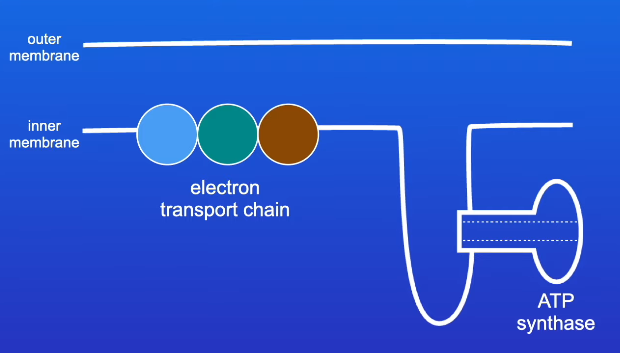
the first stage involves the electron transport chain:
reduced NAD transfers two high-energy electrons to the first protein in the ETC
the two electrons pass to the second protein
as the electrons move down the ETC they lose energy - this energy is used to pump protons from the matrix into the intermembrane space
2 electrons combine with oxygen and two hydrogens in the matric to form water
oxygen is the final electron acceptor
the electrons from FADH enter the ETC in the middle rather than the start
the concentration of protons is much greater in the intermembrane space than the matrix
ATP synthase contains an ion channel in the centre - protons diffuse down the gradient through the ion channel into the matrix
this movement of ions is used by ATP synthase to generate ATP from ADP and Pi = chemiosmosis
anaerobic respiration
in animals:
there is not enough NAD for glycolysis to take place, so the cell uses the reduced NAD produced by glycolysis to reduce the pyruvate to lactate/lactic acid:
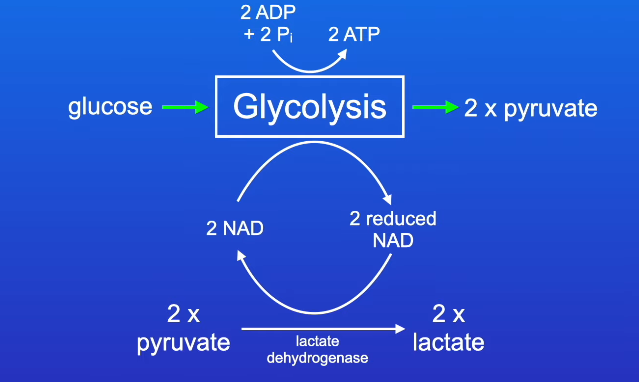
by reducing pyruvate to lactate the cell can keep glycolysis functioning
the reaction is catalysed the enzyme lactate dehydrogenase
takes place entirely in the cytoplasm
occurs in muscles during intense exercise and transported to the liver where its converted to glucose
in plants: