Etruscian - AP Art History notes (Italy) 🇮🇹
The Etruscans values gender equality and always looks forward to every individual’s afterlife.
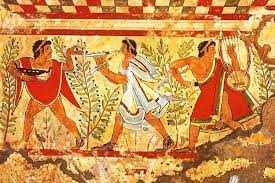
About Etruscan Architect 🏛🇮🇹
Floor plan:
Contains only 1 entrance and a patio.
shares only a few similarities with Greeks. (frieze and pediment roof - Parthenon at Athens, Greece). 🏛
Greeks have decorated frieze; Etruscians don’t have decorated frieze.
- 3 Chella; dedicated to gods.
Similarities
frieze
pediment
archaic smile
stylized hair (traditional braids)
wet drapery
contrapposto
capitals
chellas
columns
Differences (Etruscian)
sculptures are placed on top
plain frieze
terracotta
^^(6:5) ratio^^ (Greeks used (9:4) - y(x) + 1).
central staircase
Key people:
Vitruvius
^^Vitruvius did not build the Temple of Minerva; He witnessed and recorded it’s architect.^^
\
Temple of Minerva + Apollo Veii (Veii, Italy) 🏛🇮🇹
Temple of Minerva 🏛
The Temple of Minerva has many architectural inspirations from the Greeks. Most notable examples are:
- Frieze
- Columns
- Pediments
- Elevated platform ^^(similar to the White Temple Ziggurat in Uruk)^^
- Chellas
- Portico (front patio/porch)
Notable differences:
Unlike the Greeks, Etruscan temples only have 1 entrance.
- 1 central-axis entrance, only in Etruscan temple architecture.
- plain friezes (friezes are not decorated)
- pediment sculptures (sculptures are placed on top of the pediment)
Narrative: Etruscans usually refer to the Greek gods by their Roman names. ^^(Apollo still stays the same for both).^^
Minverva (Roman) 🫒 = Athena (Greek) 🇬🇷
Materials: wood, tufa (lava bricks), mudbricks.
- Architect Vitruvius recorded the architecture of the Temple of Minerva.
Apollo Veii (sculpture) 🐎
The Apollo Veii sculpture is placed on the pediment of the Temple of Minerva.
- Sculpture took inspiration from the Archaic style (Greeks).
- Possibly sculpted by ^^Vulca of Veii?^^
- Was discovered with missing arms (arms indicates movement; could be holding chariot whips)
- Apollo Veii was placed on a chariot on top of the pediment.
About Apollo Veii: The creation of Apollo Veii was sculpted and wielded sections (terracotta pieces).
- Apollo Veii was also painted.
Materials: terracotta, paint.
Apollo Veii is also stylized face and hair, has an archaic smile, wet drapery and contrapposto.
- ^^Apollo Veii is fully clothed unlike Greek Archaic art work.^^
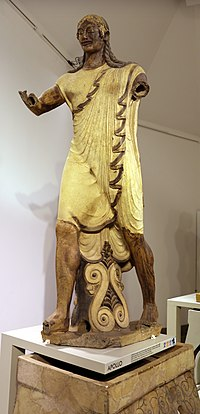 Since Apollo is placed on the pediment of the temple; Apollo is leaning forward so that the viewer below can see Apollo.
Sarcophagus of the Spouses (Cerveti, Italy) 🇮🇹
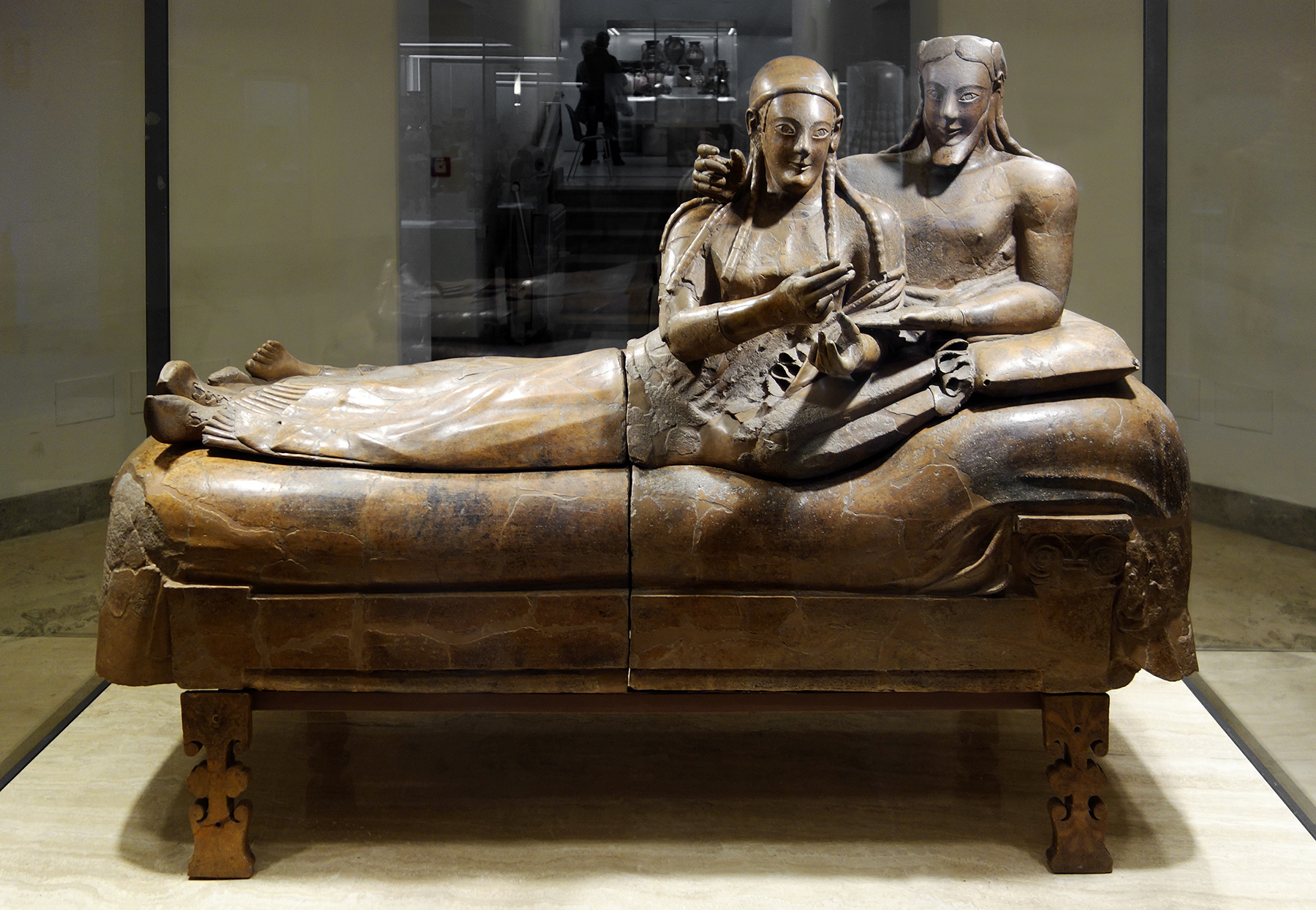
A life-sized sarcophagus ^^repository^^ that only ^^holds the^^ ^^ashes^^ ^^of the deceased;^^ ^^not^^ ^^the body.^^
- Usually created for deceased spouses; a portraiture of the spouses depicted.
analysis: the husband’s arms are usually wrapped around the wife (and sometimes holding a piece of food); the wife is shown to hold food - banquet afterlife. ^^This sarcophagus acts as a^^ ^^repository^^ ^^for ashes.^^
- equality between the husband and wife (affectionate, sharing food at the banquet).
- ^^representative of Etruscan relationships and gender equality (^^^^Avant Garde^^^^).^^
materials/techniques:
- terracotta sections + kilns (made by pieces)
- ^^archaic smile^^^^,^^ ^^stylized^^
- ^^portraiture^^ of the deceased (personally customized; first half is made in advanced; second half contains personalized portraiture)
- ^^Avant Garde^^ ^^(ahead of it’s time).^^
\
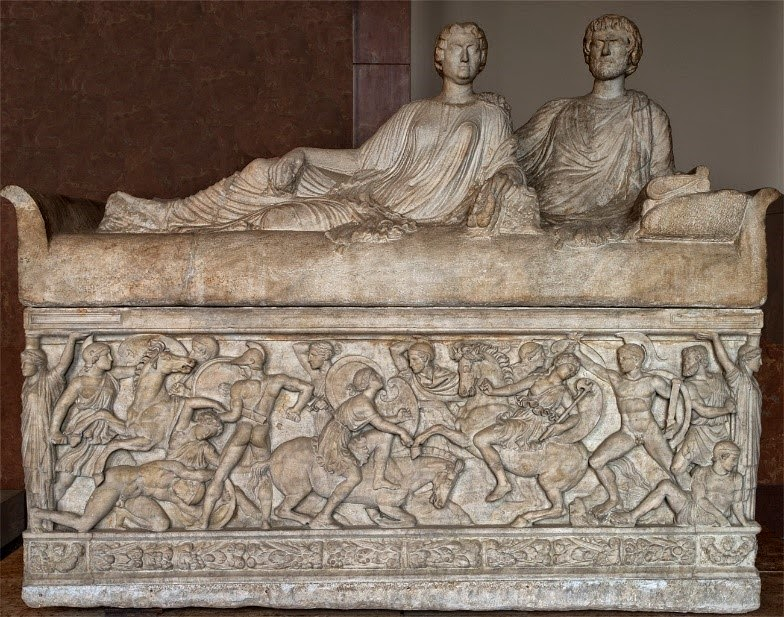
Romans took inspiration and made their own sarcophagus to a singular portraiture
Tomb of the Triclinium - Subterranean Necropolis (Cerveteri, Italy - above Rome) 🇮🇹
The Tomb of Triclinium is important because the Etruscans have a different depiction of the afterlife. Unlike the Egyptians, ^^Etruscans believe that the afterlife is full of eternal happiness and not of judgment.^^
- named after the triclinium tables discovered at the sight.
- Also called a Necropolis (City of the Dead).
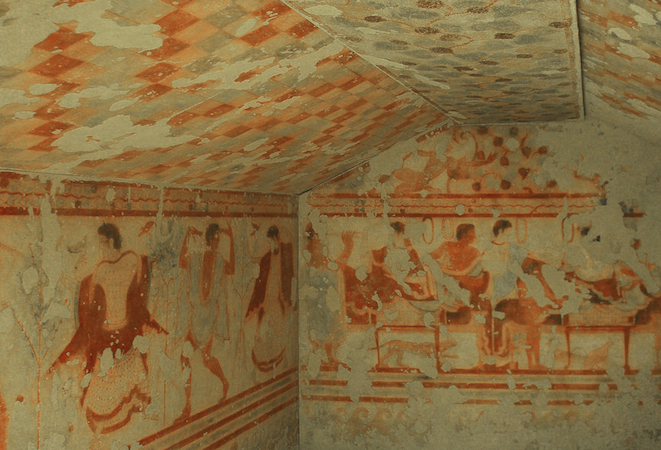
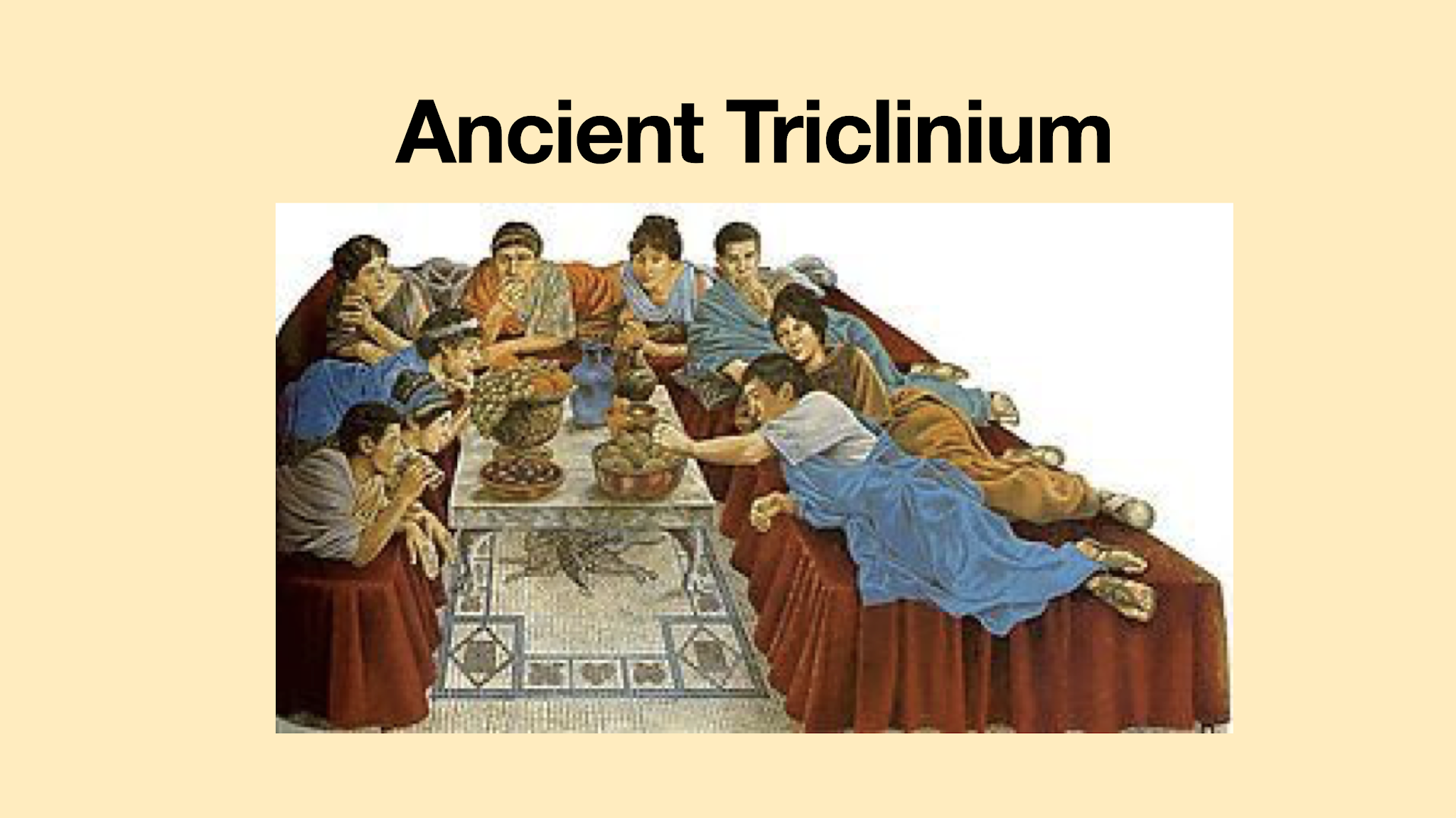
Triclinium: three-legged table.
- ^^eating while lounging is a tradition special to Etruscan culture.^^
Architecture:
- circular structure + dome on top
- niches (to hold sarcophagus)
- polychrome ceilings
- fresco - plaster and paint on walls.
- ^^subterranean^^ ^^(underground); necropolis (means city of the dead; burial site for the deceased).^^
genre scenes of people lounging in couches and eating; depiction of what the Etruscan believe was the afterlife (full of music, food, and happiness).
- ^^Fresco^^ ^^walls depict Etruscan playing instruments, dancing, lounging on their couches and eating banquets^^
polychrome: many colors; painted, printed, or decorated in several colors.
Materials:
tufa (solidified volcanic rock)
plaster; fresco technique, fresco walls