7.7 Transport in Plants
Transport of Water in Plants
- %%Transpiration%%
- Water is lost from plant via %%stomata%%
- %%Water lost from mesophyll cells%% to spaces in leaf through the cell walls
- Replaced by water reaching mesophyll cells via xylem
- Mesophyll cells %%lose water via evaporation via heat from sun%%
- Cells have l%%ower water potential%%
- %%Water enters from other cells via osmosis%%
- Which %%lowers their water potential%%
- So water enters those cells via osmosis, %%cycle continues%%
Movement of Water up Stem via Xylem
- Water lost from mesophyll cells to spaces in leaf through the cell walls
- Water molecules %%form hydrogen bonds%%, stick together, %%cohesion%%
- Water forms %%continuous column%% up stem
- As water evaporates from mesophyll cells, more molecules are %%drawn up due to cohesion%%
- %%Transpiration pull%%
- Transpiration pull %%puts xylem under tension,%% so there is %%negative pressure%% within xylem
- %%Cohesion tension theory%%
- There will be a %%change in diameter of tree trunk%% throughout day due to transpiration
- During day, %%when transpiration is high%%, there is %%more negative pressure%% inside cells so %%walls of xylem pulled inwards so diameter decreases%%
- If xylem broken and air enters it, water can no longer move up tree as column of water is broken and water cannot be pulled up
- If xylem broken, %%water does not leak out as it is not under pressure, instead air is drawn in which is consistent with it being under pressure%%
- Transpiration pull is a passive process
- %%Xylem cells dead, have no ends to produce a continuous column%%
- Energy via heat energy from sun required for transpiration
Transport of Organic Substances in the Phloem
- %%Translocation%%
- https://www.youtube.com/watch?v=5jAxyj1ZDhA
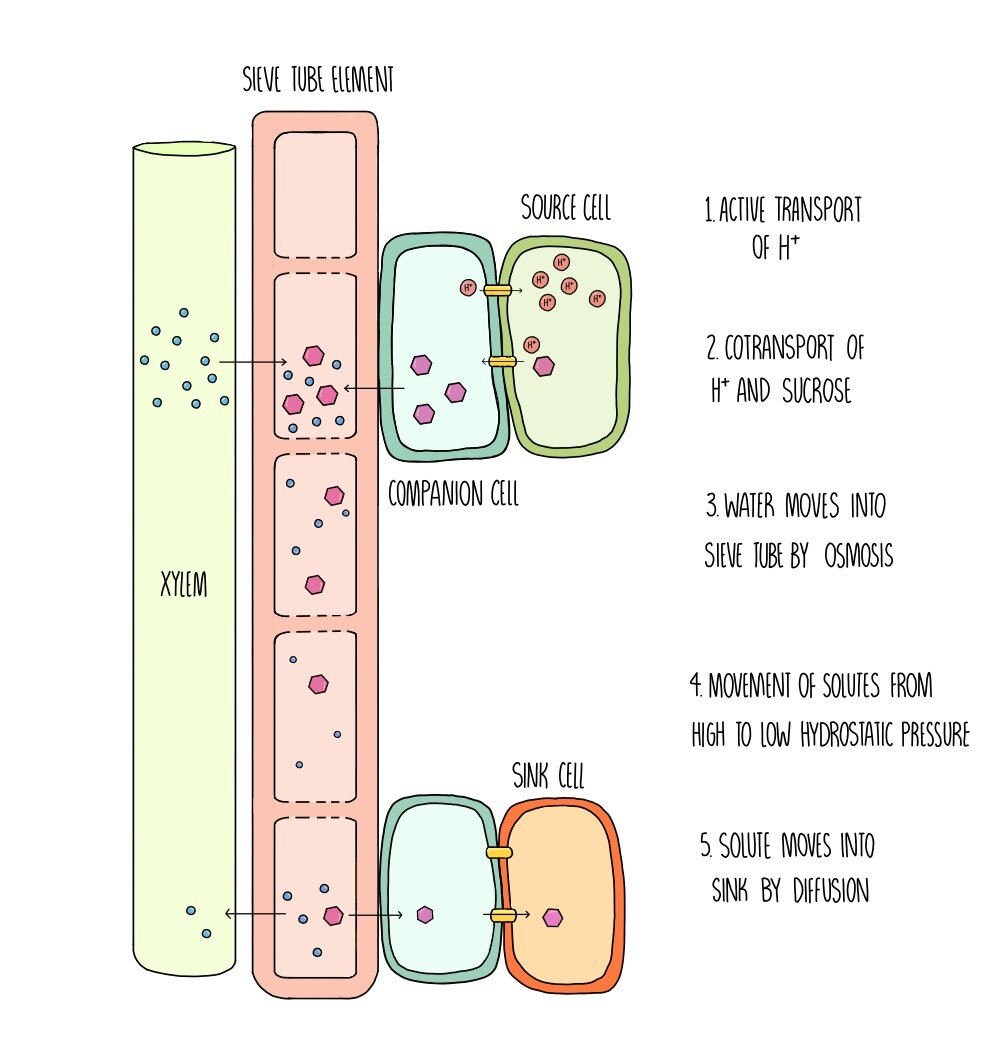
- %%Sucrose moves from companion cells into sieve tube elements%% by %%active transport%%.
- This %%reduces the water potential%% of the sieve tube element.
- %%Water moves into the phloem by osmosis%%, which %%increases the hydrostatic pressure%%.
- There is a %%pressure gradient with high hydrostatic pressure near the source cell and lower hydrostatic pressure near the sink cell%%s.
- Solutes move down the pressure gradient %%towards the sink end of the phloem%%.
- %%Solutes move into sink cells%% and are converted into other molecules (e.g. starch).
- The removal of solutes %%increases the water potential at the sink end,%% causing %%water to move out of the phloem by osmosis.%%
- This %%maintains the hydrostatic pressure gradient%% between the source and the sink
- %%Mass flow hypothesis%%
- %%Active loading%%
- The %%companion cell actively transports hydrogen ions into the surrounding cells.%%
- This creates a %%hydrogen ion gradient%% between the surrounding cells and the companion cell.
- %%Hydrogen ions move back into the companion cell%% down their concentration gradient through a %%co-transporter protein%%.
- Whenever a %%hydrogen ion moves through the co-transporter, a sucrose molecule is also transported into the companion cel%%l, against its concentration gradient.
- The %%same process occurs to transport sucrose from the companion cell into the sieve tube element.%%
Evidence for Mass Transport Theory
- There is %%pressure in the sieve tube elements, as shown by sap being released when the stem of a plant is cut%%.
- The %%concentration of sucrose is higher in the leaves (source) of plants than in roots(sink).%%
- %%Increases in sucrose levels in the leaves%% are followed by a %%similar increase in sucrose concentration in the phloem%%.
- %%Metabolic poisons/a lack of oxygen inhibit translocation of sucrose in the phloem%%
Evidence against Mass Flow Theory
- %%The function of the sieve plates is unclear%% as they would %%appear to hinder mass flow%% (some suggest though they have a structural function to help prevent bursting under pressure).
- %%Not all solutes move at the same speed%%, they should do if it is mass flow.
- %%Sucrose is delivered at more or less the same rate to all regions%%, rather than going more quickly to the ones with the lowest sucrose concentration, which the mass flow theory would suggest.
Ringing Experiments
- In order to investigate if the phloem is responsible for mass flow a ringing experiment can be used.
- In this the %%bark and phloem of a tree are removed leaving just the xylem%% in the centre.
- Overtime the %%tissues above the missing ring swell with sucrose solution and the tissue below dies.%%
- This shows that sucrose is transported in the phloem
Tracer Experiments
- Tracer experiments can also be used to investigate the transport of sucrose in plants. Plants are grown in a environment that contains %%radioactivity labelled carbon dioxide%% (14CO2).
- The presence of this means that they are %%incorporated into the sugar produced in photosynthesis.%%
- The %%movement of these sugars can now be traced%% through the plant using autoradiography.
- Those %%areas that have been exposed to the radiation produced by the 14C in the sugars will appear black%%.
- It follows that these regions correspond to the area where the phloem is and therefore suggest that this is where the sugars are transported.